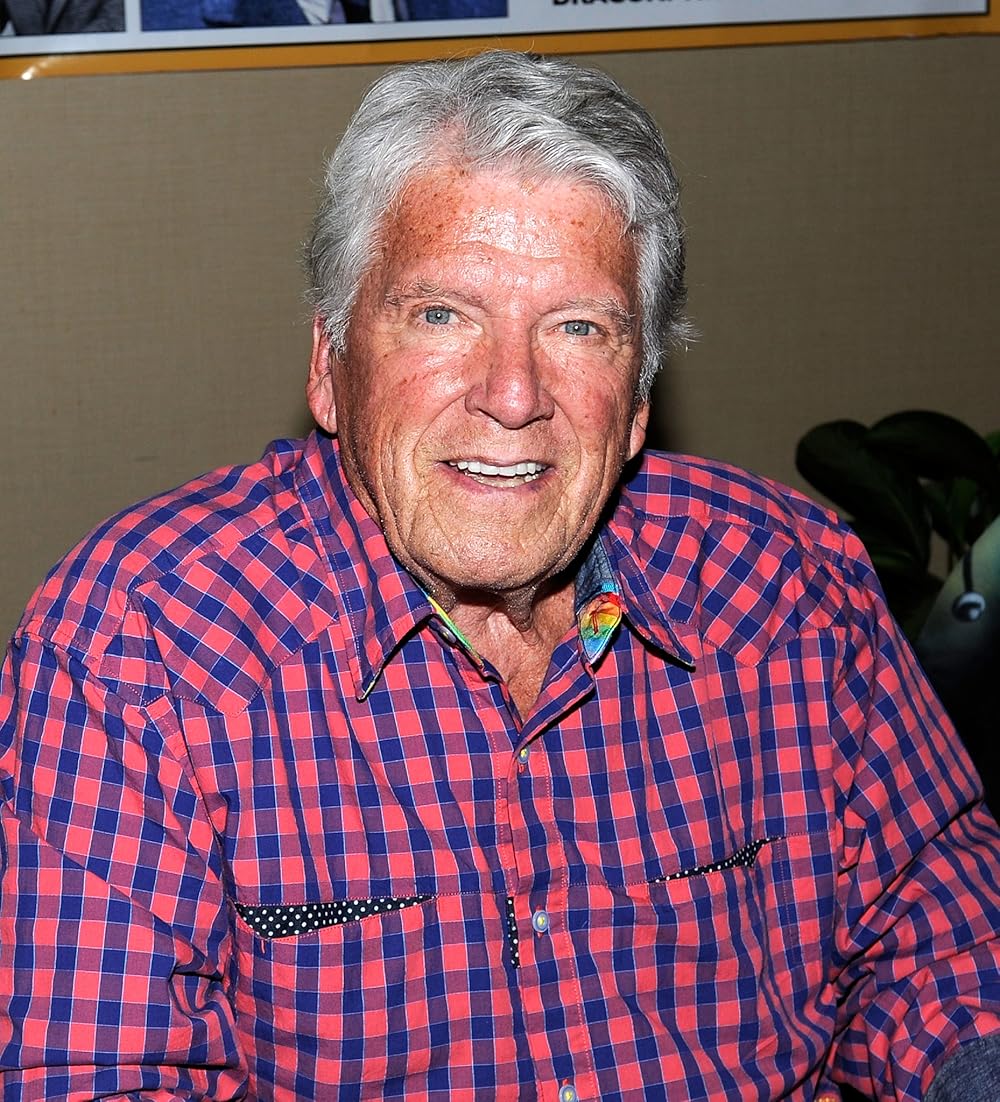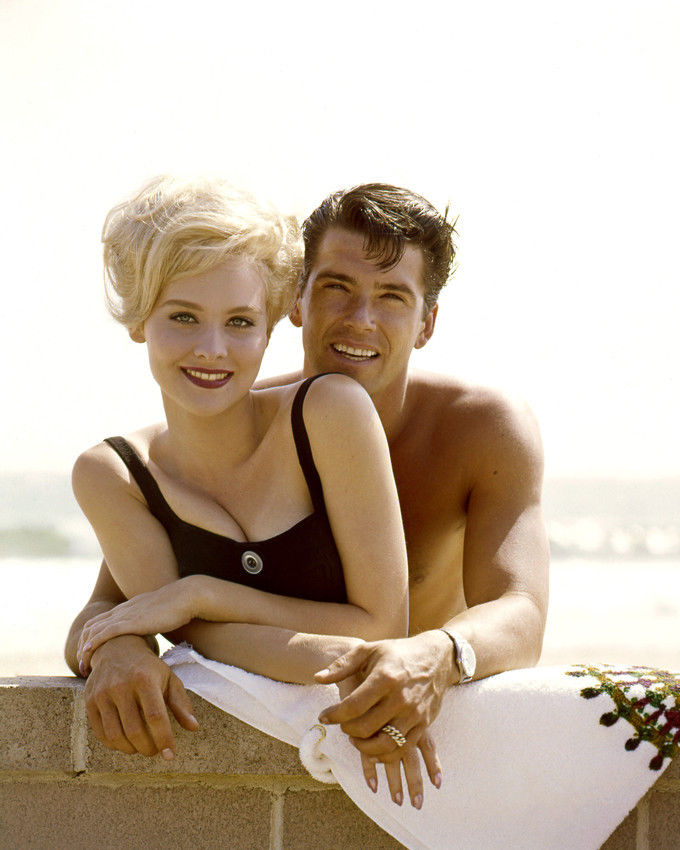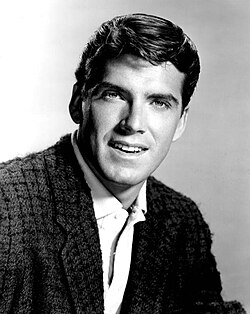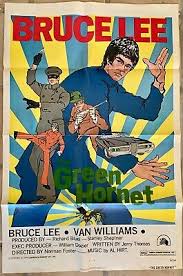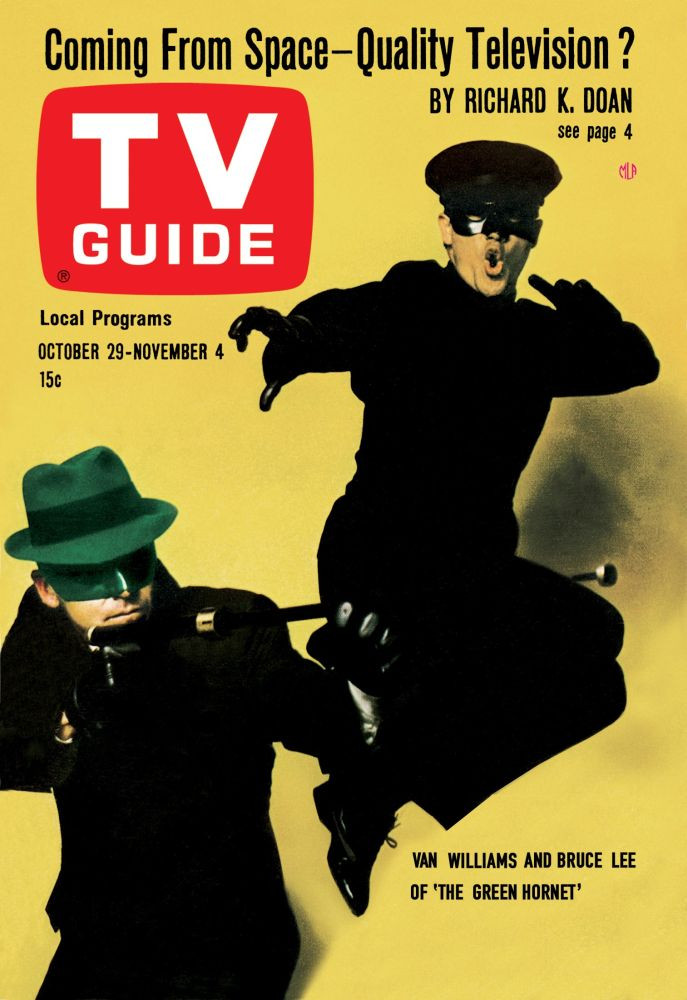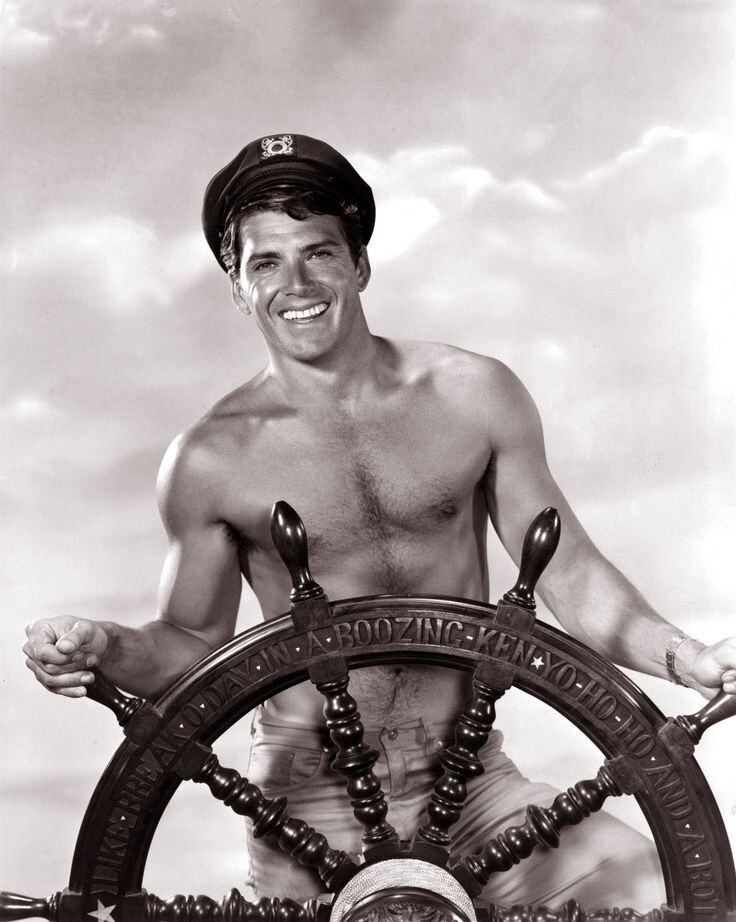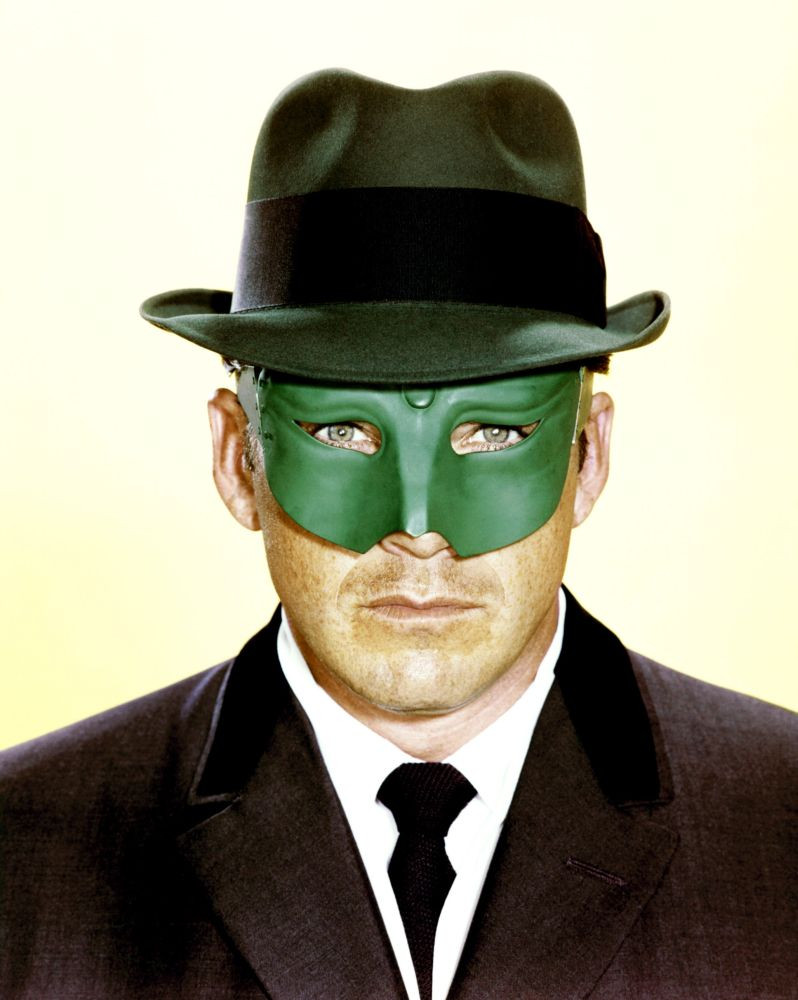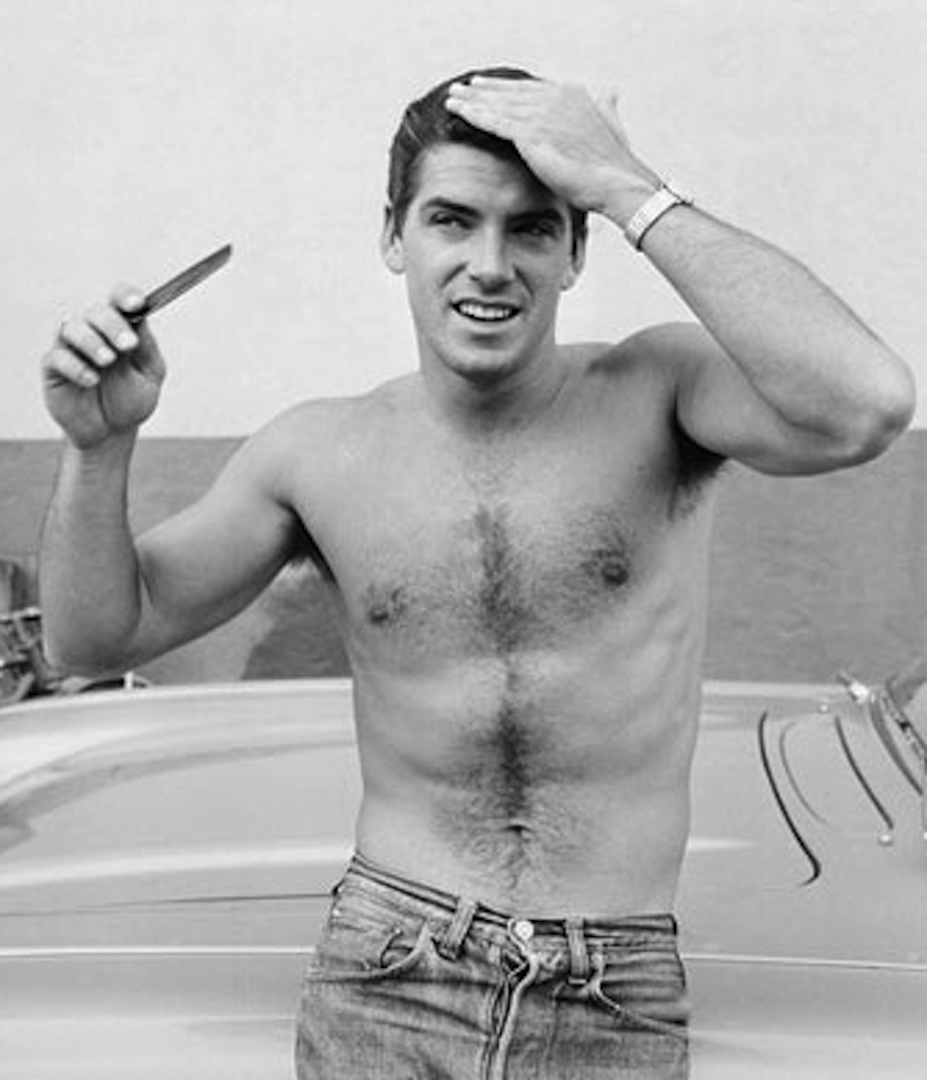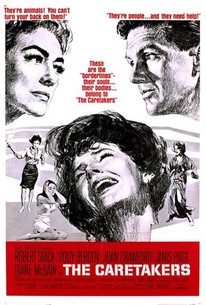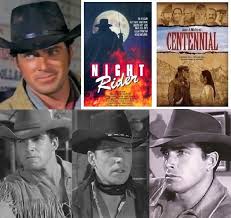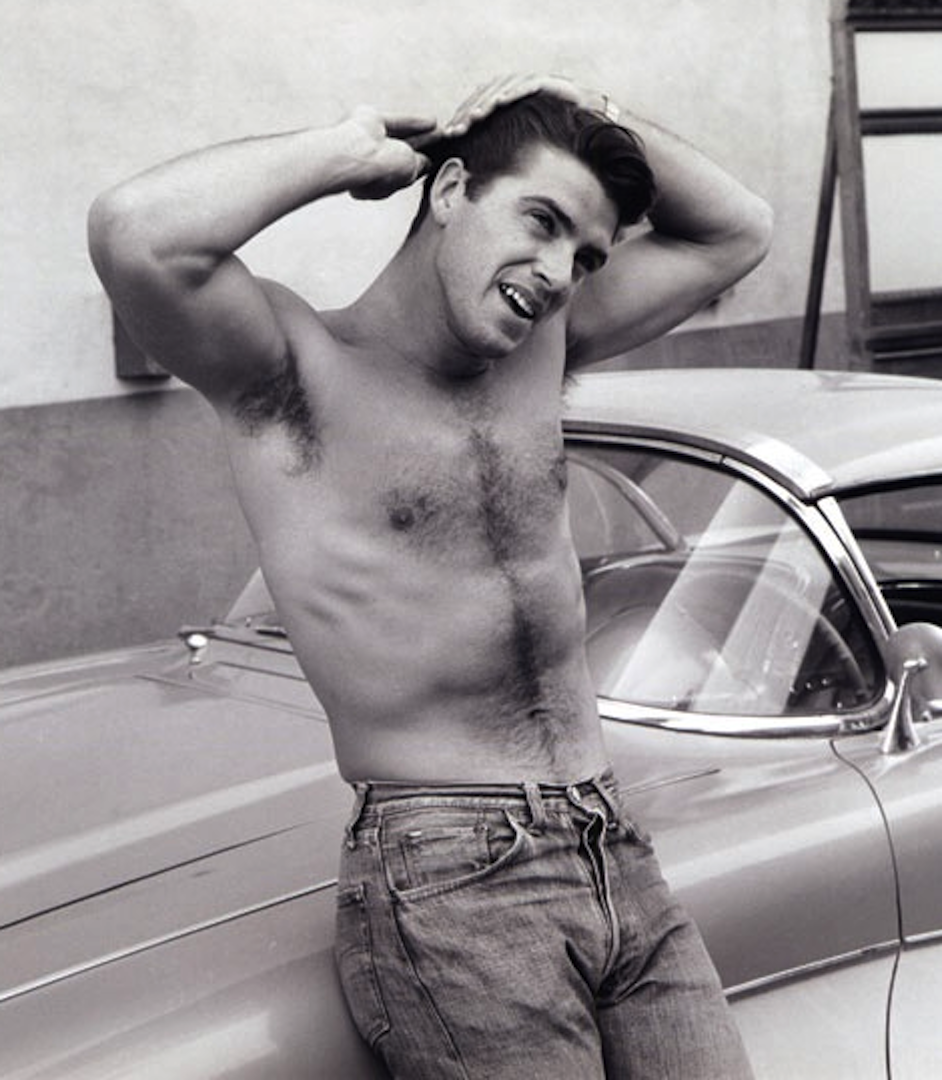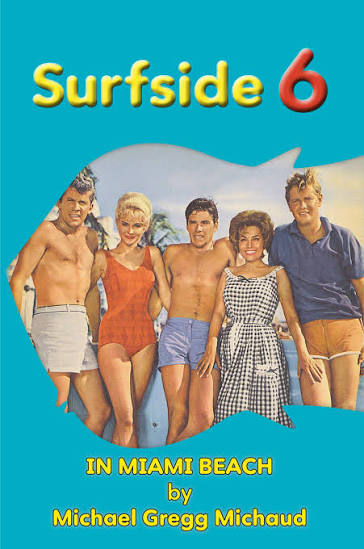


Van Williams was born in Fort Worth, Texas in 1934. He is best remembered for his role in the 1960’s television series “The Green Hornet” which also featured Bruce Lee. A prior television series of his was “Surfside Six” in 1960 which also featured Troy Donahue and Lee Patterson, all pictured above. His films include “Tall Story” and “The Caretakers”. He died in 2016 at the age of 82.
Gary Brumburgh’s entry:
You could shoehorn actor Van Williams right in there between the other tall, dark and drop-jaw gorgeous heartthrobs Tom Tryon and John Gavin of the late 1950s/early 1960s who conveyed a similar bland, heroic image. All three were too often given colorless heroes to play on film and/or TV — roles that played off their charm but seldom tested their talent.
Born on February 27, 1934 as Van Zandt Jarvis Williams, he was the son of a cattle rancher. He majored in animal husbandry and business at Texas Christian University but moved to Hawaii which changed the course of his life. While operating a salvage company and a skin-diving school during the mid-1950s, he was approached by Elizabeth Taylor and husband/producer Mike Todd, who were filming there. Encouraged by Todd to try his luck, Van arrived in Hollywood with no experience. Todd perished in a plane crash before he was able to help Van, but the young hopeful ventured on anyway, taking some acting/voice lessons, and was almost immediately cast in dramatic TV roles.
Warner Brothers had a keen eye for this type of photogenic hunk and smartly signed Van. Fitting in perfectly, he was soon showing just how irresistible he was as a clean-cut private eye on the series Bourbon Street Beat (1959). Although the show lasted only one season, Warners carried his Kenny Madison character into the more popular adventure drama Surfside 6 (1960) opposite fellow pin-up / blond beefcake bookend Troy Donahue. Series-wise, Van tried comedy next opposite Walter Brennan in The Tycoon (1964) . After his contract expired at Warners, 20th Century-Fox handed him his most vividly recalled part, that of the emerald-suited superhero The Green Hornet (1966) with the late Bruce Lee as his agile, Robin-like counterpart Kato. The show, inspired by the huge cult hitBatman (1966) enjoyed a fast start but, like its predecessor, met an equally untimely finish.
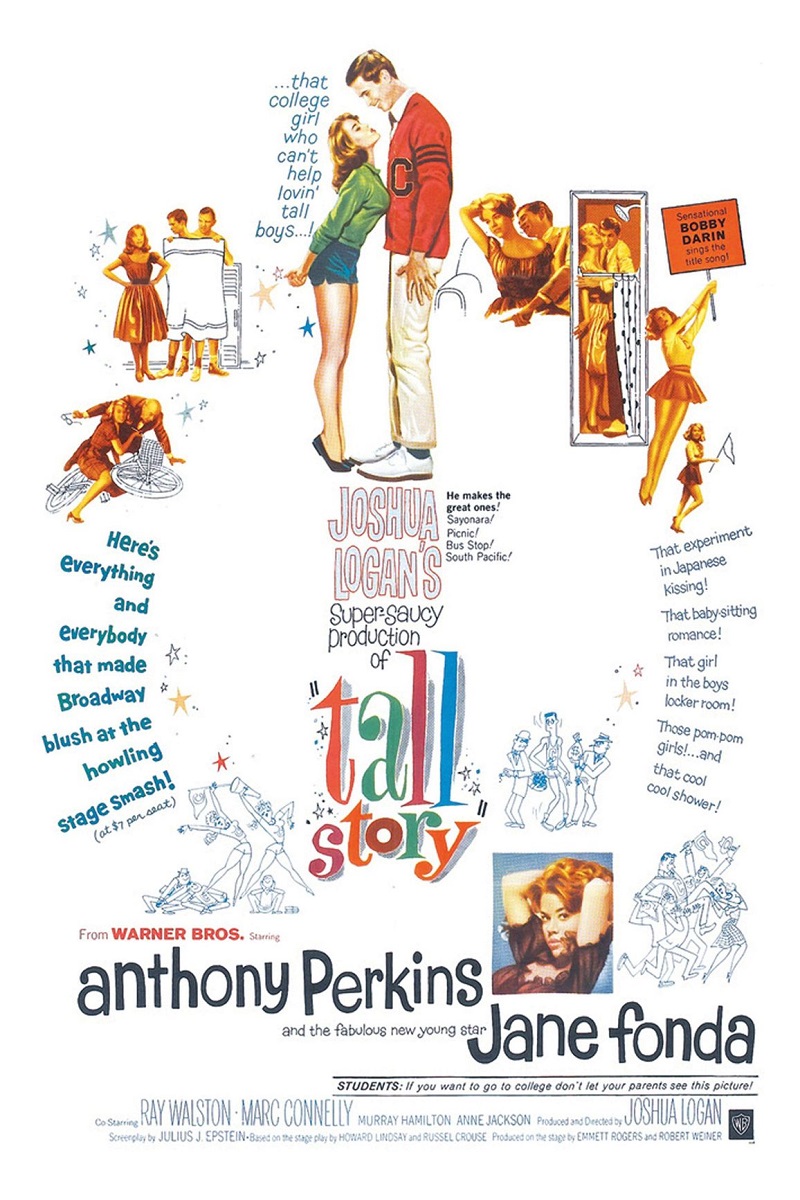
Never a strong draw in films, Van revealed quite a bit of himself (literally) in his debut inTall Story (1960) coming out of a shower. He was handed a typically staid second lead inThe Caretakers (1963). Continuing well into the 1970s to guest sporadically on the TV scene in classics like The Dick Van Dyke Show (1961), Love, American Style (1969),Mission: Impossible (1966), The Big Valley (1965)”, Nanny and the Professor (1970),Barnaby Jones (1973), and The Rockford Files (1974). Another starring series attempt with Westwind (1975) failed to make the grade and he soon let his career go. Van went on quite successfully in business with telecommunications, real estate and law enforcement supplies among his ventures. With his glossy, pretty-boy years far behind him, he has not felt the need to look back except for an occasional autograph convention.
– IMDb Mini Biography By: Gary Brumburgh / gr-home@pacbell.net
The actor Van Williams, who has died aged 82, achieved brief fame as the masked comic-book hero the Green Hornet in the 1960s US television series of the same name. As Britt Reid, a playboy media mogul who owns a newspaper and TV station, he was seen transforming into his alter ego to tackle criminals with hand-to-hand combat and two deadly weapons, a gas gun and the Hornet’s Sting sonic blaster. He was aided by Bruce Lee (in his first TV role) as Kato, his valet and martial arts expert, and Black Beauty, a customised Chrysler Crown Imperial sedan fitted with infra-green headlights, hood-mounted machine guns, a grille-mounted flame thrower and Stinger missiles stashed in the bumpers.
Unfortunately for Williams, the masked vigilante – created for radio in the 30s by George Trendle and Fran Striker – was unleashed on television viewers in 1966 shortly after the launch of the hugely popular, camped-up Batman TV series, from the same producers. “One of the things I absolutely insisted upon was that I was going to play it straight,” said Williams. “None of this ‘wham, bam, thank you, ma’am’ stuff that was going on with Batman.” But one critic described the star in costume as looking like an “overgrown grasshopper” and the drama was cancelled after just one run of 26 episodes
Williams was born in Fort Worth, Texas, the son of Priscilla (nee Jarvis) and Bernard Williams, who ran a ranch. After attending Arlington Heights high school and studying animal husbandry and business at Texas Christian university, Williams headed for the South Pacific in 1956 to work as a salvage diver.
The following year, Mike Todd, the theatre and film producer, spotted him and suggested he go into acting. He took vocal and drama lessons, worked on contract to Revue Studios for six months, soon landed bit parts on TV, then signed up for six years to Warner Bros. His big break came in the detective drama Bourbon Street Beat (1959-60) with the role of Kenny Madison, a private eye operating from above a restaurant in the French quarter of New Orleans. He reprised the role in another crime series, Surfside 6 (1960-62), featuring detectives with an office on a Miami houseboat.
Switching to sitcom, Williams played Pat Burns, assistant to the cantankerous billionaire Walter Andrews (played by Walter Brennan) and pilot of his private plane, in The Tycoon (1964-65). He later took the role of Steve Andrews, the father in a family on a journey around Pacific islands, in the children’s adventure series Westwind (1975) and appeared on and off (1976-78) as Captain MacAllister in How the West Was Won
The actor Van Williams, who has died aged 82, achieved brief fame as the masked comic-book hero the Green Hornet in the 1960s US television series of the same name. As Britt Reid, a playboy media mogul who owns a newspaper and TV station, he was seen transforming into his alter ego to tackle criminals with hand-to-hand combat and two deadly weapons, a gas gun and the Hornet’s Sting sonic blaster. He was aided by Bruce Lee (in his first TV role) as Kato, his valet and martial arts expert, and Black Beauty, a customised Chrysler Crown Imperial sedan fitted with infra-green headlights, hood-mounted machine guns, a grille-mounted flame thrower and Stinger missiles stashed in the bumpers.
Unfortunately for Williams, the masked vigilante – created for radio in the 30s by George Trendle and Fran Striker – was unleashed on television viewers in 1966 shortly after the launch of the hugely popular, camped-up Batman TV series, from the same producers. “One of the things I absolutely insisted upon was that I was going to play it straight,” said Williams. “None of this ‘wham, bam, thank you, ma’am’ stuff that was going on with Batman.” But one critic described the star in costume as looking like an “overgrown grasshopper” and the drama was cancelled after just one run of 26 episodes.
Williams was born in Fort Worth, Texas, the son of Priscilla (nee Jarvis) and Bernard Williams, who ran a ranch. After attending Arlington Heights high school and studying animal husbandry and business at Texas Christian university, Williams headed for the South Pacific in 1956 to work as a salvage diver.
The following year, Mike Todd, the theatre and film producer, spotted him and suggested he go into acting. He took vocal and drama lessons, worked on contract to Revue Studios for six months, soon landed bit parts on TV, then signed up for six years to Warner Bros. His big break came in the detective drama Bourbon Street Beat (1959-60) with the role of Kenny Madison, a private eye operating from above a restaurant in the French quarter of New Orleans. He reprised the role in another crime series, Surfside 6 (1960-62), featuring detectives with an office on a Miami houseboat.
Switching to sitcom, Williams played Pat Burns, assistant to the cantankerous billionaire Walter Andrews (played by Walter Brennan) and pilot of his private plane, in The Tycoon (1964-65). He later took the role of Steve Andrews, the father in a family on a journey around Pacific islands, in the children’s adventure series Westwind (1975) and appeared on and off (1976-78) as Captain MacAllister in How the West Was Won.

Williams became a reserve deputy in the Los Angeles county sheriff’s department in 1971, working part time at its Malibu station, where he also captained the mountain rescue team and was a volunteer firefighter. In 1982, he retired from acting to concentrate on running the telecommunications company he had set up in Santa Monica 13 years earlier. He was a partner in a 4,000-acre ranch in Hawaii and he enjoyed hunting geese, duck, elk and other game.
“I didn’t really care that much for the acting business,” Williams said. “I didn’t like the people in it, the way they operated and all the phoniness and back-stabbing. It was not a very pleasant education for a guy from Texas whose handshake was his word. Plus, I’d gone into acting looking at it as a business, not wanting necessarily to be a celebrity.”
Nevertheless, he jumped at the opportunity to take a cameo as the director of The Green Hornet in the film biopic Dragon: The Bruce Lee Story (1993).
Williams is survived by his second wife, Vicki Flaxman, whom he married in 1959, and their children, Nina, Tia and Britt; and by Lisa and Lynne, the twin daughters of his first marriage, to Drucilla Greenhaw, which ended in divorce.