

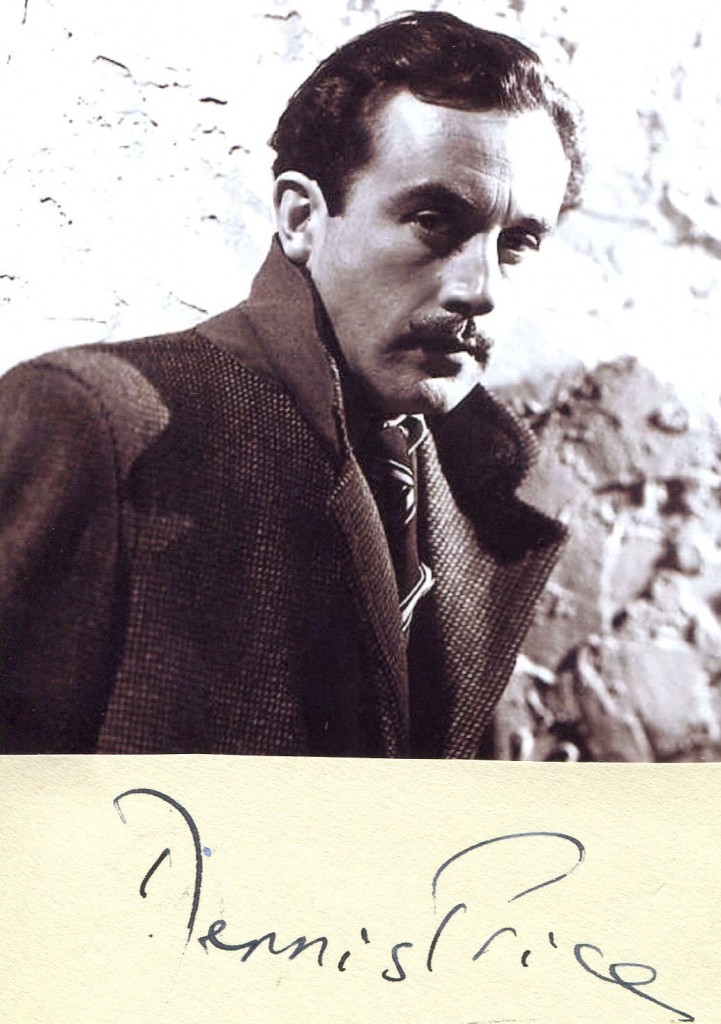
Dennis Price was a very popular British actor of the 1940’s and 50’s whose career deserves reappraisal. He was born in 1915 in Twyford, Berkshire to a military family. He made his stage debut in Croydon in 1937. His movies include “A Canterbury Tale” in 1944, “Hungary Hill” opposite Margaret Lockwood, “Kind Heart and Coronets”, “Tunes of Glory” and “Victim”. On television he starred with Ian Carmichael in the very popular “The World of Wooster” as the valet Jeeves. He died in 1973.
Gary Brumburgh’s entry:
This urbane, sourly handsome British actor was born to privilege and most of his roles would follow suit. Born Dennistoun John Franklyn Rose-Price in Berkshire in 1915, Dennis Price, the son of a brigadier-general, was expected to abide by his family wishes and make a career for himself in the army or the church. Instead he became an actor. First on stage (Oxford University Dramatic Society) where he debuted with John Gielgud in “Richard II” in 1937, he was further promoted in the theatre by Noel Coward.
After brief extra work, Price nabbed early star-making film roles in several overbaked Gainsborough mysteries/melodramas, including A Place of One’s Own (1945), The Magic Bow (1946) and Caravan (1946), but the one showcase role that could have led him to Hollywood, that of the title poet in The Bad Lord Byron (1949), proved a critical and commercial failure. He took this particularly hard and fell into severe depression. His fatally charming serial murderer in Kind Hearts and Coronets (1949), in which he does in nearly all of Alec Guinness‘ eight characters (Guiness plays eight different roles), is arguably his crowning achievement on celluloid.
By the 50s Price was suffering from severe alcoholism, which adversely affected his personal and professional career. A marriage to bit actress Joan Schofield in 1939 ended eleven years later, due to his substance abuse problem and homosexuality, the latter being a source of great internal anguish for him. They had two daughters.
Price became less reliable and fell steeply in his ranking, moving into less quality “B” pictures. Eccentric comedy renewed his fading star a bit in such delightful farces asPrivate’s Progress (1956), I’m All Right Jack (1959) and School for Scoundrels (1960). TV also saved him for a time in the 60s with the successful series The World of Wooster(1965), in which he played the disdainful butler, Jeeves.
Bad times, however, resurfaced. He filed bankruptcy in 1967 and moved to the remote Channel Island of Sark for refuge. Many of his roles were reduced to glorified cameos and the necessity for cash relegated him to appearing in campy “Z” grade cheapfests, many helmed by the infamous writer/director Jesús Franco, a sort of Spanish version of Roger Corman. Vampyros Lesbos (1971) was just one of his dreadful entries. Price also played Dr. Frankenstein for Franco in Drácula contra Frankenstein (1972) [Dracula vs. Frankenstein] and the The Erotic Rites of Frankenstein (1972) [The Erotic Rites of Frankenstein]. Fully bloated and in delicate health, he died in 1973 at age 58 in a public ward from liver cirrhosis. A sad ending for one who of Britain’s more promising actors and film stars.
– IMDb Mini Biography By: Gary Brumburgh / gr-home@pacbell.net

Dennis Price was the grand master of the “suave, cynical decline.” While he began his career as a conventional romantic lead, a critical analysis reveals a performer who found his true genius in playing high-society cads, weary aristocrats, and men whose impeccable manners masked a profound, often hilarious, moral rot.
If Roger Livesey was the “warm growl” and Isabel Jeans was “high artifice,” Dennis Price was the “velvet shiv”—smooth, sharp, and deadly.
The Price Archetype: The Elegant Enigma
Price possessed a quintessential “Public School” persona: the arched eyebrow, the clipped Mayfair accent, and an air of bored superiority. Critically, his greatest strength was his detachment. He played characters who seemed to be observing the world with a mixture of amusement and contempt, making him the perfect vessel for post-war British satire.
Critical Analysis of Key Works
1. A Canterbury Tale (1944)
-
The Role: Peter Gibbs, a cynical British soldier.
-
Critical Analysis: In this Powell and Pressburger masterpiece, Price represented the “modern, secular” Englishman.
-
The Technique: He used a “flat,” realistic acting style that contrasted with the film’s mystical themes. Critics noted his ability to convey intellectual skepticism without becoming unlikable. He was the “audience’s surrogate,” the man who needed to be convinced of the magic around him.
2. Kind Hearts and Coronets (1949)
-
The Role: Louis Mazzini, an aspiring Duke and serial killer.
-
Critical Analysis: This is Price’s definitive performance. While Alec Guinness is famous for playing eight victims, Price provides the narrative spine. * The “Internal” Performance: Price utilized a brilliant, deadpan voiceover that revealed his character’s cold-blooded ambition, while his outward physical performance remained one of chillingly perfect etiquette. He proved that a protagonist could be a murderer and still retain the audience’s sympathy through sheer vocal charm and wit. It remains one of the most sophisticated performances in the history of black comedy.
3. The Bad Lord Byron (1949)
-
The Role: Lord Byron.
-
Critical Analysis: This film was a critical failure but an acting triumph for Price.
-
Insight: He was perhaps the only actor of his generation with the requisite “Byronic” mix of beauty, melancholy, and scandal. He played the poet not as a hero, but as a haunted narcissist. The film’s failure signaled the end of Price’s time as a “traditional” leading man, as his screen persona was becoming too complex and “dark” for standard romantic fare.
4. Jeeves and Wooster (1965–1967)
-
The Role: Jeeves (in The World of Wooster).
-
Critical Analysis: In his later television career, Price became the definitive Jeeves for a generation.
-
The Shift: He moved from the “ambitious climber” of Kind Hearts to the “omniscient servant.” He used his stillness to convey power, proving that his earlier “aristocratic” air could be pivoted into a performance of supreme, quiet competence.
The “Professional Decline” and Cult Status
The latter half of Price’s career was marked by personal struggles and a prolific run in “B-movies” and horror films. However, even in low-budget fare like Theater of Blood (1973) or his work with Jess Franco, Price never “slummed.”
| Feature | Dennis Price’s Style |
| Vocal Profile | Baritone, precisely modulated, and dripping with irony. |
| Physicality | Minimalist; he “acted with his eyelids” and subtle shifts in posture. |
| The Niche | The “Gentleman Cad”—the man who steals your silver while discussing poetry. |
| Legacy | He defined the “Ealing Comedy” tone of sophisticated, ruthless wit. |