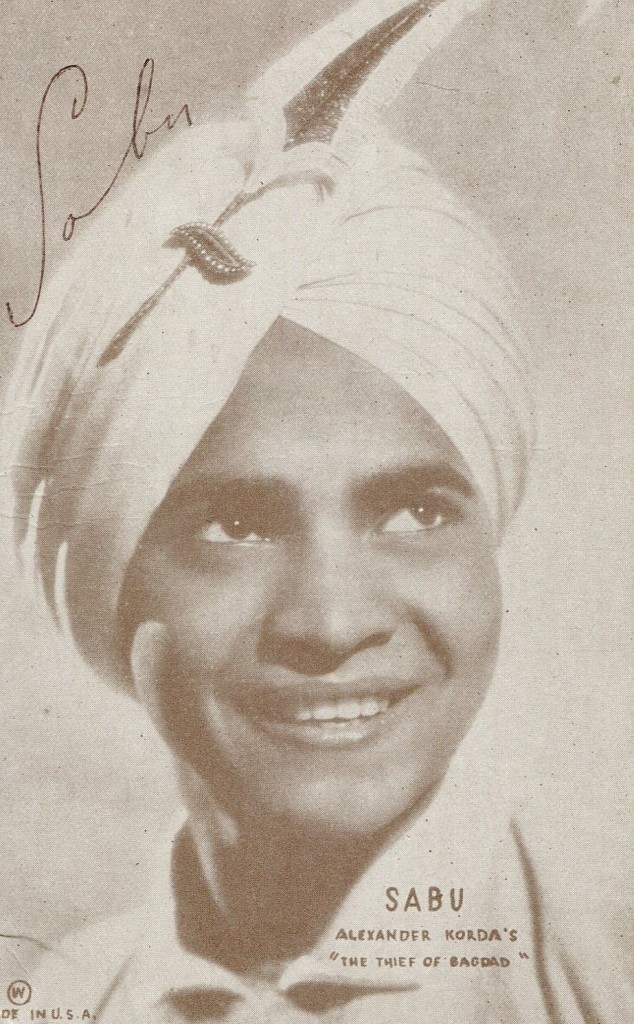
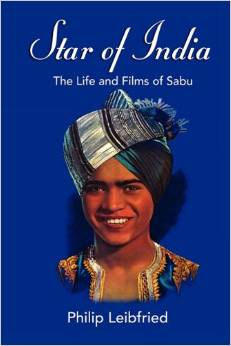
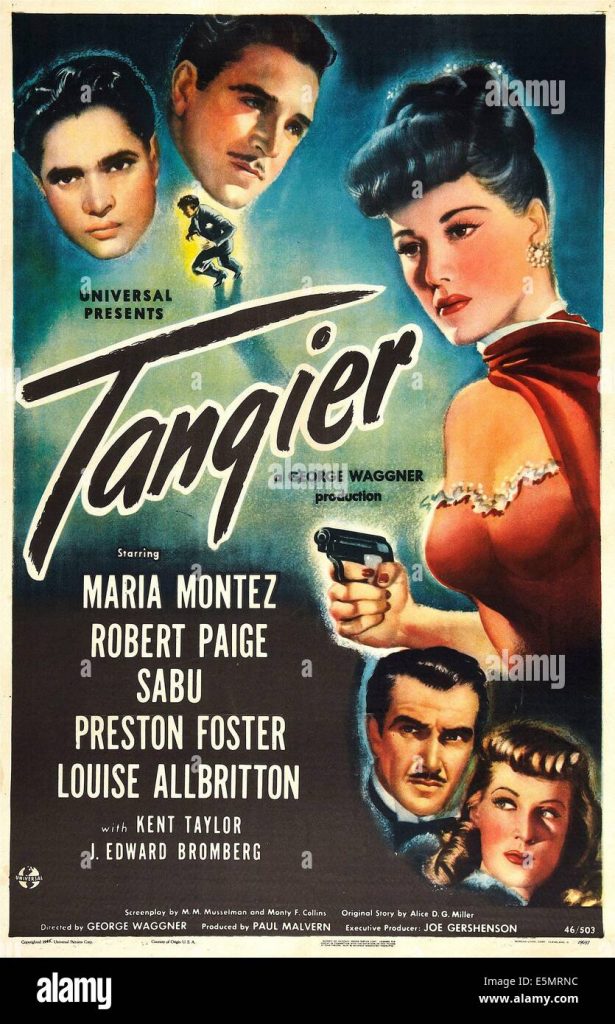
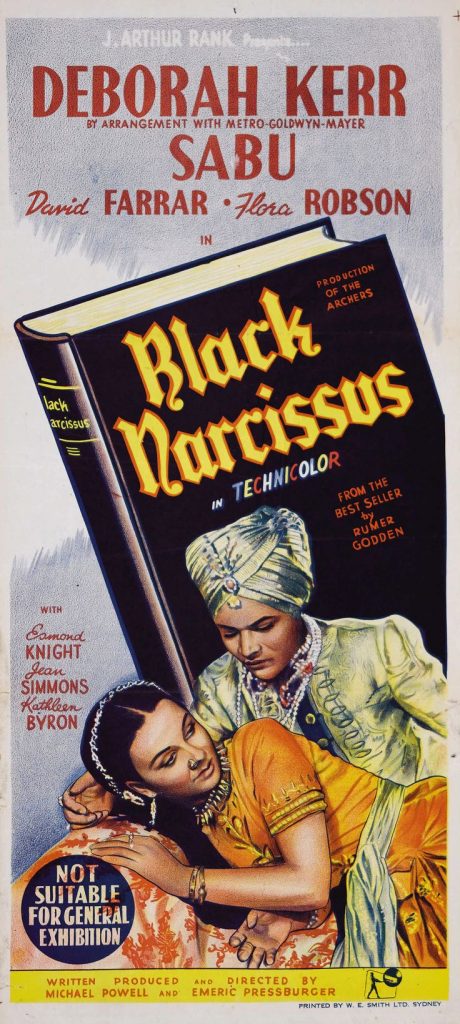
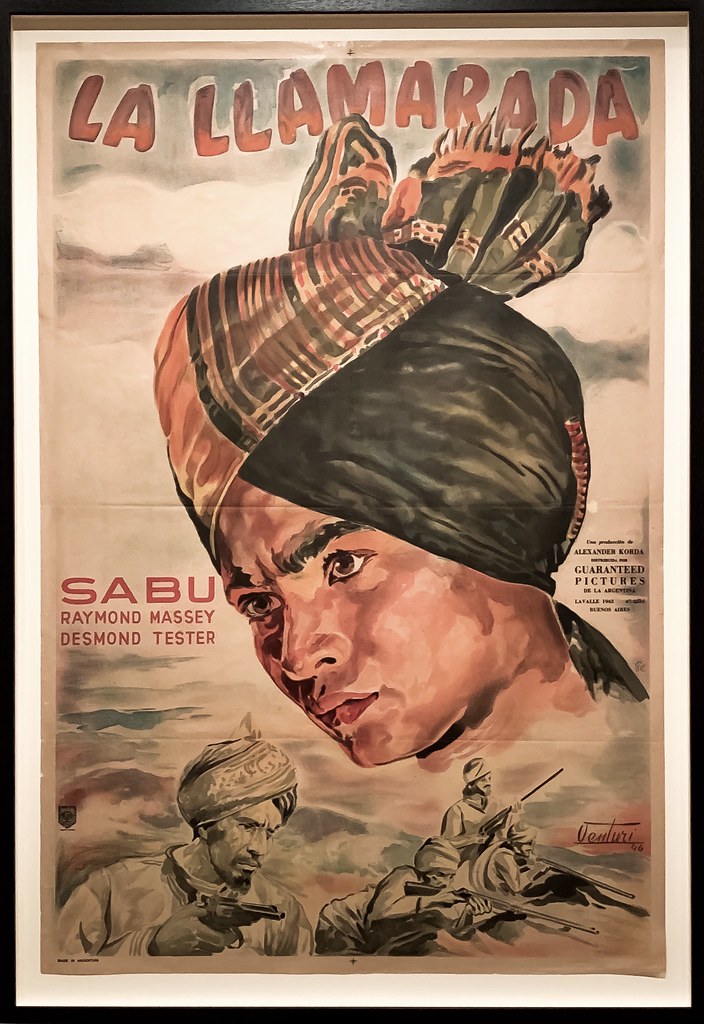
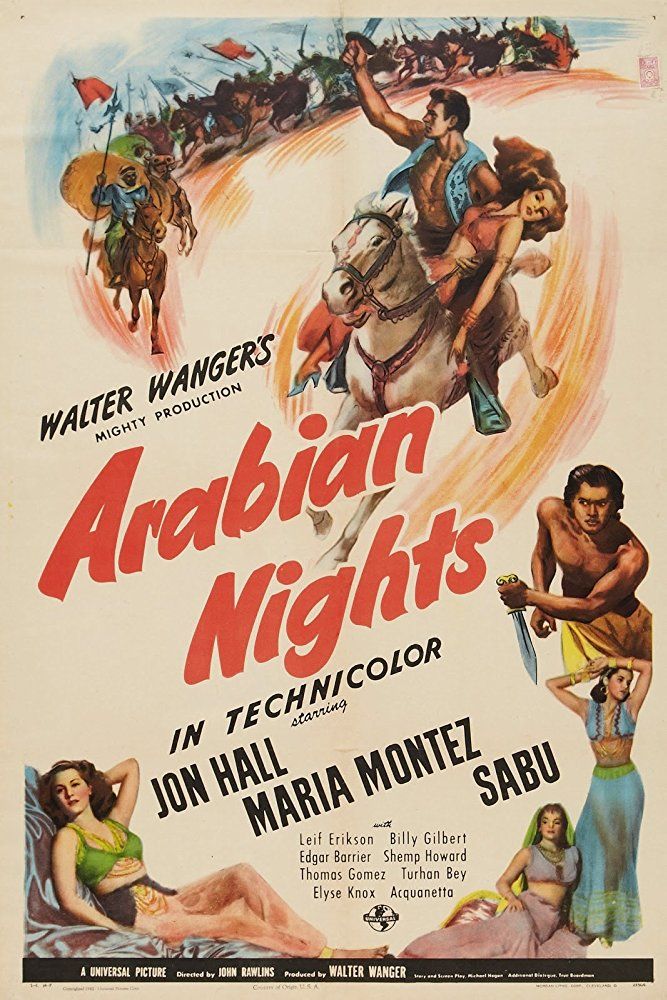
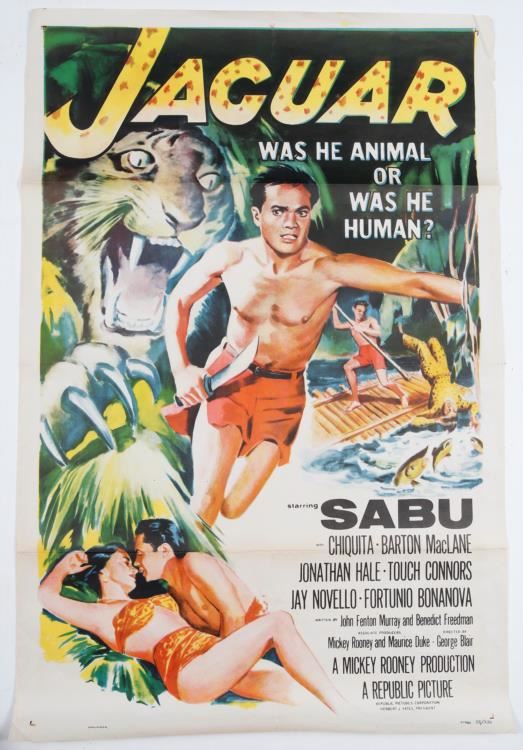
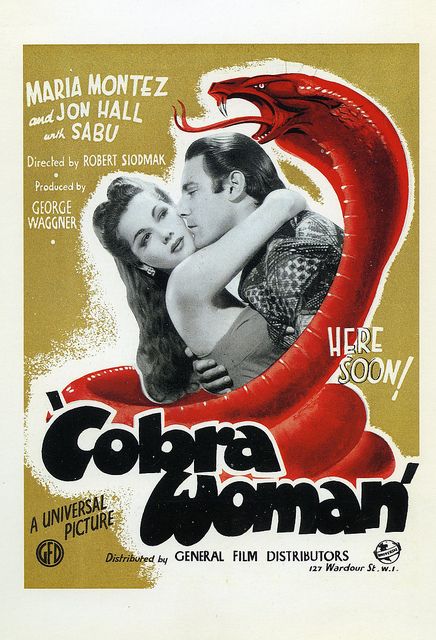
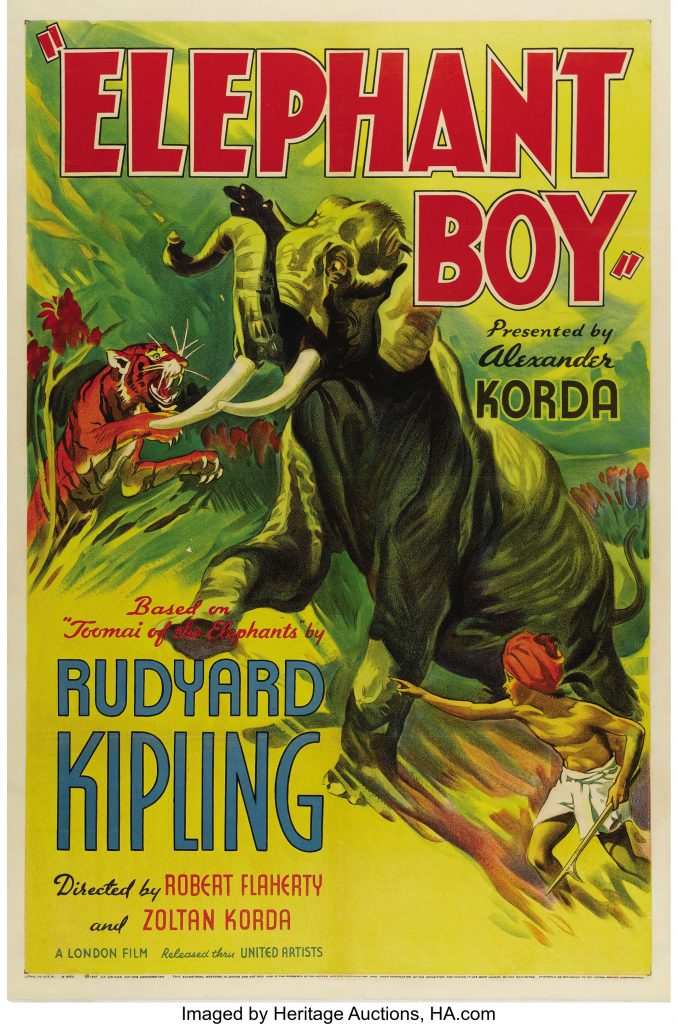
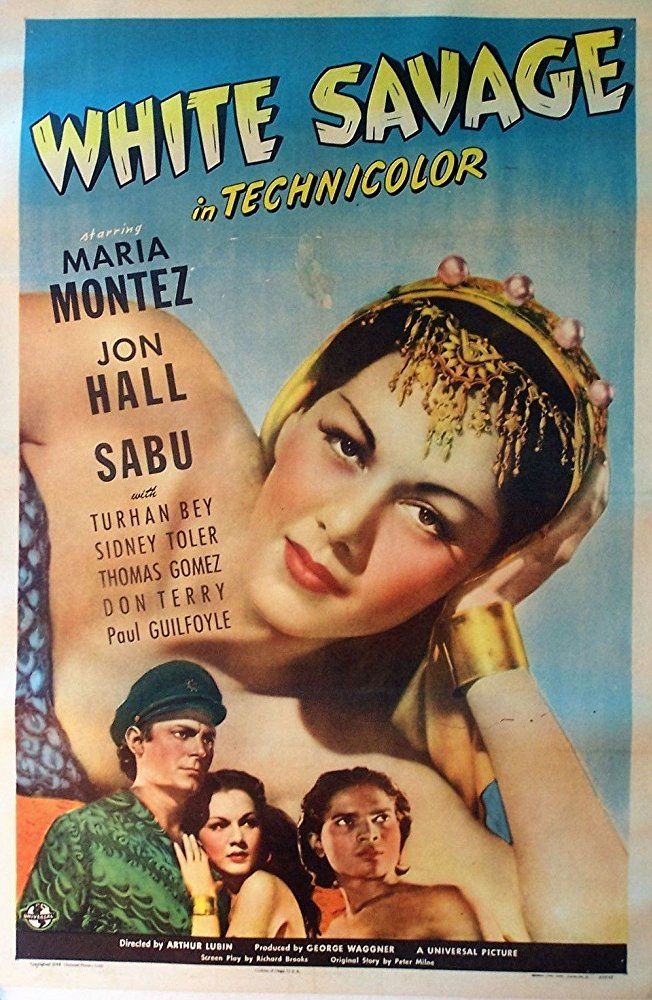
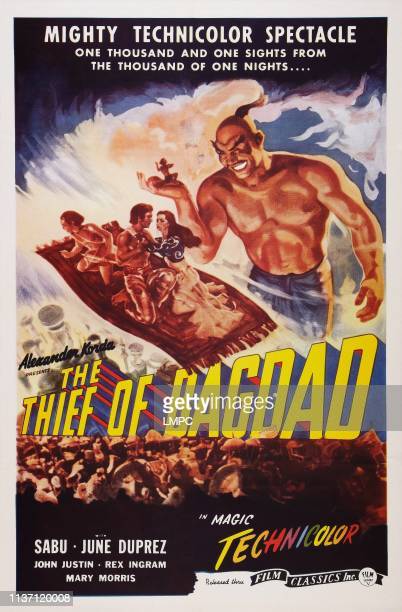
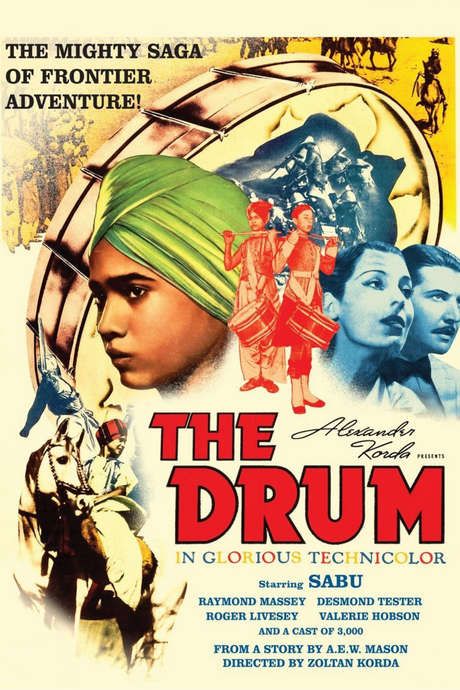
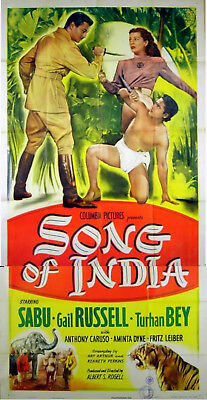
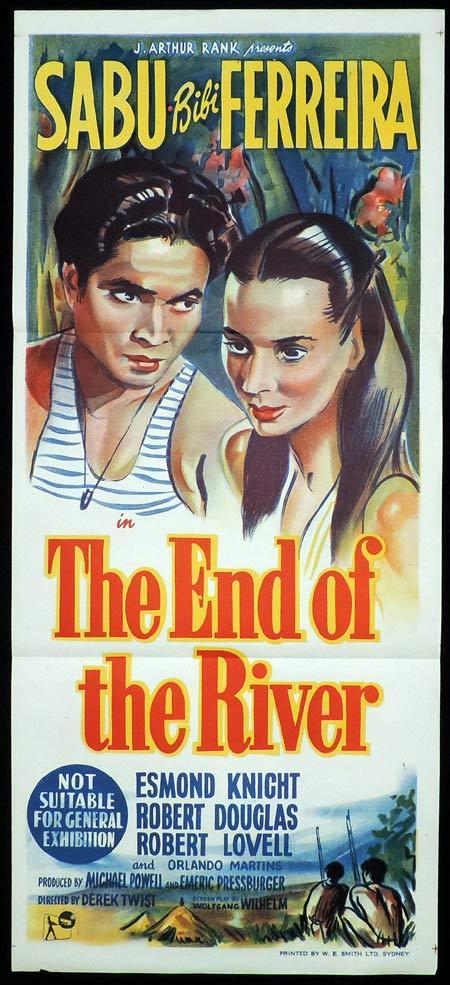
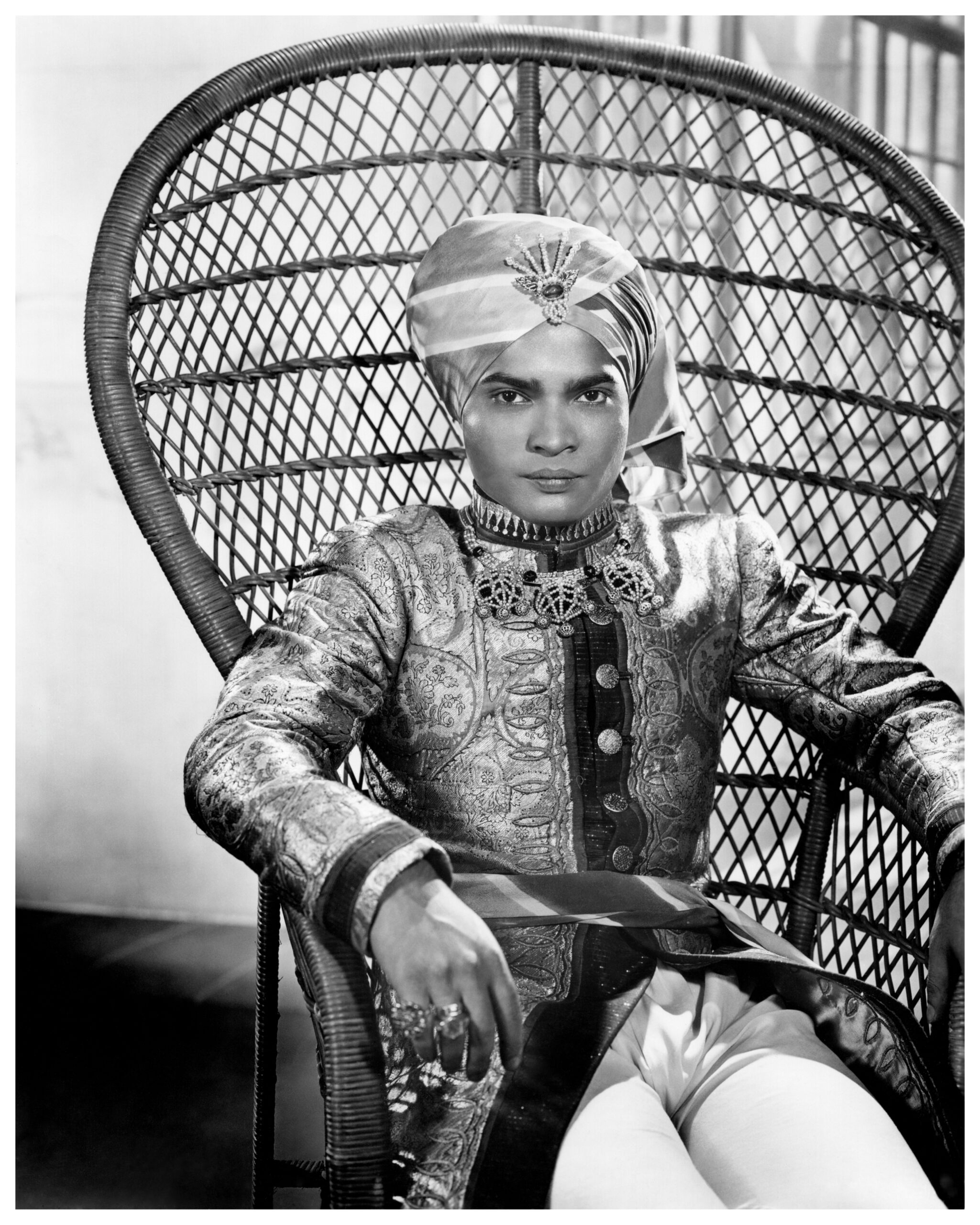
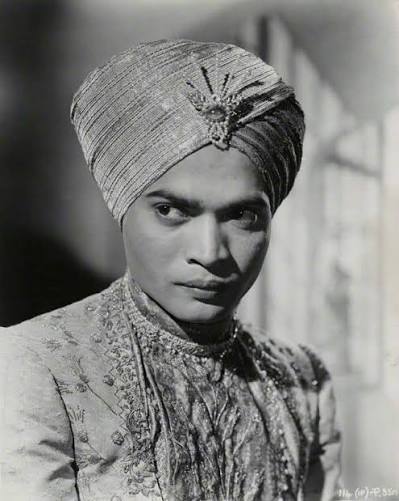
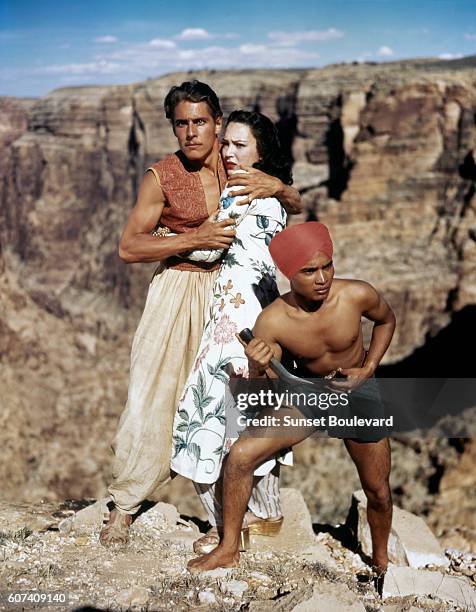
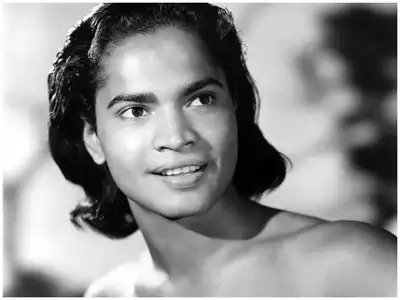
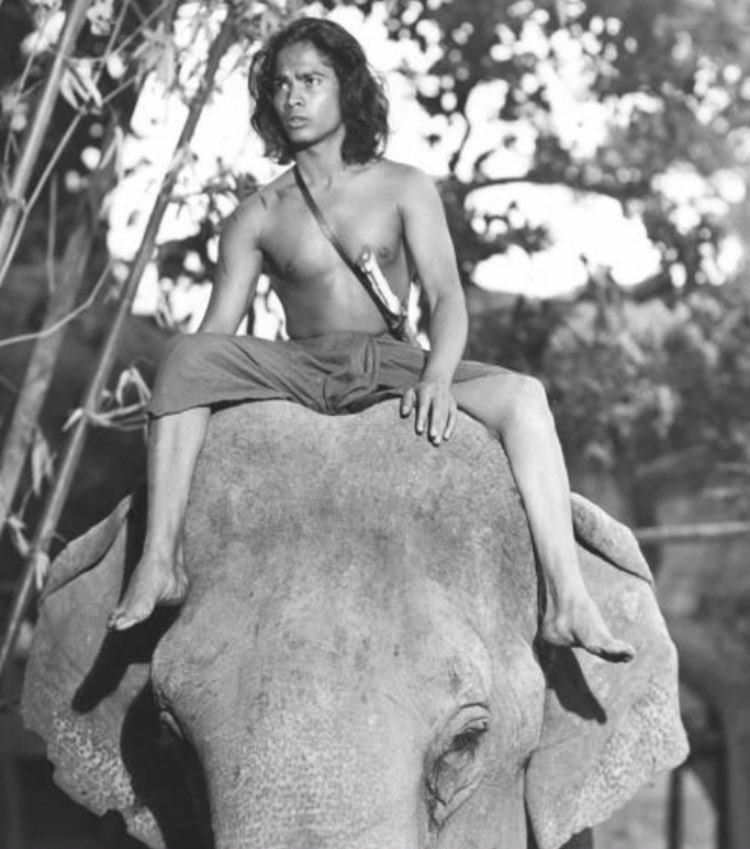
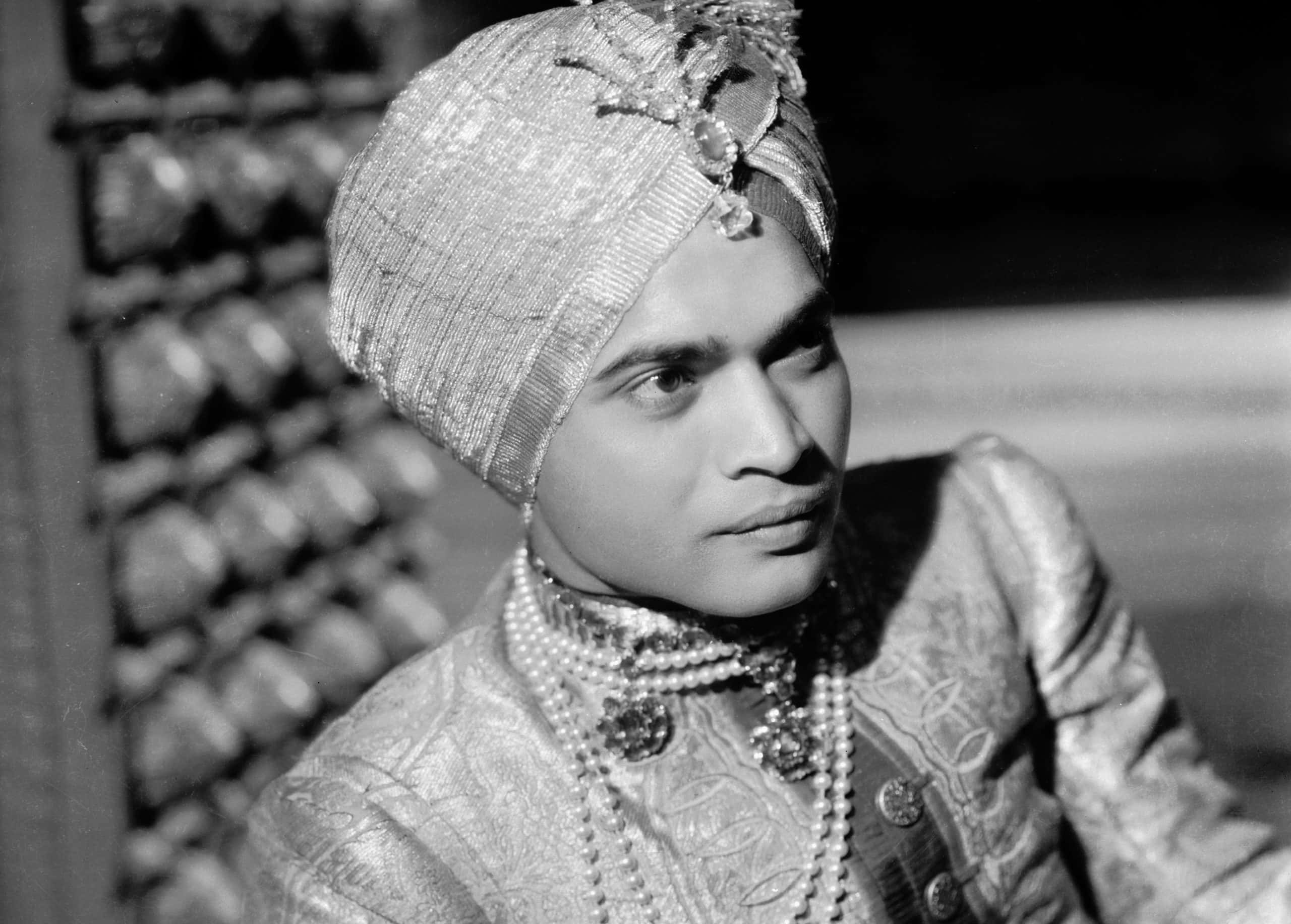
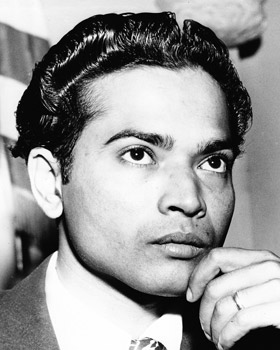
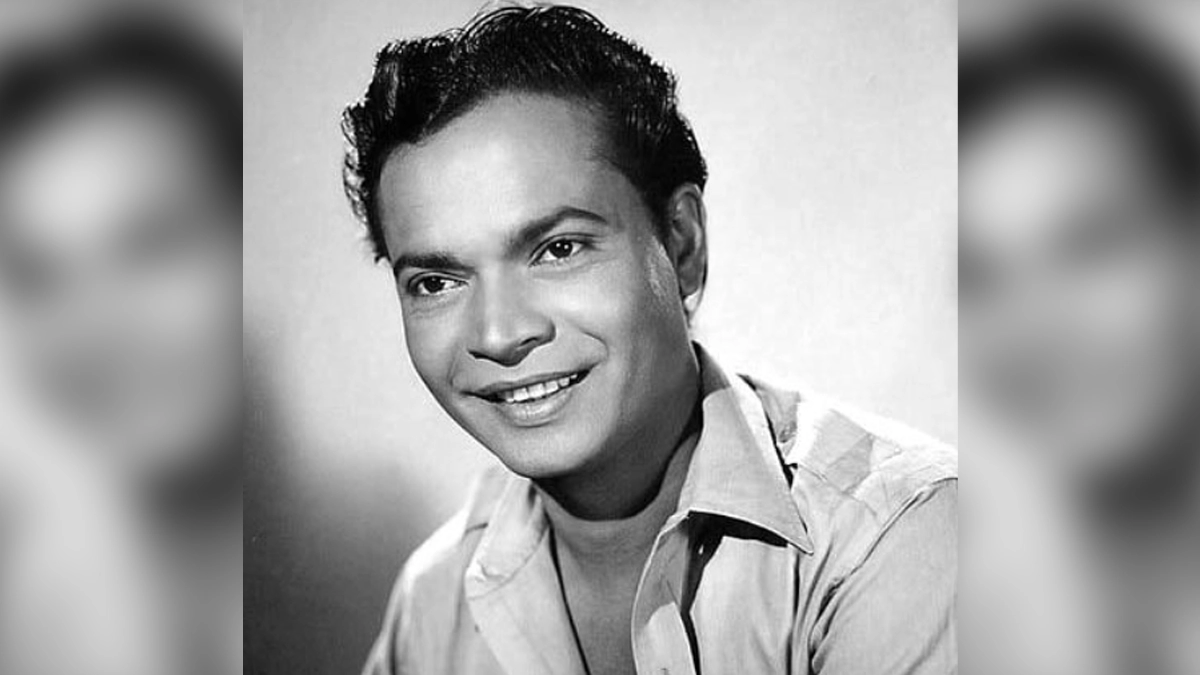
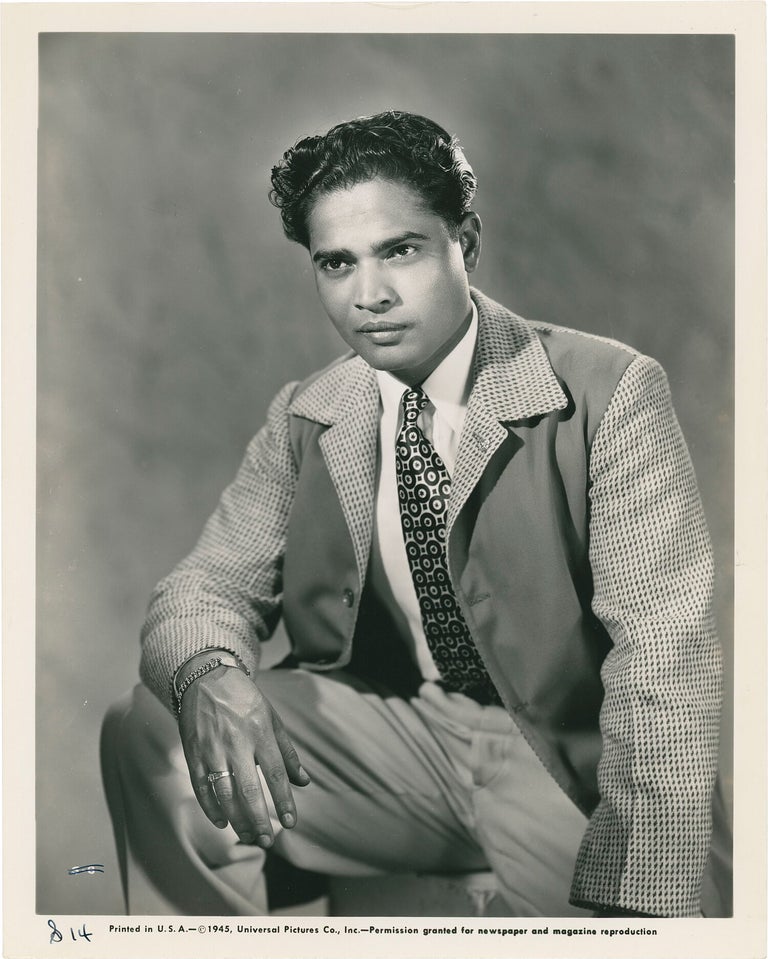
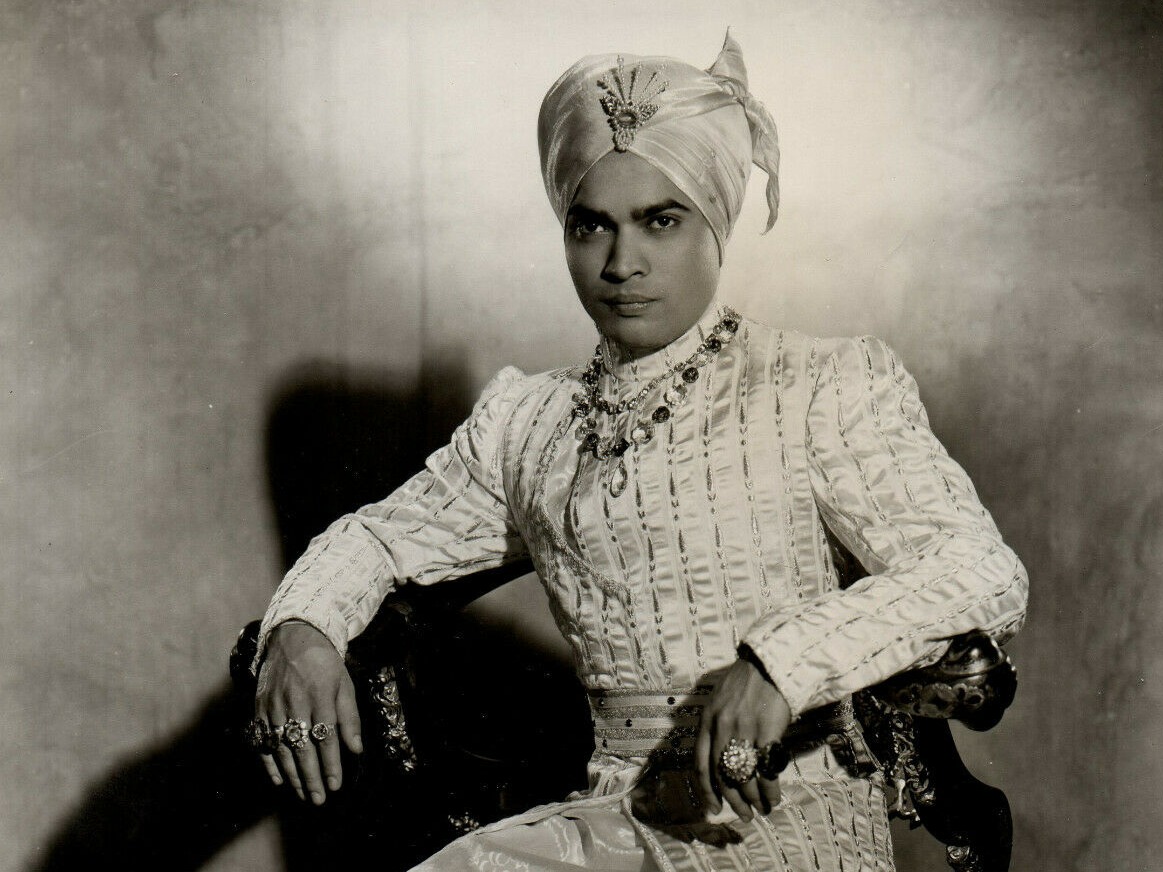
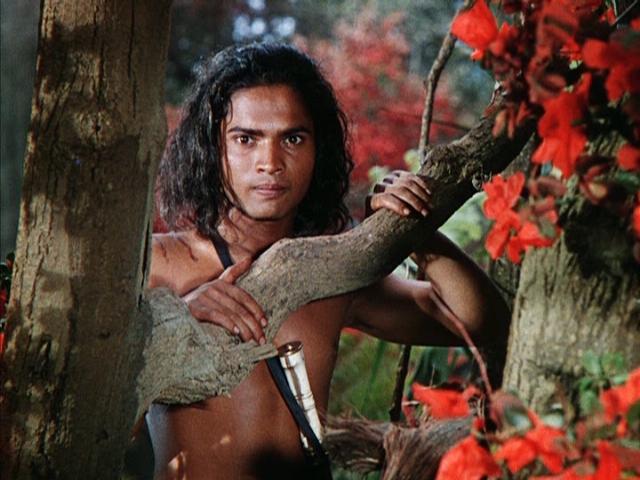
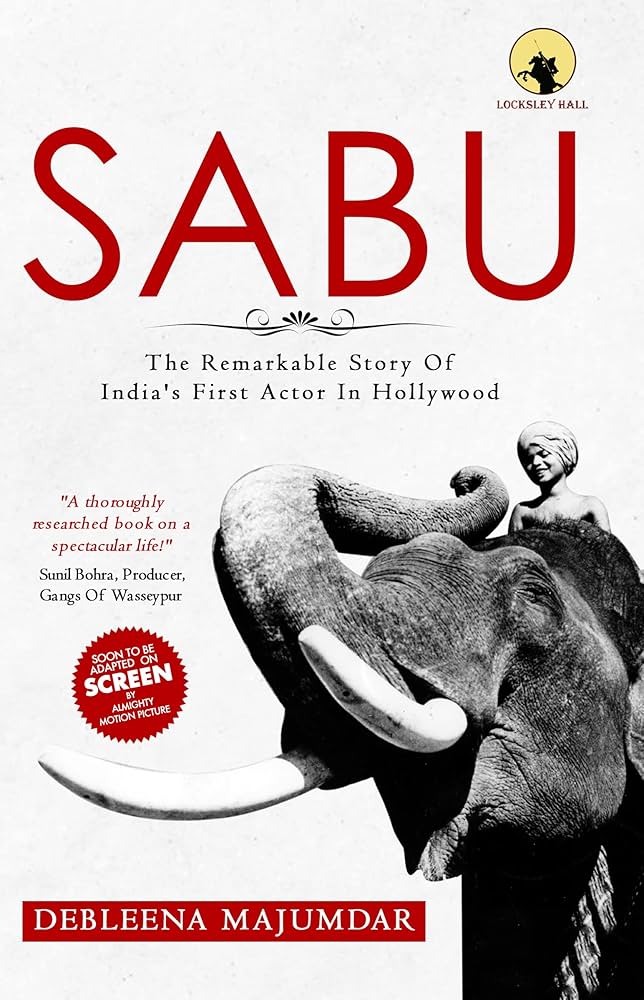
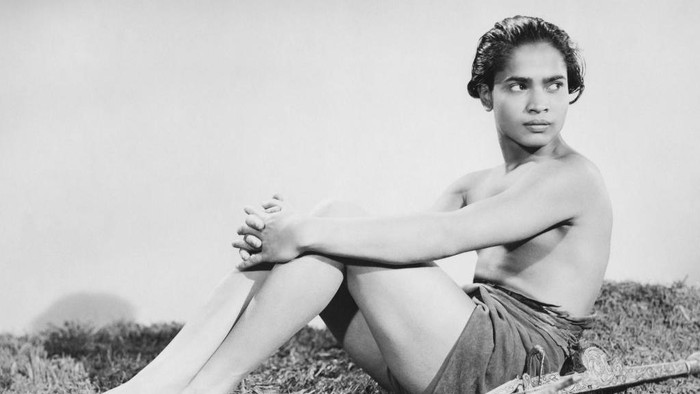
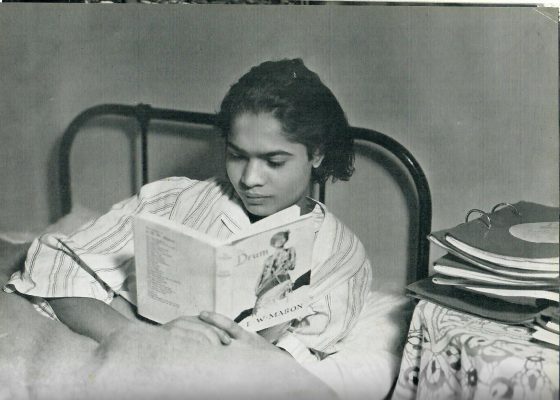
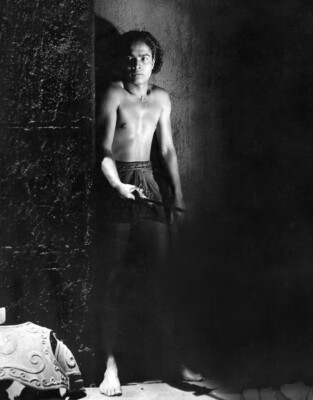
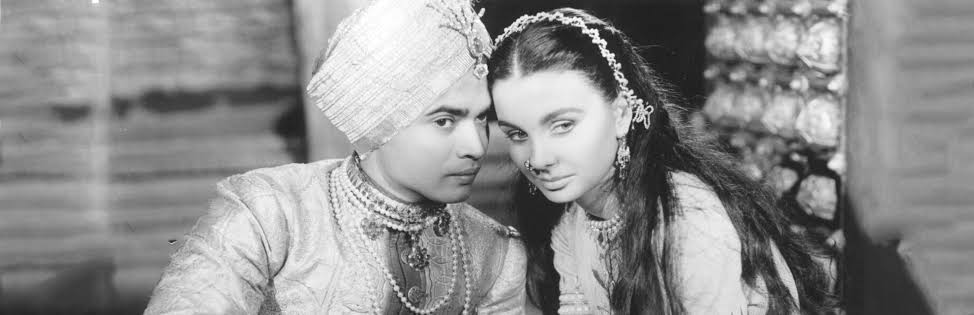
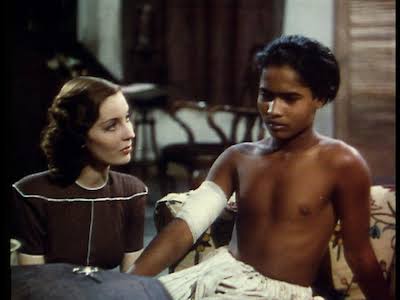
Sabu Dastagir (or Selar Shaik Sabu, depending on your resource) was born on January 27, 1924, in the little town of Mysore, India, which is nestled in the jungles of Karapur. The son of an elephant driver (mahout) in service for the Maharajah of his town, the young stable boy learned responsibility early in life when, at age 9, his father died and Sabu immediately became the ward of the royal elephant stables. As with many Hollywood success stories, good timing and dumb luck allowed the impoverished youth a chance for a better life. By sheer chance the timid 12-year-old orphan was discovered by a British location crew while searching for a youth to play the title role (an elephant driver!) in their upcoming feature Elephant Boy (1937). Quite taken aback by his earnest looks, engaging naturalness and adaptability to wild animals and their natural habitat, the studio handed the boy a film career on a sterling silver platter and was placed under exclusive contract by the mogul Alexander Korda himself.
Sabu and his older brother (as guardian) were whisked away to England to complete the picture and became subsequent wards of the British government. They were given excellent schooling in the process and Sabu quickly learned the English language in preparation for his upcoming films. Elephant Boy (1937) was an unqualified hit and the young actor was promptly placed front and center once again in the film Drums (1938) surrounded by an impressive British cast that included Raymond Massey and Valerie Hobson. With the parallel success of the Tarzan jungle movies in America, Hollywood starting taking a keen look at this refreshingly new boy talent when he first arrived in the U.S. for a publicity tour of the film. Again, his second film was given rave reviews, proving that Sabu would not be just a one-hit wonder.
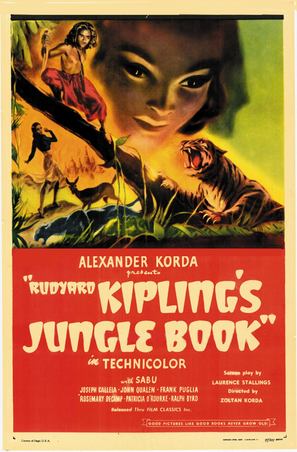
His third film for Korda is considered one of the great true classics. In the Arabian fantasy-adventure The Thief of Bagdad (1940), Sabu plays Abu the Thief and is not only surrounded by superb actors — notably June Duprez, John Justin, Rex Ingram (as the genie) and Conrad Veidt (as the evil Grand Vizier) — but exceptional writing and incredible special effects. Sabu’s name began stirring international ears. His last pairing with Korda was the excellent adaptation of Rudyard Kipling‘s classic book Jungle Book(1942) playing Mowgli, the boy raised by wolves, who must adapt to the ways of mankind after being returned to his mother. The movie was directed by Alexander’s brother Zoltan Korda.
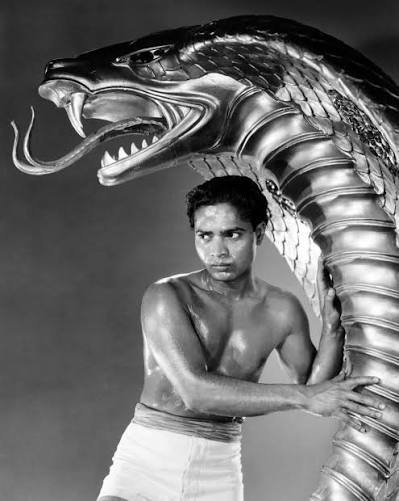
Following this triumph, Sabu officially became the exotic commodity of Universal Pictures and he settled in America. Although initially rewarding monetarily, it proved to be undoing. Unfortunately (and too often typical), a haphazard assembly-line of empty-minded features were developed that hardly compared to the quality pictures in England under Korda. Saddled alongside the unexceptional Maria Montez and Jon Hall, his vehicles Arabian Nights (1942), White Savage (1943) and Cobra Woman (1944) were, for the most part, drivel but certainly did fit the bill as colorful, mindless entertainment.
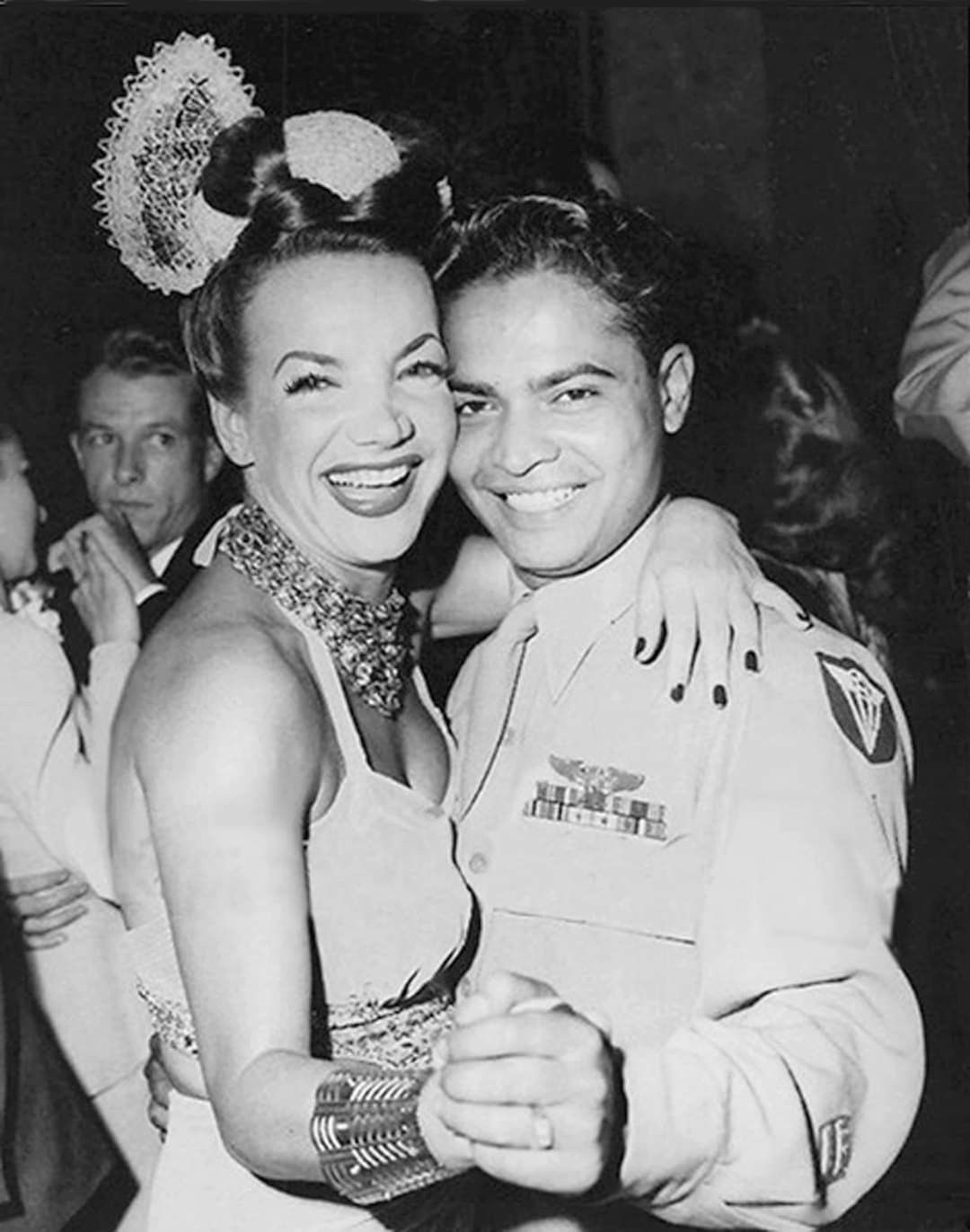
Almost 20 years old by the time he became a citizen of the U.S. in 1944, he enlisted in the Army Air Force and earned WWII distinction in combat missions (Distinguished Service Cross, Air Medal, among others) as a tail gunner. By the time Sabu returned to Universal and filming, the charm of his youth had worn off and the boyish stereotype impossible to escape.
Post-war audiences developed new tastes, but Sabu had not choice but to trudge on with retreads of his former glory. Films such as Tangier (1946) again opposite Ms. Montez,Man-Eater of Kumaon (1948) and Song of India (1949) opposite lovely princess Gail Russell did little to advance his career. While filming the last-mentioned movie, Sabu met and married actress Marilyn Cooper who temporarily filled in for an ailing Ms. Russell on the set. The couple went on to have two children.
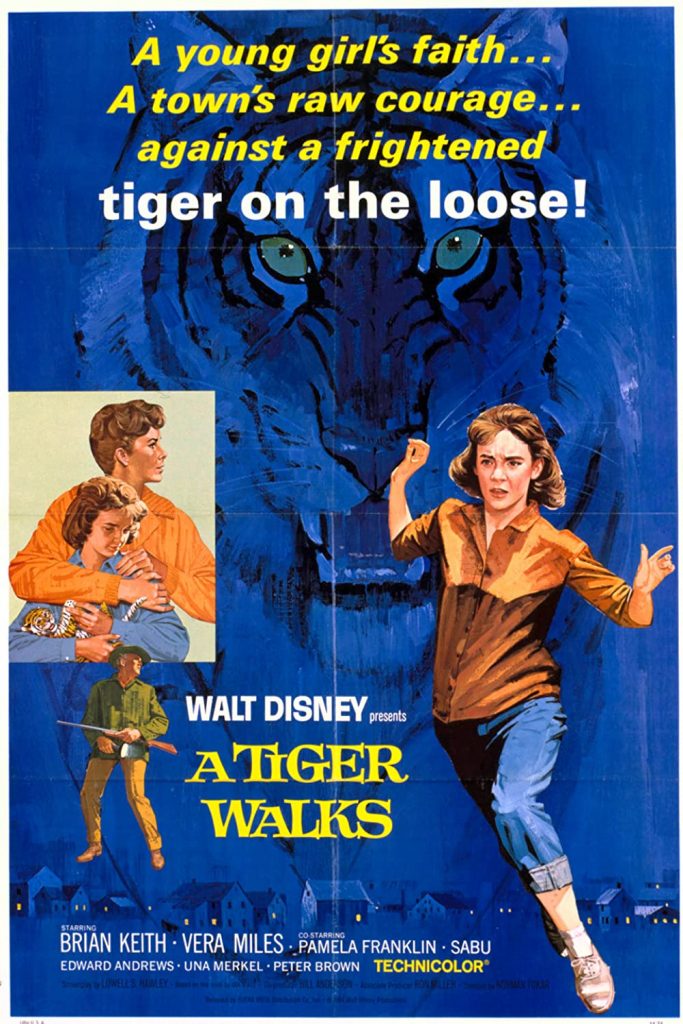
Sabu actually fared better back in England during the late 40s, starring in the crime drama The End of the River (1947) and appearing fourth-billed as a native general in the exquisitely photographed Black Narcissus (1947). Daring in subject matter, the film hadDeborah Kerr heading up a group of Anglican nuns who battle crude traditions, unexpected passions and stark raving madness while setting up a Himalayan order. By the mid-50s Sabu’s career was rapidly approaching extinction, seeking work wherever he could find it – in low-budget Europe productions, public appearances, etc. An attempt to conjure up a TV series for himself failed. His life was further aggravated by unpleasant civil and paternity suits brought about against him. His last two pictures were supporting roles in Rampage (1963), which starred Robert Mitchum, and A Tiger Walks (1964), a thoroughly routine Disney picture which was released posthumously.
Sabu died unexpectedly at age 39 of a heart attack on December 2, 1963, at his home in Southern California and was buried at Forest Lawn Cemetery in the Hollywood Hills. SonPaul Sabu developed into an accomplished songwriter and even formed a rock band called Sabu; daughter Jasmine Sabu, who died in 2001, was a noted horse trainer whose skill was utilized occasionally for films. Although he went the way of too many of our former stars, Sabu continues to enchant and excite newer generations with his unmatched athletic skills and magnetic charm in those early adventure fantasies of yesteryear.
– IMDb Mini Biography By: Gary Brumburgh / gr-home@pacbell.net
SabuThe Thief Of Bagdad, poster, US poster art, top from left: Sabu, John Justin, June Duprez, Rex Ingram, 1940. (Photo by LMPC via Getty Images)
Sabu (born Selar Shaik) occupies a unique and complex position in film history. He was the first Indian actor to become a major international star in Hollywood and British cinema, yet his career is a study in the limitations of the “exotic” archetype during the mid-20th century.
Critically, Sabu was an actor of extraordinary naturalism. Unlike the stage-trained British actors he often worked with, Sabu possessed a “camera-ready” spontaneity and a legendary rapport with animals that made him the definitive screen “nature boy.”
The Analytical Overview: From Stables to Stardom
1. The Alexander Korda Discovery (1937–1940)
Discovered as a young stable boy in Mysore, Sabu was thrust into the British film industry by mogul Alexander Korda.
Elephant Boy (1937): Directed by Robert Flaherty and Zoltan Korda.
Critical Analysis: This film established the “Sabu Persona.” He was not “acting” in the traditional sense; he was embodying a lived reality. His comfort with the elephant, Irawatha, provided a documentary-like authenticity that captivated Western audiences. Critics noted his “radiant smile” and “unselfconscious grace,” which served as a powerful (if romanticized) bridge between East and West.
2. The Technicolor Masterpieces (1940–1942)
This period represents the peak of Sabu’s artistic and commercial influence, where he became the face of the high-budget “Orientalist” fantasy.
The Thief of Bagdad (1940): As Abu the thief, Sabu provided the energetic, human heart of a film defined by groundbreaking special effects.
Jungle Book (1942): Playing Mowgli, he delivered what many consider the definitive live-action interpretation of the character.
Critical Analysis: In these films, Sabu’s physicality was his greatest tool. He moved with a lithe, athletic precision that made the fantastical elements of the plots feel grounded. Critically, he managed to avoid the “caricature” trap of the era by infusing his characters with a sharp, street-smart wit. He wasn’t just a “child of nature”; he was a clever protagonist who often outsmarted the villains.
3. The Universal “Exotic” Cycle (1942–1946)
Moving to Hollywood during the war, Sabu was paired with Maria Montez and Jon Hall in a series of escapist Technicolor adventures (Arabian Nights, White Savage, Cobra Woman).
Critical Analysis: This was a period of artistic stagnation. Hollywood utilized Sabu primarily as “scenery”—a youthful, bronzed figure to add color to the frame. The scripts rarely demanded the emotional depth he had shown in his Korda films. However, even in these formulaic roles, his “essential goodness” and screen charisma remained intact, making him one of the most bankable stars of the war years.
4. Black Narcissus (1947): The Mature Shift
Returning to work with Michael Powell and Emeric Pressburger, Sabu delivered his most sophisticated performance as The Young General.
Critical Analysis: This role subverted his earlier “jungle boy” image. Clad in silks and drenched in expensive perfume, he played a character defined by vanity and romantic obsession. * Insight: Powell used Sabu to represent the “sensory lure” of India that distracts the nuns. Sabu’s performance was subtle and knowing; he played the General with a touch of “arrogant charm” that proved he had matured into a capable character actor who could handle complex, psychological subtext.
The Technical Profile: The “Authentic” Outsider
Attribute
Sabu’s Cinematic Impact
Physicality
Incredible agility and a “fearless” interaction with wildlife.
Vocal Style
A clear, rhythmic English delivery that felt both “exotic” and accessible.
Screen Presence
Projected a “purity of spirit” that made him an ideal hero for moral fables.
Historical Legacy
He broke the “color bar” in leading roles, though he remained confined by “Eastern” tropes.
Ross Kemp was born on July 21, 1964 in Barking, Essex, England. His mother, Jean, was a hairdresser and his father, John, was a policeman with the Metropolitan Police force. He has a brother named Darren who is a documentary producer for the BBC.
Ross attended Shenfield High School, where he is remembered as an excellent athlete. He wanted to be an actor from a young age and went on to study drama at the Webber Douglas Academy. He has rarely been out of work since leaving the academy in 1985, appearing on stage, in films, on television and in various adverts.
His first credited television appearance was in 1986, playing Graham Lodsworth in “Emmerdale Farm” (now “Emmerdale”). His most famous role to date was his award-winning portrayal of hardman Grant Mitchell in the popular BBC series “EastEnders”.
“In an interview once, Rex Harrison referred to Alan Jay Lerner, the writer of ‘My Fair Lady’:’ I owe that man such a great deal’. Few actors are so in debt. ‘My Fair Lady’ cam to him when he was past middle age and transformed him from leading man to super-star. He had even been a formidable light comedian but a fairish run of poor films had kept this Rolls Royce of actors going in only low gear. He is a player of strong personal style, presumably achieved by much work but looking deceptively easy., the aristocratic elegant Englishman, with ingratiating hints of well-being and devilry. He can play with real bite. Noel Coward’s famous crack is not quite fair:’ If next to me, you were not the finest light-comedian in the world, you’d be good for only one thing: selling cars in Great Portland Street’. It suggests that behind Harrison’s smooth surface bravado, there is not very much – which is intriguingly possible; ut it also suggests superb self-confidence and it was that deepened into arrogance, which made him such a marvellous Higgins. To the extent that ‘My Fair Lady’ put him right to the forefront of actors, with roles to match, we all owe Alan Jay Lerner a great deal”. – David Shipman in “The Great Movie Stars – The International Years”. (1972).
TCM Overview:
Stagestruck from boyhood, suave British actor Rex Harrison joined the Liverpool Repertory Theatre at the age of 16, beginning a 66-year career that would culminate with his final performance on Broadway, May 11, 1990, three weeks prior to his death. Best known for his Tony- and Oscar-winning portrayal of Professor Henry Higgins in Alan Jay Lerner and Frederick Loewe’s “My Fair Lady”, he made his West End debut in “Getting George Married” (1930) and his Broadway debut in “Sweet Aloes” (1936), but it was a two year run on the London stage in Sir Terrence Rattigan’s “French Without Tears” that made him a star. Appearances in other sophisticated comedies, S N Behrman’s “No Time for Comedy” and Noel Coward’s “Design for Living” (both 1939), established him as what Coward himself called “the best light comedian in the world–after me.”
Harrison’s feature debut came in “The Great Game” (1930), and starring turns in movies like “Night Train to Munich”, (1940) “Major Barbara” (1941) and “Blithe Spirit” (1945) brought him to the attention of Hollywood, leading to a seven-year contract with 20th Century-Fox. He scored a major triumph as the King in “Anna and the King of Siam” (1946) and recorded another success with “The Ghost and Mrs. Muir” (1947), but subsequent films performed poorly at the box office, although Preston Sturges’ “Unfaithfully Yours” (1948) later acquired a cult status. Actor and studio parted company by mutual agreement, and Harrison returned to Broadway, earning a Tony for his 1948 performance as King Henry VIII in Maxwell Anderson’s “Anne of the Thousand Days”. Continued acclaim followed for his work in T S Eliot’s “The Cocktail Party” and John van Druten’s “Bell, Book and Candle” (both 1950). He directed and starred in “The Love of Four Colonels” (1953) and a revival of “Bell, Book and Candle” (1954) and helmed “Nina” (1955), all for the London stage. He made his Broadway directing debut with “The Bright One” (1958).
Despite having, in his own words, a vocal range of “one-and-a-half notes”, Harrison talked his way through the numbers of Lerner and Loewe’s “My Fair Lady” (1956), directed for the stage by Moss Hart, and became the darling of the critics, playing the show for two years in New York and another in London. His waspish professor of phonetics was “crisp, lean, complacent and condescending until at last a real flare of human emotions burns the egotism away,” wrote Brooks Atkinson in THE NEW YORK TIMES, and the success of “My Fair Lady” once again brought Harrison important film offers. He earned his first Oscar nomination for his portrayal of Julius Caesar in “Cleopatra” (1963), stealing the picture from his more famous co-stars, Elizabeth Taylor and Richard Burton. Reprising Higgins for the 1964 film version of “My Fair Lady” opposite Audrey Hepburn brought him a Best Actor Oscar and international fame, and “Dr. Dolittle” (1967) introduced him to a new generation of moviegoers as he shamelessly enjoyed himself playing the fanciful jungle gentleman who conversed with wildlife.
Harrison devoted most of his remaining years to his first love, the stage, taking parts in such diverse plays as Luigi Pirandello’s “Henry IV” and Rattigan’s “In Praise of Love” (both 1974). He co-starred with Claudette Colbert in a Broadway production of “The Kingfisher” (1978), and, after returning to Broadway in “My Fair Lady” (1981), garnered some of the best reviews of his career for a Broadway revival of “Heartbreak House” (1983), later captured for posterity in a 1985 Showtime cable special. Harrison portrayed Lord Grenham in London and Broadway productions of “Aren’t We All?” (1984-85) and Grand Duke Cyril Romanov in the NBC miniseries, “Anastasia: The Story of Anna” (1986). He last appeared on the London stage in “The Admirable Crichton” (1988) and bowed out in a Broadway revival of W Somerset Maugham’s “The Circle”, playing eight times a week just prior to his June 1990 death. The oft-married man dubbed ‘Sexy Rexy’ by Walter Winchell never wanted to be anything but an actor and never intended to retire. “He died with his boots on, no doubt about it,” said “The Circle” producer Elliot Martin.
The Foxes Of Harrow, poster, Rex Harrison, Maureen O’Hara, Vanessa Brown, 1947. (Photo by LMPC via Getty Images)Rex Harrison
Despite being far from a household name, Mackenzie Crook continued to win over audiences on both sides of the Atlantic with his quirky comic turns in film and on television. Crook first became known in the U.K. as a stand-up comedian and popular television performer, most notably as the humorless and possibly deranged Gareth Keenan on Ricky Gervais and Stephen Merchant’s creation, “The Office” (BBC 2, 2001-03). As Ragetti, the formerly immortal pirate with an uncooperative wooden eyeball in “Pirates of the Caribbean: Curse of the Black Pearl” (2003) and its mega-successful sequel, “Pirates of the Caribbean: Dead Man’s Chest” (2006), Crook nearly stole every scene he was in. While a third appearance in the second “Pirates” film kept him working, acclaimed performances onstage in London and on Broadway in such productions as 2011’s “Jerusalem” garnered the actor a well deserved respectability. Exceptionally versatile and thoroughly committed to honing his craft, Crook’s unique attributes ensured him a robust career in virtually any medium he chose to work within.
Born Paul Crook in Maidstone, Kent, on Sept. 29, 1971, Crook wanted to become an actor, but finding the idea of drama school less than appealing, pursued a career in stand-up comedy as an alternate route into the business. He developed two popular characters – Mr. Bagwell, a heartless schoolteacher, and Charlie Cheese, a grimly desperate performer – and toured the U.K. comedy circuit for eight years. His talents caught the attention of the producers of the comedy series “The Eleven O’Clock Show” (BBC 4, 1998-2000), which also served as a launching pad for such talented English comic performers as Sascha Baron Cohen. In 2001, he parlayed his comic talents into another sketch show, “TV to Go” (BBC, 2001-02).
In 2001, he joined his fellow “Eleven O’ Clock Show” alum Ricky Gervais in his and Stephen Merchant’s acclaimed series “The Office,” where his “assistant to the regional manager” Gareth Keenan, with his insanely inflated self-importance and obsession with his lieutenant status in the Territorial Army, became one of the show’s most popular characters. Crook followed this with minor roles in several television series, as well as a small part as an usher in the film “Finding Neverland” (2004). Its star, Johnny Depp, had bonded with Crook during its making, and recommended the actor to play a small role as a comic relief pirate who serves under the spectral Captain Barbossa (Geoffrey Rush) in his next film, the Disney production “Pirates of the Caribbean: The Curse of the Black Pearl” (2003). That film went on to become a colossal worldwide hit, cementing Crook’s pop culture status by earning him an action figure in his character’s likeness.
Despite the success of “Pirates,” Crook continued to ply his trade in comedy on the small screen in his home country, most notably on the controversial animated series “Popetown” (BBC 3, 2005), about the long-suffering staff of a particularly troublesome pontiff. Crook also appeared as Launcelot Gobbo in Michael Radford’s film version of “The Merchant of Venice” (2004), starring Al Pacino and Jeremy Irons; as a weasel/henchman in Terry Gilliam’s ill-fated “The Brothers Grimm” (2005); and made an impression on critics and audiences alike as the fragile Billy Bibbitt in the 2004 West End stage production of “One Flew Over the Cuckoo’s Nest” opposite Christian Slater.
In 2006, Crook returned as Ragetti in “Pirates of the Caribbean: Dead Man’s Chest,” which proved even more of a box office juggernaut than its prequel. The character was revived for the visually stunning, but narratively muddy “Pirates of the Caribbean: At World’s End” (2007). He portrayed another less-than-savory character in the subterranean fable “City of Ember” (2008) then made his Broadway debut that same year in a revival of Chekhov’s “The Seagull.” Originally mounted at London’s Royal Court Theatre in 2007, the production also starred Peter Sarsgaard and Kristin Scott Thomas. Back in theaters, albeit with limited release in the U.S., Crook was seen in an adaptation of pulp writer Robert E. Howard’s swashbuckling puritan avenger “Solomon Kane” (2009). He soon returned to Broadway, where he received a 2011 Tony nomination for his supporting role in the drama “Jerusalem,” another play brought to New York after it (and Crook) garnered stunning reviews for its lengthy U.K. run. Other film work included a turn in the medieval action-drama “Ironclad” (2011) in addition to voicing the character of Ernie the smuggler in Steven Spielberg’s computer-animated adaptation of the beloved European comic book series, “The Adventures of Tintin” (2011).
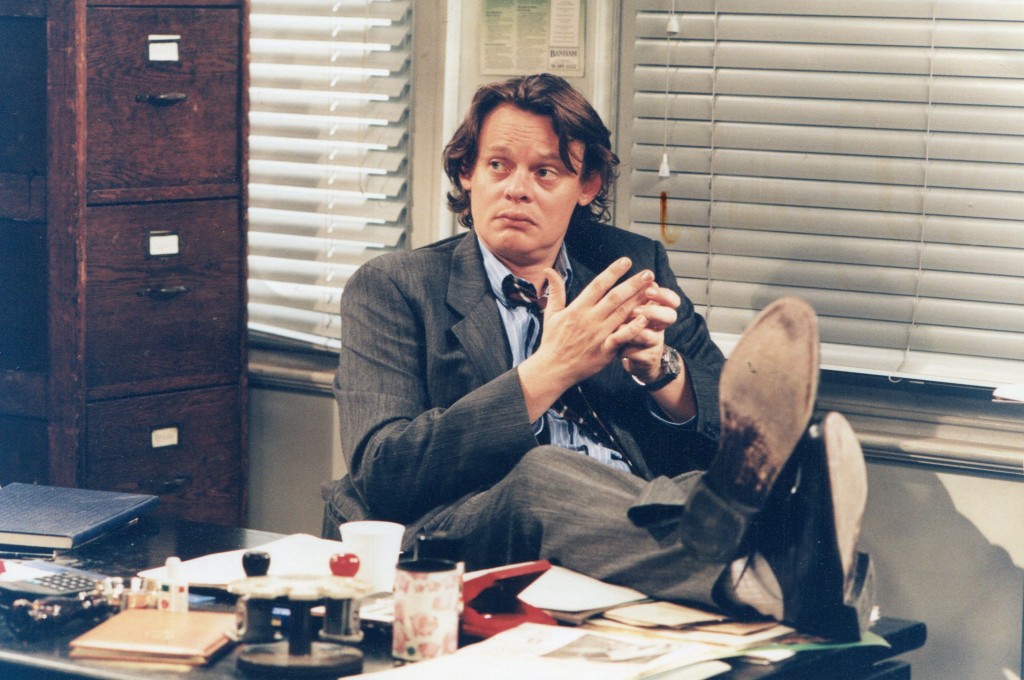
Martin Clunes rose to the top of the U.K.’s comedy scene in the 1990s on the groundbreaking situation comedy “Men Behaving Badly” (ITV/BBC, 1992-99) and went on to equal his success as the title character of the network’s light drama “Doc Martin” (2004- ). A third-generation thespian, the London-born Clunes cut his teeth in the theater and on some short-lived sitcoms in the 1980s before beginning a running collaboration with comic mainstay Harry Enfield. In 1992, he and Enfield were paired on ITV’s comedy of ne’er-do-wells, “Men Behaving Badly,” and the show kicked into more ribald gear once picked up by the BBC in 1994, with Neil Morrissey taking over as his flatmate. It made Clunes a crossover star, expanding his CV with dramatic turns in telefilms such as “Goodbye, Mr. Chips” (ITV, 2002) and periodic supporting parts, as with his turn as small-town doctor in the sleeper indie hit “Saving Grace” (2002). The film spawned two spin-off telefilms prefiguring his character, Doc Martin, as a London physician simplifying his life; he would reinvent the character as an inveterate curmudgeon for ITV in 2004 in what would become the long-running series franchised into international phenomenon. He kept his hand in series comedy with the well-regarded sitcom “William and Mary” (ITV, 2003-05) and the less successful outing “Reggie Perrin” (BBC, 2009-2010). From behaving badly to being one of his country’s better regarded personalities, Clunes made a career spinning ratings gold for U.K. broadcasters.
He was born Alexander Martin Clunes on Nov. 28, 1961 in Wimbledon, London, U.K., the son of two generations British stage mainstays. His father, Alec Clunes, was a renowned actor of Shakespearean fare and British film, while his mother, Daphne, was an aficionado of the craft who encouraged Martin to follow in his father’s footsteps and later sat on the board of the London Academy of Music and Dramatic Art. The Clunes patriarch was often on the road for his work, and Martin and sister Amanda only found out years later that his father and mother were estranged when the former died of cancer in 1970. Martin was sent to boarding school at the Royal Russell School in Croydon, a traumatic period in which he suffered both physically and psychologically from the school’s draconian disciplinary codes. He honed his own burgeoning talents at The Arts Educational Schools in Chiswick, London, developing a sense of humor, he later said, to cope with school bullies. With the mentoring of his mother’s cousin Jeremy Brett, a prolific actor who later gained fame in the 1980s as Britain’s latest Sherlock Holmes, Martin decided try his hand at show business. Brett, he later said, even offered to pay for surgery to pin Clunes’ prominent ears back. With all this assistance, Clunes won his first paying job as a member of the repertory of the Mercury Theatre in Colchester and spent much of his early career as a stage actor.
He made his television debut in 1982 as a cocky young ally of the U.K.’s long-running sci-fi hero in a brief arc on “Dr. Who” (BBC, 1963-1989), and he would periodically return to the medium in ensuing years on short-lived situation comedies “No Place Like Home” (BBC, 1983) and “All at No. 20” (ITV, 1986-87). In 1987, he landed in auspicious company, doing a run of Shakespearean works for the English Shakespeare Company at London’s venerable Old Vic Theatre, and the next year snared a role opposite Edward Fox and Rex Harrison in a revival of the Brit comedy classic “The Admirable Crichton” at the Theatre Royal Haymarket. In 1990 he married fellow actor Lucy Aston. Television kept calling, often with series one-off roles, but that same year, Clunes kicked off what would become a prolific decade of television work when comedian Harry Enfield tapped him for the ensemble of his BBC sketch show, “Harry Enfield’s Television Programme” (1990-92) He and Enfield worked together again, alongside Jim Broadbent, on the short comedy series “Gone to the Dogs” for ITV in 1991, and again in the 1994 update of the sketch comedy series “Harry Enfield and Chums.” Also in 1991, he joined Hugh Laurie and Stephen Fry for the second season of their the dimwits-in-high-places comedy “Jeeves and Wooster” (ITV, 1990-93), with Clunes doing a four-episode turn as upper-class twit Cyril “Barmy” Fotheringay Phipps.
Meanwhile, Enfield was contacted by TV producer Beryl Vertue about starring in a new sitcom for ITV based on Simon Nye’s novel about beer-swilling slackers, Men Behaving Badly. Enfield, taking the role of Dermot, lured Clunes along to play his roommate Gary, a desk jockey who after work indulges a rampant Peter Pan-complex by way of boozing, vegetating, ogling and sundry hijinks. After the first six-episode season, however, Enfield felt uncomfortable in a sitcom format and Dermot was written out in favor of a new flatmate, Tony, played by Neil Morrissey. The show rated poorly during its second season and, with Enfield no longer its tentpole, ITV decided to axe it. The BBC picked it up and gave it a later-evening time slot, loosing writers to create a racier show, and “MBB” found a groove, drawing bigger audiences and a raft of awards, including a Best Comedy Actor BAFTA win for Clunes in 1996 and nomination in 1997. He veered into more dramatic fare off-season, starring in the miniseries “Demob” (1993), the tale of two onetime musical comedians (Clunes and Griff Rhys-Jones) who, after service in World War II, go to extraordinary lengths to reestablish their careers in a much-changed Britain.
In 1994, he garnered the lead in the feature “Staggered,” and when two directors dropped off the project, Clunes stepped up and took the helm of the project. In the film, he played a man waking up naked in Scotland and embarking on an odyssey to traverse the length of Britain to make it to his wedding in London. With his own marriage to XXX crumbling, Clunes began a relationship with “Staggered” producer, Philippa Braithwaite, with the couple marrying in 1997 in the wake of his and Aston’s divorce. By this time, he became much in-demand for TV movies and as a feature film supporting player, including a small turn in the Oscar-winning “Shakespeare In Love” (1998) and picked up a voiceover job as the title cartoon dog on the children’s series “Kipper” (ITV, 1997). After “Men Behaving Badly” shuttered in 1999, Braithwaite produced a little film that would give birth to another long-lived, multi-layered project for the both of them. “Saving Grace,” co-scripted by Scottish-born comedian Craig Ferguson, starred Brenda Blethyn as a woman whose recently deceased husband leaves her with nothing but her green thumb, while her inept gardener (Ferguson) helps her raise a crop of marijuana in a small Cornwall town. Clunes took third billing as Dr. Martin Bamford, the town doctor, buddy of Ferguson and partaker of the weed.
One of the bankrollers of the film, Sky Pictures, expressed interest in doing a pseudo spin-off of the show starring Clunes, initially a prequel concept telling the story of how Dr. Bamford came to reside in the remote town. Braithwaite and Clunes’ Buffalo Pictures put in motion “Doc Martin” (Sky TV, 2001), which saw Clunes rendering the character as a successful London obstetrician whose life falls apart when he discovers his wife has cheated on him, prompting him to seek a kind of walkabout in a Cornwall town he visited as a child and finding a more blue-collar groove among its eccentric, simpler folk. He kept up his bona fides as comic leading man in whacky-caper ITV movies such as “Hunting Venus” (1999), which Clunes also directed, reuniting him with “MBB” co-star Morrissey; “Dirty Tricks” (2000) and “The Booze Cruise” (2003). He also tapped into more dramatic work, playing the swaggering agent of the king in an updated film adaptation of “Lorna Doone” (BBC/A&E, 2000); the eerily charming 1940s serial killer John George Haigh in “A is for Acid” (ITV, 2002); and the titular, big-hearted boarding school teacher in a remake of “Goodbye, Mr. Chips.”
He reprised his Doc Martin character for Sky in 2003 in “Doc Martin and the Legend of the Cloutie,” which saw the doc scheming to keep the area around the village pristine by convincing some citified land developers that the land they purchased is haunted. That year, he returned to series television for ITV’s “William and Mary,” with him playing an amiable but unsatisfied undertaker embarking on a rollercoaster of a relationship with a professional midwife (Julie Graham). “William and Mary” ran three seasons, but even before it concluded, Clunes, Braithwaite and writer-producer Dominic Minghella had taken the Doc Martin franchise to another level. ITV commissioned it as a series, and they began tinkering with the concept. When it debuted in 2004, the sympathetic, well-meant Dr. Martin had (presumably for copyright reasons) a new surname, Ellingham, and a radically altered disposition, reintroduced to the quirky fishing village as a surly, antisocial London surgeon who, having developed an aversion to blood, seeks work as a general practitioner. Even more of a fish-out-of-water tale, the show became a monumental hit, often topping 10 million viewers per episode, as it followed his alienation from and grudging acceptance by the local townsfolk.
The show proved such a phenomenon, its concept and storylines were licensed for adaptations for Greek, German, Spanish and French television, while PBS aired the original in the States. Yet after the third season, and in the wake of his mother’s death in 2007, Clunes decided to take a break from acting. He penned a book bespeaking his love of dogs, A Dog’s Life, in 2008, which culled memories of his own family’s pets and delved deeper into the history of dogs. He would eventually semi-adapt the book for a documentary for ITV. In 2009, “Doc Martin” resumed production to great fanfare. Though it became a rare long-running drama in the U.K., Clunes supplemented his schedule in 2009 with Simon Nye’s ballyhooed remake of the BBC classic comedy “The Fall and Rise of Reginald Perrin” (1976-79), simply redubbed “Reggie Perrin.” He played the title character, a man in the midst of a midlife crisis who seeks respite in fantasy and plots to fake his own death. Though not well-rated, the show lasted two seasons on the BBC.
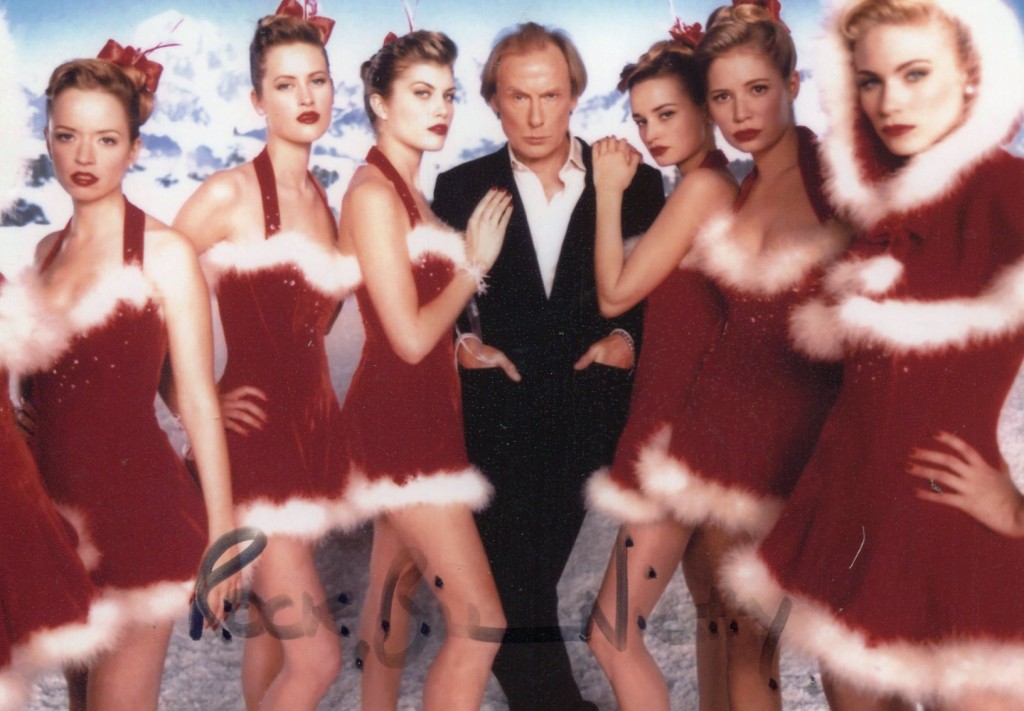
Despite decades on the British dramatic stage and in small, offbeat comedies, Bill Nighy remained one of England’s best kept secrets until scene-stealing supporting roles in a number of mainstream American hits led to his remarkable success after the age of 50. Following his series role on the widely acclaimed British serial “State of Play” (BBC One, 2003), Nighy had his international breakthrough with his casting as the villainous Viktor in the “Underworld” horror-action series and earned critical acclaim for the spark he injected into “Love Actually” (2003) with his role of an aging rock star. His lean, elegant stature immediately found a niche in witty blockbusters like “The Hitchhiker’s Guide to the Galaxy” (2005), while his portrayal of the cephalopod Davy Jones in the second and third installments of the “Pirates of the Caribbean” franchise (2006-07) introduced him to a wider audience. He delivered strong performances in historical dramas as well, namely “The Constant Gardner” (2005) and “Valkyrie” (2008), and displayed his lighter side in whimsical comedies like “The Best Exotic Marigold Hotel” (2012). Staying true to his roots as both a dramatic and comedic performer, Nighy managed to stay relevant to contemporary audiences on both sides of the Atlantic without sacrificing his stature as one of Britain’s finest performers.
William Nighy was born on Dec. 12, 1949 and grew up in Caterham, Surrey, just southwest of London, where his dad managed a garage and his mum worked as a psychiatric nurse. A restless, rock-n-roll-loving youth, he left school early and spent time traveling in France, taking on odd jobs while entertaining the notion of following in the footsteps of one his heroes, Ernest Hemingway, by becoming a writer. While his dreams of penning a great novel did not materialize, he did find a creative outlet in theater, urged to audition for a drama program by a girlfriend he was hoping to impress. He did more than impress her; he was actually accepted into the Guildford School of Drama and spent two years training there. By the mid-1970s, he was working regularly as a player and staffer at the Everyman Theatre in Liverpool, in addition to traveling with Van Load, a theater group he helped found which toured pubs, parking lots, prisons, and other places where the average public could have the chance to enjoy a live production. Nighy made his way onto the London stage, beginning what would be a long career with the National Theater and breaking into film with bit parts in the spy thriller “Eye of the Needle” (1981) and the family favorite “Little Lord Fauntleroy” (1980), among others. Nighy mostly stuck with theater and BBC radio dramas throughout the 1980s, appearing in “King Lear” at the National Theater and voicing radio adaptations of “Lord of the Rings” and the British sitcom, “Yes Minister.”
In 1989, Nighy raised his screen profile with a supporting role in Dwight Little’s adaptation of “Phantom of the Opera” (1989) and one in “Mack the Knife” (1989) co-starring Raul Julia and Richard Harris. He also appeared in Harold Pinter’s “Betrayal” on the London stage in 1991, but by the following year, it was becoming clear that both the actor’s career and personal life were hampered by Nighy’s excessive drinking and drug habits. He became sober in 1992 and resumed his career with clear eyes and a starring role as an unscrupulous academic in a National Theater production of Tom Stoppard’s “Arcadia.” Nighy’s first major movie role, alongside Robin Williams in Bill Forsyth’s “Being Human” (1993), was only given limited release but the actor enjoyed considerable attention for back-to-back stage runs in Chekhov’s “The Seagull” and David Hare’s “Skylight,” which toured the U.K. following a successful run at London’s Vaudeville Theater. The newly sober actor’s career continued to blossom with a role in the children’s fantasy feature “Fairytale: A True Story” (1997), and in the hilarious “Still Crazy” (1998), where he played an aging rocker who reunites with his 1970s rock band to relive the glory days. His work in the latter film was so beloved, he earned theEvening Standard‘s Peter Sellers Award for his comedic performance as the band’s egotistical lead singer.
Nighy continued to endear himself to British comedy fans in Ade Edmondson’s “Guest House Paradiso” (1999), an adaptation of the slapstick BBC series “Bottom.” For his lead role as a psychiatrist in the National Theater production of “Blue/Orange,” Nighy won a nomination from the prestigious Olivier Awards and enjoyed an extended run of the play on the West End. He resumed his film career with another pair of offbeat comedies – Paddy Breathnach’s “Blow Dry” (2001) and Peter Cattaneo’s “Lucky Break” (2002), which earned Nighy a Best Supporting Actor nomination from the London Film Critics Circle for playing one in a troupe of prison inmates who stage a play to cover up an escape attempt. Supporting roles in “The Lawless Heart” (2001), about complicated dalliances in a small English town and the period drama “I Capture the Castle” (2002) still did not quite establish Nighy as a well-known presence on British screens, but he finally enjoyed that position with a recurring role on the British comedy series “Auf Wiedersehen, Pet” in 2002. The following year, he exploded into American commercial cinemas playing the nefarious vampire elder Viktor in the horror actioner “Underworld” (2003). He endeared himself to an entirely different demographic in the ensemble romantic comedy “Love Actually” (2003), stealing the show from a hunky young cast with his spot-on performance as another over-the-hill rocker hoping for a comeback.
Nighy earned a slew of recognition including a BAFTA Award for Supporting Actor for “Love Actually,” and went on to give delightfully offbeat supporting performances in “very British” comedies “Shaun of the Dead” (2004), starring Simon Pegg as a twenty-something slacker fighting off zombies, and the long awaited adaptation of Douglas Adams’ sci-fi classic “The Hitchhiker’s Guide to the Galaxy” (2005), where he portrayed planet designer Slartibartfast. Making an about-face from his string of outrageous comedies, Nighy offered an excellent dramatic performance as a greedy British official in “The Constant Gardener” (2005), director Fernando Meirelles’ adaptation of the John le Carré novel about a diplomat (Ralph Fiennes) whose wife (Rachel Wiesz) is murdered after discovering corruption between the pharmaceutical industry and Kenyan government. The film was one of the best reviewed of the year and earned Oscar and Golden Globe nominations for best film. The same year, Nighy earned his own Golden Globe nod for “The Girl in the Café” (HBO, 2005), in which he starred as a shy civil servant who meets a mysterious woman (Kelly MacDonald) and develops a life-changing relationship with her. Nighy revived his evil vampire leader in the bloody, over-the-top sequel “Underworld: Evolution” (2006), then earned his first Golden Globe win for starring as an executive whose personal life is a mess after he loses his wife in the BBC television movie, “Gideon’s Daughter” (2006).
The actor lent his velvety voice to the sewer-set animated film “Flushed Away” (2006) and continued to entertain family audiences as undead pirate Davy Jones in the box office record breaker “Pirates of the Caribbean: Dead Man’s Chest” (2006). The fifty-something actor also made his Broadway debut in David Hare’s “The Vertical Hour,” for which he earned rave reviews, and had a supporting role in the highly acclaimed psychological drama “Notes on a Scandal” (2006) the same year. In the third blockbuster of the series, Nighy appeared as Davy Jones in “Pirates of the Caribbean 3” (2007) and followed up with an solemn but sympathetic portrayal of Freidrich Olbricht, a German general who conspired to kill Adolph Hitler, in Bryan Singer’s “Valkyrie” (2008). From sharing the spotlight with star Tom Cruise, Nighy took front and center in the sequel “Underworld: Rise of the Lycans” (2009), one of the better reviewed films of the series and one that found an enthusiastic reception at the box office.
Despite his success with giant Hollywood films, Nighy remained loyal to British cinema and returned to the U.K. sound stage for “Pirate Radio” (2009), Richard Curtis’ comedic chronicle of the underground radio movement that flourished in the U.K. in the 1960s. He went on to star as a hit man who falls for an intended victim (Emily Blunt) in the comedy “Wild Target” (2009) and also delivered the World War II drama “1939” (2009) and the live action/3-D animation hybrid “G-Force” (2009) the same year. Meanwhile, Nighy was the latest British actor to join the “Harry Potter” series, playing Rufus Scrimgeour, the new Minister of Magic, in “Harry Potter and the Deathly Hollows: Part 1” (2010). After voicing Rattlesnake Jake in the animated “Rango” (2011) and Grandsanta in “Arthur Christmas” (2011), Nighy returned to his native country to star in “Page Eight” (BBC, 2011), playing a long-time MI5 officer trying to expose the fact that the Prime Minister (Ralph Fiennes) covered the torturing of prisoners overseas that ultimately cost British lives. Nighy’s performance was hailed with a Golden Globe nomination for Best Actor in a miniseries or TV movie. He went on to play Hephaestus, a Greek god stripped of his powers for siding with Hades (Ralph Fiennes) in “Wrath of the Titans” (2012), and followed that with a turn as a rebel leader in the panned remake of “Total Recall” (2012). Showing his lighter side, Nighy was a retiree who had lost most of his savings and seeks respite alongside a group of fellow pensioners – including Maggie Smith, Judi Dench and Tom Wilkinson – at “The Best Exotic Marigold Hotel” (2012).
In 2013, Nighy appeared in CGI form as a literally gigantic leader in the fantasy film “Jack the Giant Slayer,” featuring fellow U.K. actors Ewan McGregor and Nicholas Hoult. Later in the year, he reunited yet again with “Love Actually” director Richard Curtis as a time-traveling patriarch in the romantic comedy “About Time,” and he worked with another frequent collaborator, Edgar Wright, in a voice role for his apocalyptic comedy “The World’s End.”
Prolific British film actor Michael Caine rose to fame as an icon of London’s ‘swinging ’60s,’ but four decades later, having contributed to some of cinematic history’s highest and lowest moments, he was recognized as an international film legend. Caine initially seemed an unlikely movie star, with his glasses and working class cockney accent, but with films like “The Ipcress File” (1965) and “Alfie” (1966), he came to personify the cultural upheaval of 1960s Britain, when the smashing of class barriers finally meant that regular blokes had a shot at the spotlight. With his foundation in repertory theater, Caine had already played hundreds of characters by the time he hit it big, and that background made him one of the most versatile leading actors on film. He deftly transitioned from gritty mobster (“Get Carter”), to scheming soldier (“The Man Who Would Be King”), warm-hearted doctor (“The Cider House Rules”), charming con man (“Dirty Rotten Scoundrels”), erudite professor (“Educating Rita”) to transvestite psychologist murderer (“Dressed to Kill”). Caine convincingly inhabited some of the best-known characters in literature and world history – not through self-analysis and method acting, but by holding up a mirror to the audience, presenting them with truths about themselves. His realistic acting style and ability to connect with an audience earned the actor a reputation for being approachable and down-to-earth, despite his ultra-luxury lifestyle and bona fide star status. For Caine, this was no act, as he had risen from the poorest of the poor with all odds seemingly stacked against him.
Michael Caine was born Maurice Joseph Micklewhite Jr. in the charity wing of St. Olaves hospital in the Rotherhithe area of South London on March 14, 1933. The child of a fish market worker (with an unlucky gambling habit) and a cleaning woman, Caine was born with rickets from prenatal malnutrition and wore leg braces as a child. He was also diagnosed with blepharitis – an inflammation of the eyelids responsible for his heavy-lidded look, and a mild facial tic that was then known as St. Vitus dance. Caine’s younger brother Stanley was born two years later, and the family lived in a two-room flat with no electricity or running water. Generations of earlier Micklewhites may have been satisfied working at the fish market, but Caine – a voracious reader and avid moviegoer – knew that there was a better life out there and he was going to live it. However, there was little encouragement or opportunity for young working class toughs like Caine to explore drama. West End theaters were out of reach, drama lessons were unheard of, and the family did not have a TV, so for Caine, the movie theater became his second home. He idolized Humphrey Bogart, as much for the powerful onscreen characters he created as for the luxurious movie star lifestyle he lived, but Caine had no idea how one even began the journey from his South London flat to a Hollywood mansion. And the code of his class dictated that he was born a cockney and that was all he would ever be. But Caine’s intelligence and interest in the arts did make him different from the street gangs who did not quite accept him. He was finally given the chance to explore his interests at the age of 14, when he joined a local youth program designed to keep kids off the street. Their drama department gave Caine his first exposure to the stage, and he appeared in all their stage productions, as well as found a mentor in a film history teacher and short filmmaker who worked with the group, giving Caine an early education in filmmaking.
Caine left school at 16 and landed an entry-level production job at an industrial film company. At 18, he was called upon to do military service, and for the next two years, served overseas and even saw frontline combat in Korea. He made his glorious re-entry into civilian life working at a butter factory before landing a job as an assistant stage manager and eventually an actor at a repertory theater in West Sussex. However, a bout of post-war malaria forced him offstage for a time. After his recovery, he joined another repertory theater in the seaside town of Lowestoft. As with his earlier position, Caine barely made enough money to cover his living expenses, but the experience proved to be invaluable, with the actor often having to learn a new role every week.
While in Lowestoft, Caine met and fell in love with fellow troupe member Patricia Haines. The couple married and moved to London to try their acting luck, but Haines fared better. With his roles few and far between, Caine was forced to work as a plumber’s assistant and a baker. The financial pressure proved to be too much for the young couple, especially after the birth of their daughter, leaving both to eventually move back home with their parents and to divorce. Caine’s father died shortly thereafter and with the walls closing in on him, he escaped to Paris for a month, wandering the streets and sleeping in subway stations and brothels. He eventually dragged himself home to find a telegram from his agent, offering him a bit part in the military drama “Hell in Korea” (1956). This led to small, mostly uncredited appearances in more films and TV, alternating with civilian jobs and frequent moving from one cheap roommate situation to another. His misery had plenty of company, as he had made scores of friends who were struggling artists and actors, all hoping against hope that they would someday be household names – Harold Pinter, Terence Stamp, David Hockey, even his barber, Vidal Sassoon.
Caine, who had by now officially changed his stage name to Caine in order to appear in an actor’s equity production, carried on with play after play, eventually making it to the London’s famed West End in 1963. He understood that stage was his training ground, but Caine’s sights were still firmly set on becoming a film actor of the most glamorous sort. Not long afterwards, he went on an audition for a role as a cockney soldier in a war film, only to have the American director take one look at his lean frame and long blond locks and instead cast him in a leading role as an upper crust army officer. “Zulu” (1964) was truly Caine’s breakthrough, earning him more money than he had ever seen, as well as an offer to star in the espionage thriller “The Ipcress File” (1965) and a seven-year film contract. In “The Ipcress File,” Caine played working-class spy Harry Palmer – the antithesis of James Bond’s ridiculous glamour – who drank pints of beer rather than shaken martinis, and whose mode of transport was a public bus, not a snappy sports car. Caine gave an exceptional performance; his matter-of-fact delivery perfectly suited for the part. With his salary of 10,000 pounds a week, he moved his mother to a nicer flat, got himself a new place, and outfitted it with the best of everything.
“Ipcress” won Caine sizable fame, but “Alfie” (1966) succeeded in making the long-struggling, 33-year-old actor a household name. A swinging cockney cad with a great tailor and insatiable appetite for the ladies, Caine’s Alfie – along with the success of the Beatles – signaled a major shift in the British cultural voice away from the elite aristocracy and towards anyone who wanted to join the youth-driven party. Caine earned an Oscar-nomination for “Alfie” and made his U.S. debut later that year opposite Shirley MacLaine, who invited him to appear in the enjoyable comic caper “Gambit.” The full-time movie star reprised Harry Palmer with “Funeral in Berlin” (1966) and “Billion Dollar Brain” (1967), before churning out two American films for 20th Century Fox – “Deadfall” (1968) and “The Magus” (1968) – and starring in one of the most memorable films of his career, the action comedy classic, “The Italian Job” (1969).
Caine had established himself with wry, street smart characters who were ultimately likeable even when they were up to no good, but there was nothing he could not or would not tackle. Evolving with the climate of the times, Caine reflected the grittier, more violent atmosphere of the city streets with 1971’s landmark action film “Get Carter,” playing a hit man searching for the man who killed his own brother. In 1972, he held his own opposite acting giant Laurence Olivier in the psychological tete a tete, “Sleuth,” earning his second Best Actor Oscar nomination. In 1975, Caine was thrilled to receive an offer from director John Huston to take the leading role initially intended for his hero Humphrey Bogart in the epic adventure “The Man Who Would Be King.” He next revisited his flair for comedy in the classic Neil Simon ensemble romp “California Suite” (1978), playing a British tourist in Beverly Hills. Forever worried that his fortune might dry up and his fame disappear, Caine tried to stay as busy as possible, which explained why he finished out the decade with horrific missteps, “The Swarm” (1978) and “Beyond the Poseidon Adventure” (1979).
Caine had spent considerable time stateside during his career. With penal taxes threatening to bankrupt him, he and his second wife Shakira (also an actress and co-star of “The Man who Would Be King”) and their daughter moved to the famed Hollywood Hills, with Caine officially realizing his childhood dreams of the movie star life. He was welcomed to America with an offer from controversial director Brian DePalma to play a transvestite psychiatrist in his stylized thriller “Dressed To Kill” (1980) and one from Sidney Lumet to play opposite Christopher Reeve in the thriller “Deathtrap” (1982), which generated controversy for an onscreen kiss between the co-stars. With Caine’s next film, “Educating Rita” (1983), any recent trespasses were soon forgotten. Caine took home Golden Globe and BAFTA awards as well as another Oscar nomination for his portrayal of Dr. Frank Bryant, a college professor and failed poet whose alcoholic self-loathing turns a corner when he begins tutoring a hairdresser (Julie Walters) looking to improve her lot in life. Caine played the complexities of Bryant’s despairing soul with a stirring subtlety that reminded audiences why he had been a leading man for 20 years.
Caine finally picked up an Oscar in the Best Supporting Actor category for “Hannah and Her Sisters” (1986). In what was arguably Woody Allen’s best ensemble piece, Caine was tenderly sympathetic as a cultured accountant who becomes lovestruck by his wife’s sister (Barbara Hershey), who is herself trapped in a suffocating relationship. Back in London, Caine gave a mesmerizing performance as a contemptible mob boss in Neil Jordan’s “Mona Lisa” (1986). Any discussion of Caine’s work during the 1980s should mention the actor’s theory that for every five films, you need one standout picture in order to survive. He knew from experience, having dodged the bullet several times. 1987’s “Jaws: The Revenge” and ’88’s “Bullseye” definitely fell into the clunker category, but Caine bounced back quickly with a Golden Globe-winning performance in the miniseries “Jack the Ripper” (CBS, 1988). Ever a delight when he returned to comedy, Caine’s sophistication paired nicely with the broad antics of Steve Martin in 1988’s classic con men comedy, “Dirty Rotten Scoundrels” (1988).
By the 1990s, Michael Caine was again living in London and enjoying his status as an elder statesman of the cinema. For the first time since prior to becoming a film star, he appeared in a number of television projects, starring in 1990’s “Jekyll & Hyde” (ABC) and producing and starring in HBO’s spy drama “Blue Ice” (1993). He made a rare family film appearance as Scrooge in “A Muppet Christmas Carol”(1992), before reprising an aging Harry Palmer in Showtime’s original “Bullet to Beijing” (1995). If one mercifully overlooked the lackluster Steven Seagal vehicle “On Deadly Ground” (1994), Caine could be said to have made a most auspicious return to the big screen in his excellent but little seen performance as a ruthless safe cracker in “Blood & Wine” (1996). Instead, the film adaptation of the West End hit “Little Voice” (1998) proved to be Caine’s so-called comeback. As Ray Say, a Northern seaside town-dwelling talent scout whose London accent divulges his washed up status, the actor gave a stand-out performance in a film brimming with exceptional acting. Always keeping Ray Say’s pathetic desperation just below the surface until the end, Caine reached new heights in an already remarkable career. His show-stopping performance of “It’s Over” was nothing short of breathtaking, so it was not surprising that the legendary actor should win that year’s Golden Globe.
Caine’s big screen renaissance also included a fifth Oscar nomination and second win for Best Supporting Actor in Lasse Hallstrom’s “The Cider House Rules” (1999). Caine was back at the top of his game as a New England orphanage-running abortionist, and it was the actor’s keen subtlety that saved what might have been a treacly sentimental parable into something of moving relevance. The 66-year-old actor celebrated his latest landmark by taking a year off for the first time in his life since he began working at age 16. He wrote and released the entertaining autobiography What’s It All About? and decided to retire. For Caine, retirement meant taking small supporting roles as they interested him, but passing on leads that would take months to shoot and involve rigorous promotional tours. Still, to Caine, essentially retirement still meant appearing in two or three movies a year. He took a small role in the pointless Stallone-helmed remake of his early hit “Get Carter” (2000), and likewise paid homage to the cheeky spy dramas he helped popularize in “Austin Powers in Goldmember” (2002), playing the equally randy father of Mike Myer’s “shagadellic” secret agent.
Caine “came out of retirement” in 2002 and earned some of the best acting notices of his career for playing a British journalist covering the early days of Vietnam’s revolt against the French government in Graham Greene’s “The Quiet American.” He earned another Best Actor Academy Award nomination and went back to smaller roles with “Batman Begins” (2006), the stylish period thriller “The Prestige” (2006), and Alfonso Cuarón’s apocalyptic “Children of Men” (2006).
In 2007, Caine again revisited an earlier triumph with an updated version of 1972’s “Sleuth,” playing the aging writer role that had been Laurence Olivier’s and Jude Law in Caine’s original role as the young upstart vying for the writer’s wife. Despite the screenplay by Caine’s old friend Harold Pinter and direction by Kenneth Branagh, the overwrought film lacked the allure of the original. Law had previously starred in a 2004 remake of “Alfie,” but like most remakes of Caine’s prime work, it paled in comparison.
All actors had their side investments and pet projects, and for Michael Caine it was being a restaurateur. Caine, at one time, had partnerships in five restaurants, including his first venture, Langan’s Brasserie in London and the English-style grille Shepherd’s. The actor took an active role in running the businesses and could frequently be seen dining under his own awnings. He eventually sold all of his restaurant interests, but added another title to his long resume in the summer of 2007 when he released the CD Cained, a collection of chill-out tracks. Though he was admittedly far north of the electronica music’s demographic, Caine was a big fan of chill-out music and after years of making compilations for friends, he was encouraged by his friend Elton John to release his own collection of favorites.
Caine’s body of work was recognized in 1999 with an Evening Standard British Film Awards Lifetime Achievement Award. The following year, he was knighted by British Prime Minister Tony Blair and given a Lifetime Achievement Award from the UK Empire Awards. The National Board of Review honored Caine with a Career Achievement Award and the San Sebastian Film Festival recognized the actor with a Lifetime Achievement Award in 2000. The Film Society of Lincoln Center honored Caine with a star-studded Gala Tribute in 2004. Caine accepted his honor with the expected witty charm: ”I’ve been practicing humility all day. It’s very difficult for someone who’s been an actor for 40 years.”
1720342 Beau Brummel de CurtisBernhardt avec Stewart Granger et Elizabeth Taylor 1954; (add.info.: Beau Brummel de CurtisBernhardt avec Stewart Granger et Elizabeth Taylor 1954).Young Bess, poster, Stewart Granger, Deborah Kerr, Jean Simmons, Charles Laughton, 1953. (Photo by LMPC via Getty Images)
When Stewart Granger was the hottest male property around the British studios he was seldom taken seriously. He was just too good-looking, involved in too many junky films – and by his own admission – too arrogant. His relationship with the press was poor, so he was irritatingly labelled ‘glamour boy’. The name hardly stuck, but he never managed to get away from the dimpled teeth-flashing he-male roles he started with and only in glimpses has he been able to show that there is something more in him”. – David Shipman in “The Great Movie Stars- The International Years”. (1972)
Tom Vallance’s “Independent” obituary from 1993:
James Lablache Stewart (Stewart Granger), actor: born London 6 March 1913; married 1938 Elspeth March (one son, one daughter; marriage dissolved 1948), 1950 Jean Simmons (one daughter; marriage dissolved 1960), 1964 Viviane Lecerf (one daughter; marriage dissolved 1969); died Santa Monica, California 16 August 1993.
TALL, DARK, debonair and rakishly handsome, Stewart Granger was one of the greatest British stars of the Forties, and went on to become one of the handful to achieve true international stardom in Hollywood. He was one of that quartet of stars – along with Margaret Lockwood, James Mason and Phyllis Calvert – who became associated with the enormous successes made by the Gainsborough Studios under the auspices of Maurice Ostrer, starting with The Man in Grey (1943), and including Fanny by Gaslight, Love Story, Madonna of the Seven Moons (all 1944), and Caravan (1946).
Granger’s dashing good looks, energy, humour and the arrogance that laced his romantic ardour made him the British cinema’s foremost sex symbol, with a huge teenage following, and in Hollywood he took his place among the greatest swashbucklers with at least one of his movies, Scaramouche (1952), a masterpiece comparable to the best of Errol Flynn. Though Mason was the finer actor, Granger achieved greater popularity in the Hollywood cinema, and it is ironic that Mason’s finest role there, as Norman Maine in A Star is Born (1954), went to him only after Granger turned it down. It is to be regretted that Granger’s enormous ego (to which he freely confessed) did not allow him to accept the role or the character roles later in his career that might have sustained and enhanced his reputation.
He was born James Stewart in London in 1913 and had planned to be a doctor. But he lacked the dedication (as he later admitted) to continue medical studies. A friend suggested that since he had a car and a good set of clothes he could find work as a film extra for a guinea a day. Work at the studios during 1933 – the Babe Daniels musical A Southern Mai, Allan Dwan’s I Spy, in which he acted as stand-in for Ben Lyon, and Give Her a Ring are his only known credits from this period – aroused an interest in acting and Granger won a scholarship to the Webber-Douglas School of Dramatic Art. He served a long apprenticeship in the theatre, working with the Hull and Birmingham repertory companies at the Malvern Festival (1936-37), where his performance as Magnus in The Apple Cart won the approval of its author, George Bernard Shaw, as well as that of the critics, and making his London debut at Drury Lane in 1938 in a short-lived musical version of Sanders of the River called The Sun Never Sets. He later talked warmly of these early years: ‘I learnt acting in the reps, where the audience teaches you – particularly timing.’
At Birmingham he had met the actress Elspeth March, and in 1938, while he was appearing at the Gate Theatre in Serena Blandish with Vivien Leigh, he and March were married. The same year he was given his first sizable screen role, as the romantic lead in So This Is London. His billing read Stewart Granger, the name he had taken to avoid confusion with the Hollywood actor, though throughout his life he would be known to his friends as ‘Jimmy’. In 1939 he and his wife starred in a season of plays in Aberdeen, including Hay Fever, Arms and the Man and On Approval – Michael Denison and Dulcie Gray were juveniles with the company.
After touring with the Old Vic as Dunois in St Joan, Granger was given a small role in Pen Tennyson’s admirably understated saga of the wartime navy Convoy (1940) before his acting career was interrupted by war service. He joined the Gordon Highlanders, then won a commission with the Black Watch but was invalided out with an ulcer. He resumed his career with two supporting film roles, in Secret Mission (1942) and Thursday’s Child (1943), before being asked to take over the role of Maxim DeWinter in a successful London stage production of Rebecca, and it was while appearing in this that he tested for The Man in Grey. This florid Regency melodrama was an unprecedented success, establishing a ‘house style’ that Gainsborough Pictures would market for several years to come and boosting the careers of all four stars. Granger, the least known, was an overnight sensation, causing the critic CA Lejeune to state in her review, ‘I don’t know of any British actor I would sooner sign as a prospect.’
Granger had indeed been signed to a contract. Before the release of The Man in Grey he had been assigned to The Lamp Still Burns, a restrained tribute to the nursing profession, then he was cast again with Calvert and Mason in Fanny by Gaslight, another great Gainsborough hit. Granger liked Mason, who shared his traits of independence and an outspoken disdain for the films they were making, but he envied Mason his villainous roles, maintaining they were more interesting than the heroic ones he was playing. He had particular disdain for his next two scripts.
Love Story starred Margaret Lockwood as a concert pianist with a fatal disease and Granger as the engineer she falls for – he does not know that she is dying, she does not know that he is going blind. With a background of pounding Cornish waves and a popular musical piece called ‘Cornish Rhapsody’, it was the sort of heady stuff to which audiences of the time flocked, and it was the perfect showcase for the mixture of bravado and vulnerability that was to make the best of Granger’s performances so appealing.
In Madonna of the Seven Moons (1944) Granger was a Romany gypsy who wooed a tempestuous hoyden (Calvert), in reality a society matron with a split personality. It was another gigantic success and the song a dubbed Granger sang, ‘Rosanna’, became a hit. Though Granger described these films as ‘terrible’ he also conceded that ‘they provided the escapism people needed’. (Whether regarded as camp, nostalgia or just plain fun, they are still giving pleasure 50 years on.)
Granger at last played a villain in his next film, Sidney Gilliatt’s Waterloo Road (1944), as a shady black marketeer who has dodged the draft and tries to steal the lonely wife (Joy Shelton) of a serviceman (John Mills). It was a splendidly gritty slice of wartime life and climaxed with a fist-fight between the two men which was uncompromisingly realistic for its day and achieved considerable notoriety. News of Granger’s fan following had by now spread to the United States, and when his next film, Gabriel Pascal’s financially disastrous Caesar and Cleopatra (1945), opened there, one critic described him as ‘the pet of the British bobby-soxers’.
Just before the war’s end, Granger did an Ensa tour through Europe performing Gaslight with Deborah Kerr, with whom he became romantically involved. (Granger later claimed in his autobiography that Kerr had initially seduced him in a London taxi, to which the actress’s response when queried on the story was, ‘What a gallant man he is]’) He then mistakenly turned down The Wicked Lady because the part of the highwayman was too small. James Mason took the role in Gainsborough’s most successful film. Instead, Granger did a sprawling but popular melodrama, Caravan (1946) and a highly fictionalised account of the life of Paganini, The Magic Bow (1946).
The actor’s arrogance and volatile temperament had not endeared him to some of his co-stars – during the filming of The Man in Grey his colleagues wrote a joint letter to his agent insisting that his strong language be curbed – and when Calvert was cast with him for the fourth time in The Magic Bow she rang him to ask if they should do it. He replied, ‘If you’re talking about our personal feelings, no. But if you’re talking about Our Public, yes.’ Yehudi Menuhin played the violin on the soundtrack, but the script was poor. Granger’s champion Lejeune gave it a one-word review (‘Fiddlesticks’) and even the public was disappointed.
Cinema was changing in the postwar atmosphere and though more realism was injected into Granger’s next few films, they failed to match his earlier successes at the box-office; Frank Launder’s Captain Boycott (1947), based on the true story of an Irish farmers’ revolt against unprincipled landlords, Marc Allegret’s Blanche Fury (1948), a tragic tale of treachery and murder, and Basil Deardon’s Saraband for Dead Lovers (1948), the story of Sophie Dorothea’s doomed romance with Konigsmark, were all too grim for popular acceptance, though the last two had beautiful colour photography and splendid performances.
Granger had during this time been falling in love with the talented and beautiful actress Jean Simmons, though he confessed to some concern about their difference in age (she was 16 years younger). In 1949 he and March were divorced, and he conceived the idea for an updating of the Daddy Longlegs story as a vehicle for himself and Simmons. The result, Adam and Evelyne (1949), was a charming and popular romantic comedy, but the couple followed this with an ill-advised stage production of Tolstoy’s The Power of Darkness. Granger later stated that he thought they would be applauded for choosing such a challenging project rather than a safe commercial venture, but the brooding, morbid piece (Simmons played a mentally retarded peasant) was disliked by audiences and regarded by critics as another example of Granger’s arrogance and pretensions.
Long aware that international stardom could only be achieved in Hollywood, Granger was delighted when MGM offered him the lead in King Solomon’s Mines (1950). Made partially in Africa, it was a creditable version of H. Rider Haggard’s adventure classic with Granger a dashingly heroic Allan Quatermain. It got his Hollywood career off to a rousing start, but his hesitancy to sign a long-term contract with the studio lost him the lead in Quo Vadis?, and when he finally committed himself he was rewarded with an uneasily comic version of Kipling’s Soldiers Three and a mild comedy- thriller, The Light Touch.
Next, though, came what is probably Granger’s finest film, George Sidney’s Scaramouche (1952), an exquisitely fashioned adaptation of the Rafael Sabatini classic with Granger as a roistering devil-may-care playboy-poet who, setting out to avenge his friend’s death by sword, becomes a fencing champion and joins a pantomime troupe to conceal his identity. Ardently wooing the demure Janet Leigh, exchanging verbal barbs with his waspish mistress Eleanor Parker, performing slapstick with the troupe or fencing as to the manner born, Granger is superb in a swashbuckling performance to rank with the best.
Sumptuously produced and directed with visual panache, the film builds excitingly to its memorable climax, a seven-minute swordfight in a theatre taking the protagonists over the boxes, through corridors, down the immense foyer staircase and finally on to the stage where props and curtains are slashed in this great action sequence. Scaramouche was a subject dear to Granger’s heart – he had read the book as a child and seen the 1923 silent version – and another classic of the past, The Prisoner of Zenda (1952), provided him with another fine heroic role. A scene-by- scene remake of the 1937 version (the film’s director, Richard Thorpe, had a Moviola on the set running the original), it tends to be underrated due to the classic quality of the earlier version, but Granger, Deborah Kerr and James Mason are excellent substitutes for the original cast and the final sabre duel is very exciting.
Granger and Simmons were married in 1950, and she joined him later in Hollywood when her remaining contract with Rank was bought by Howard Hughes. In 1953, while Granger was making Salome with Rita Hayworth, he and Simmons sued Hughes, who was claiming that he had the actress under personal contract for seven years. Much of Hollywood was sceptical at their taking on such a Goliath, but they won and Simmons was able to star at MGM in Young Bess (1953) with Granger, Charles Laughton and Deborah Kerr supporting the radiant star. Granger would later cite this as his best Hollywood film.
The couple owned a house overlooking the San Fernando Valley and regular visitors to their Sunday brunches included Elizabeth Taylor and Michael Wilding (who had been an extra with Granger), Richard and Sybil Burton, and Spencer Tracy, after whom they named their daughter. Granger had two children by his first marriage, Jamie and Lindsay, who lived with the couple in Hollywood for several years while growing up.
It was Tracy who suggested to the director George Cukor that Granger would be perfect as Norman Maine in A Star is Born after the first choice, Cary Grant, had turned it down. Granger auditioned with Judy Garland at Cukor’s home but the director’s insistence on advising on every vocal inflexion annoyed the actor and he walked out. He later expressed regret at turning down the role which proved the highlight of his old friend James Mason’s Hollywood career. It is highly probable that Granger would have been superb as the alcoholic former swashbuckler who sees his wife’s star rising as his fades, and it would doubtless have helped a career which was starting to fade.
Granger played the title-role in Beau Brummel (1954), which had only gorgeous decor to recommend it. The film caused a scandal in England when chosen for the Royal Film Performance since it shows the descent into madness of King George III. Fritz Lang’s Moonfleet (1955) was a disappointing smuggling adventure but Footsteps in the Fog (1955), made in England with Simmons, was an effective Victorian thriller. Granger finally worked with Cukor on Bhowani Junction (1956), an interesting attempt to film John Masters’s novel set against 1947 anti-imperialist India. Granger began a lifelong friendship with his co-star Ava Gardner, but Cukor was disparaging about him. ‘I wanted Trevor Howard; Granger was just a movie star.’
His contract coming to an end, he was given less important films by the studio, and he turned down the role of Messala in Ben Hur rather than be billed below Charlton Heston. Although 43 years old, he refused to see himself in character parts, while being disarmingly modest about his abilities: ‘I know I haven’t a nutshell of talent compared to my wife, Jean Simmons,’ he said in 1958. The couple had been very much in love, but the long separations involved in their careers eventually put a strain on the marriage and they were divorced in 1960, the year Granger made his last truly successful film as a star, Henry Hathaway’s rollicking comedy adventure North to Alaska, co-starring John Wayne.
Granger showed that he could still play a swashbuckling role with flair in Swordsman of Sienna (1961), but most of his films for the next decade were made on the Continent, including three as the German author Karl May’s western hero Old Surehand, and in the Seventies he become active in television movies. He played the villain in the 1978 adventure The Wild Geese, supporting his old friend Richard Burton, and in 1990 returned to the theatre, touring England and then making an acclaimed Broadway debut in Somerset Maugham’s The Circle with Rex Harrison and Glynis Johns