

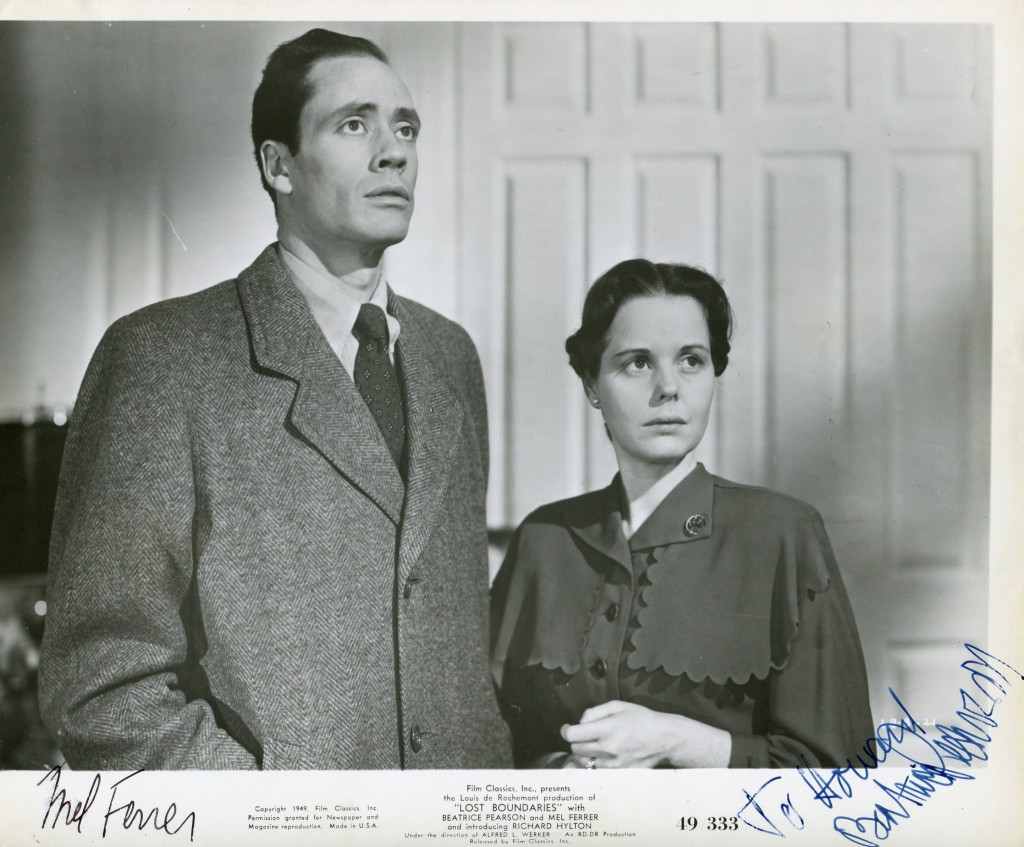
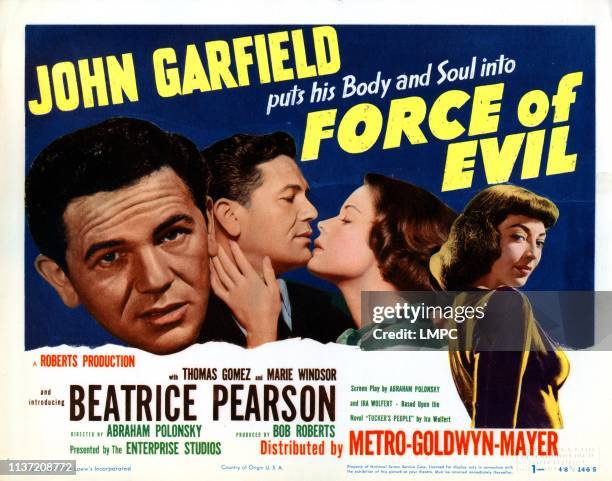
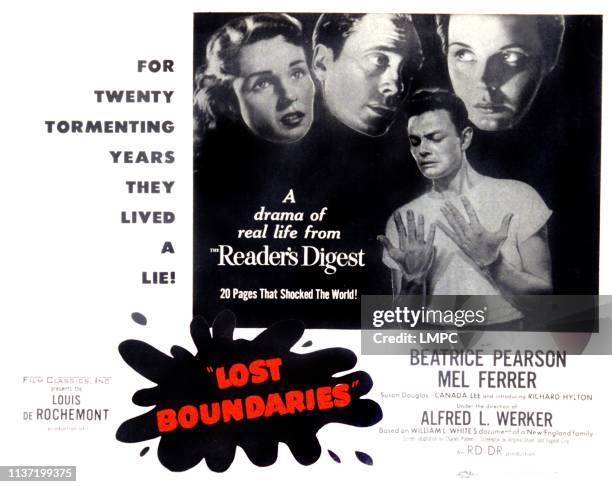
Beatrice Pearson was born in 1920 in Dennison, Texas. Her only films were leading roles in “Force of Evil” opposite John Garfield in 1948 and “Lost Boundaries” opposite Mel Ferrer the following year. She died in 1986 at the age of 65.
IMDB entry:
American leading actress who made a brief foray into films. A native of Denison, Texas, Pearson worked as an usher in a movie theatre and as a model before becoming an actor. Producer David O. Selznick introduced her to actor John Garfield, who was instrumental in her being cast opposite him in Force of Evil (1948). However, she did scarcely any more film work before retiring from the screen and devoting herself exclusively to the stage.
– IMDb Mini Biography By: Jim Beaver <jumblejim@prodigy.net>
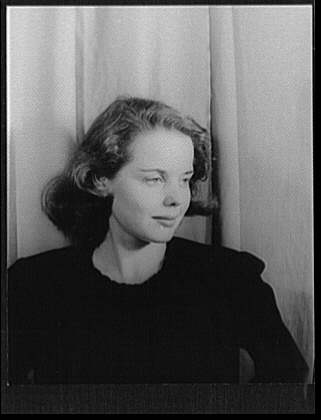
Beatrice Pearson (1919–1986) remains one of the most fascinatingly brief and undervalued figures of mid‑century American cinema—a performer of striking naturalism and moral intelligence who appeared in only two major films yet impressed critics with a delicacy of perception unusual in the Hollywood environment of the 1940s. Her career, though curtailed by industry instability and personal mischance, offers a rare early example of the “documentary realist” acting that later flourished in the 1950s American art‑film and method movements.
Early Life and Training
Born in Dennison, Texas, and raised largely in New York, Beatrice Pearson trained in theatre through the American Academy of Dramatic Arts and the Actors Laboratory, the West Coast’s counterpart of the Group Theatre that emphasized psychological truth over theatricality. She supported herself as a stage extra and model while refining a restrained performance style rooted in Stanislavskian observation rather than declamatory polish.
Director Elia Kazan was an early admirer; she modeled briefly for sculptor William Zorach (the resulting work sometimes cited in critical writings about her poise). Columbia Pictures executives discovered her through stage auditions in the early 1940s, granting a studio contract. Yet Pearson refused to accept typecasting as a starlet; her early reluctance to compromise on superficial roles contributed to a years‑long delay before a screen debut.
Stage Beginnings
In 1943 Pearson replaced Frances Dee as Emily in the Broadway production of Our Town—a part she approached not as sentimental nostalgia but with subtle intellectual curiosity. Reviewers noted her ability to give everyday gesture poetic weight without sentiment. The New York Times described her as “a thoughtful, transparent actress—more observer than ingénue.”
Her regional stage work through the mid‑1940s, particularly in Tennessee Williams one‑acts and Federal Theatre‑derived social dramas, honed the humane attentiveness that would characterize her film presence.
Screen Breakthrough: Force of Evil (1948)
Context
Abraham Polonsky’s Force of Evil, one of the most literate works of postwar film noir, offered Pearson her debut—an extraordinary first lead role opposite John Garfield. As Edna Tucker, secretary to a corrupt lawyer, she represented both conscience and possibility amidst moral decay.
Critical Reception
Contemporary praise was strong though muted by the film’s political controversy (Polonsky and Garfield would soon be blacklisted). The New Republic wrote that Pearson “plays purity without fuss,” while Time found her “a fascinating modern presence: not the saint but the look of integrity in motion.”
Modern critics recognize Force of Evil as a masterpiece of existential noir, and Pearson a prime reason for its depth. In scenes with Garfield, her performative stillness—slight glances, contained breath—acts as counterpoint to his guilt‑ridden energy. She conveys compassion not as sentiment but as comprehension.
Film historian Foster Hirsch called her “the film’s moral Intelligence Quotient—an actress who renders decency psychologically credible.”
Technique and Impression
While other noir heroines leaned on allure or fatalism, Pearson built tension through listening. Her diction is unforced, cadence conversational, foreshadowing the later naturalism of actors like Kim Hunter and Julie Harris. Camera close‑ups show an emotional transparency rare in the stylized lighting of the period: her eyes, not her gestures, register revelation.
Cinematographer George Barnes’s preference for natural light accentuated this authenticity; Pearson became the realistic nucleus of an otherwise stylized morality play. That contrast—humanity amid design—secured her small but enduring reputation.
Lost Boundaries (1949): Courage and Composure
Her second and final major film, Lost Boundaries, directed by Alfred Werker for Louis de Rochemont’s semi‑documentary unit, tackled racial passing at a time Hollywood avoided confronting race directly. Pearson played Lucille Willis, a light‑skinned Black woman who passes as white along with her husband (Mel Ferr er).
The film’s quasi‑realist style—shot on location in New England—placed unusual weight on naturalistic performance. Pearson anchored it. Her reading avoids melodrama; she expresses moral conflict internally, allowing micro‑expressions rather than declamation to convey the double life’s strain.
Contemporary responses acknowledged the restraint:
- The New York Times: “Beatrice Pearson’s serene integrity gives the story its heartbeat.”
- Variety: “She holds the screen by controlled emotion rather than playing for sympathy.”
Critics later pointed out the paradox that, in 1949’s segregated Hollywood, a white actress embodied a Black character who could pass—the film’s sincerity thus entangled with limitation. Yet scholars including Donald Bogle and J. Hoberman emphasize Pearson’s sensitivity: rather than caricature, she offered a study of repression and conscience, inadvertently exposing the industry’s own ambivalence about race.
Her work aligns with neorealist influences (Rossellini, De Sica) then seeping into American semi‑documentary forms: a subdued emotional realism anticipating 1950s independent acting styles.
Stage and Television Appearances: 1950s
The political climate after Force of Evil hindered many of that film’s participants, and Pearson’s own progress slowed partly due to typecasting as a “serious” rather than glamorous performer. She returned to the stage, appearing in regional rep and television anthology series such as Studio One and Philco Television Playhouse, where her naturalism suited live drama.
TV critics referred to her “quiet magnetism”—a phrase recurring through her notices. Yet by mid‑1950s she withdrew from performing, reportedly dissatisfied with formulaic domestic roles offered to mature actresses.
Acting Style and Technique
| Trait | Description & Critical Perspective |
|---|---|
| Naturalism Before the Trend | Pearson’s unforced vocal rhythm, economy of gesture, and psychological listening anticipated the style associated with Actors Studio graduates but without method excess. She fused stage polish with cinematic intimacy, a combination later seen in Teresa Wright and Joanne Woodward. |
| Moral Intensity | In both films she embodies conscience—without sermonizing. Critics identify her characters as the films’ ethical centers, defined less by innocence than by awareness. |
| Non‑Glamour Authenticity | In an era of overtly stylized femininity, her realism read as modern and disarming. Some producers considered her “too serious,” which paradoxically curtailed her career even as critics praised the quality. |
| Facial Expressivity | Close‑ups reveal inner reasoning rather than theatrical emotion. Polonsky called her “the least inert face I ever photographed—she thinks visibly.” |
Comparative and Thematic Context
- Kindred Performers: Teresa Wright, Kim Hunter, Mildred Dunnock—women celebrated for decency and quiet authority rather than glamour.
- Influence: Though her filmography is slim, her performances influenced later portrayals of moral intelligence in noir and realism. Martin Scorsese has cited Force of Evil (and by implication Pearson’s role) as formative on his moral‑drama sensibility.
- Gender Dimension: Pearson’s refusal to cater to pin‑up archetypes aligned her with mid‑century independent women in Hollywood (Barbara Bel Geddes, Betsy Blair). Her career’s brevity exemplifies how 1940s industry patterns limited serious actresses who neither fit ingénue nor vamp molds.
Critical Legacy
Although she retired early, subsequent scholarship in noir and postwar realism consistently singles out Pearson’s two features as landmarks of moral and performative modernity.
- The Film Society of Lincoln Center’s 1988 Polonsky retrospective described her as “an actress decades ahead of her time—instinctively serving camerawork’s intimacy rather than subduing it.”
- Contemporary film historians recognize her partnership with Polonsky as socially emblematic: a truthful female voice within a male‑driven tragedy of corruption.
- In the context of racial discourse, Lost Boundaries has drawn reevaluation for its respectful depiction of interracial identity—and critics note that Pearson’s empathy and restraint prevented the material from collapsing into liberal self‑congratulation.
Her contribution, though numerically small, bridges the energy of 1930s social realism with the emergent sincerity of postwar American acting. She has become what scholar Janine Basinger calls “one of Hollywood’s moral minor‑key figures—proof that subtlety, if fleeting, can resonate for generations.”
Summary Evaluation
| Strengths | Limitations |
|---|---|
| Authenticity and Understatement: Could render ordinary virtue dramatic. | Small body of work prevented evolution or wider recognition. |
| Moral and Emotional Intelligence: Humanized Hollywood’s moral allegories. | Misfit within studio glamour system. |
| Proto‑Realist Technique: Anticipated television realism and later indie naturalism. | Industrial politics (blacklist context, gender bias) curtailed opportunity. |
### In Essence
Beatrice Pearson remains one of classic Hollywood’s most eloquent might‑have‑beens: an actress whose two cinematic performances capture the shift from theatrical style to inward realism. In Force of Evil and Lost Boundaries, she subordinated vanity to empathy, anchoring moral tension with quiet, lived truth. Her legacy endures not in quantity of roles but in quality of presence—a reminder of how even a fleeting film career can demonstrate the full maturity of screen acting’s art.