

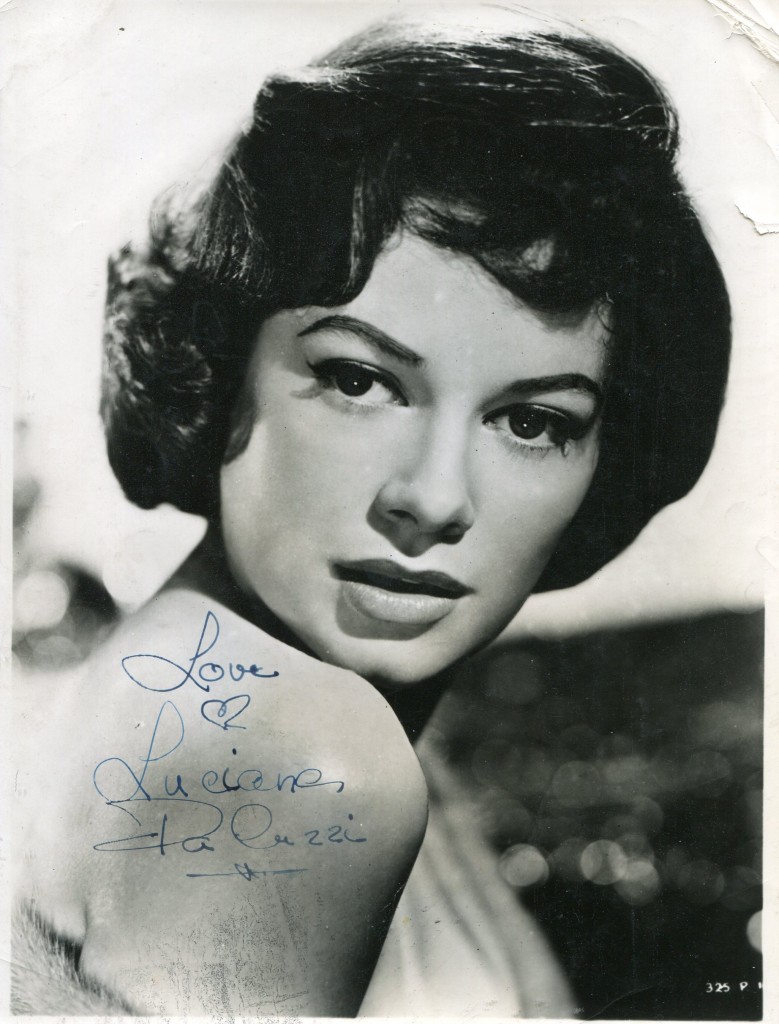


Luciana Paluzzi’s an Italian actress, best known for playing SPECTRE assassin Fiona Volpe in the fourth James Bond film, “Thunderball”..
For the film, she had auditioned for the part of the lead Bond girl, Dominetta “Domino” Petacchi, but producers cast Claudine Auger, changing the Domino character from an Italian to a Frenchwoman and renaming her Dominique Derval.


Luciana Paluzzi (born 1937) is far more than the “Bond Girl” label that often defines her. While she achieved global immortality as the ultimate femme fatale in Thunderball, a critical analysis of her career reveals a tireless and versatile international performer. Paluzzi was a key figure in the “transatlantic” era of cinema, moving fluidly between the sophisticated art-house sensibilities of Italy and the high-gloss commercialism of Hollywood.
1. Career Arc: From Rome to the Bahamas
The Continental Start (1950s): Paluzzi began her career in her native Italy during the height of the “Hollywood on the Tiber” era. Her early roles were often uncredited or minor parts in massive productions like Three Coins in the Fountain (1954), where she learned the mechanics of big-studio filmmaking.
The Spy and Action Queen (1960s): This was her definitive decade. She became a staple of the “Eurospy” genre and achieved peak stardom as Fiona Volpe in the Bond franchise. She was one of the few European actresses of the time to successfully transition into American television, starring in the series Five Fingers.
The Genre Specialist (1970s): As the industry shifted, Paluzzi embraced the “Giallo” (Italian thriller) and “Poliziotteschi” (crime) movements. She brought a sense of “prestige” to these gritty, often low-budget films, playing mature, complex women who were frequently more intelligent than their male counterparts.
The Graceful Exit: Paluzzi retired from acting in the late 1970s following her marriage to American media mogul Michael Solomon, leaving behind a body of work that spans over 80 credits across multiple languages.
2. Critical Analysis of Key Performances
Thunderball (1965) – The “Fatal” Prototype
As Fiona Volpe, the SPECTRE assassin.
Analysis: Paluzzi’s performance is widely considered the gold standard for the “Evil Bond Girl.” Unlike the “damsels” that populated much of the early 007 era, Paluzzi’s Fiona was a predator. She utilized a high-status physicality and a mocking, self-assured vocal delivery that made her a genuine threat to Sean Connery’s Bond.
Critique: Critics often point out that Paluzzi outshone the film’s “primary” Bond girl (Claudine Auger). Her performance was critical because it introduced agency and competence to the female villain archetype. She didn’t just lure men to their deaths; she actively enjoyed the hunt. The scene where she berates Bond for his “vanity” in thinking he could turn her to the side of good remains one of the franchise’s sharpest moments of dialogue.
The Klansman (1974) – The Gritty Realist
As Trixie, in a film that dealt with the brutal racial tensions of the American South.
Analysis: This was a significant departure from her glamorous roots. Paluzzi had to shed her “Euro-chic” persona to inhabit a more desperate, grounded reality.
Critique: While the film itself was critically polarized, Paluzzi was praised for her lack of vanity. She showed a capacity for “ugly” emotion—fear, exhaustion, and cynicism—that proved she was a capable character actress who had been largely underutilized by the “glamour” machine of the 1960s.
99 Women (1969) – The Exploitation Professional
As Nathalie Mendoza in Jess Franco’s “women in prison” film.
Analysis: Despite the “exploitation” nature of the genre, Paluzzi approached the role with Shakespearean gravity. She played the character with a cold, architectural distance.
Critique: Paluzzi was an expert at elevating the material. Critics noted that her presence alone gave the film a level of technical legitimacy. She used her “stillness” to command the screen, proving that a seasoned professional could maintain dignity even within the most sensationalist scripts.
3. Style and Legacy: The “Red-Haired” Intelligence
Luciana Paluzzi’s style was defined by a calculating elegance. She was rarely the “victim” on screen; she was the observer.
| Attribute | Critical Impact |
| Vocal Authority | She possessed a husky, deliberate way of speaking that suggested she was always three steps ahead of everyone else in the scene. |
| Physical Poise | Her background in European cinema gave her a “statuesque” quality; she moved with the economy of a dancer, making her action scenes feel more credible. |
| The “Modern” Sensibility | She was one of the first European actresses to project a “liberated” energy—she played women who were unapologetic about their desires and their ambitions. |
The “Bond” Shadow
Critically, Paluzzi is often discussed in the context of “what could have been.” She famously auditioned for the lead role of Domino in Thunderball, but when she lost it to Claudine Auger, the producers created the role of Fiona Volpe specifically for her. In many ways, the “secondary” role allowed her to be more memorable. She became the symbol of a new kind of female character: the one who refuses to be “tamed” by the hero.
Critical Note: Luciana Paluzzi was the “Anti-Ingenue.” In an era that rewarded passivity in women, she chose roles that required sharpness, wit, and danger. Her legacy is that of an international icon who proved that beauty was a weapon, and intelligence was its edge