

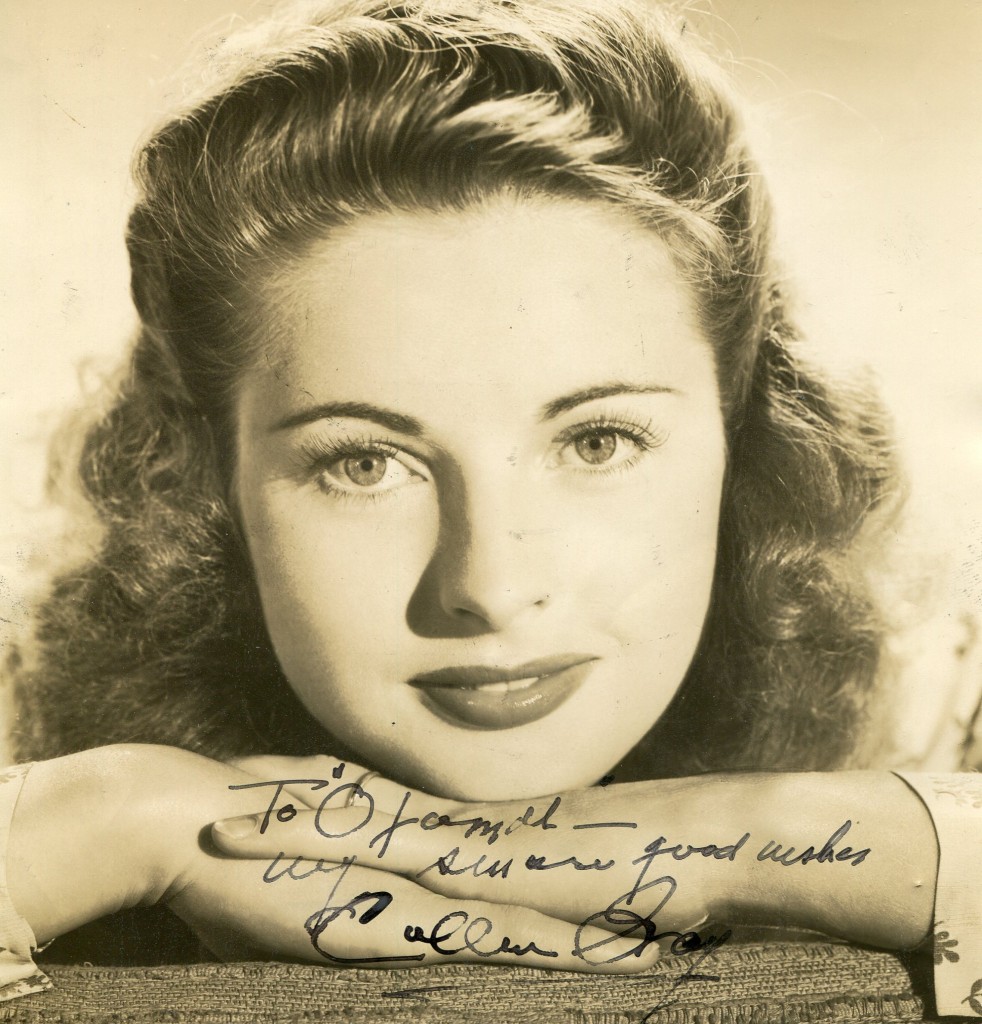
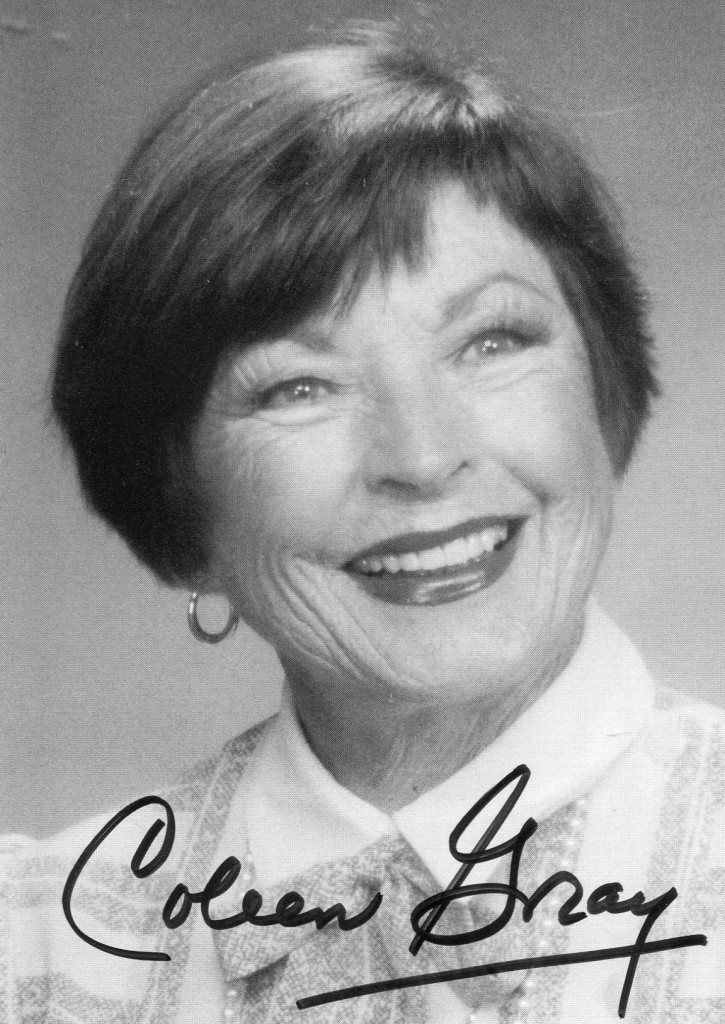
Coleen Gray

Coleen Gray
Coleen Gray
Coleen Gray
Coleen Gray

Coleen Gray was born in Nebraska in 1922.   Se made some terrific movies in the 1940’s including “Nightmare Alley”, “Red River”, “Kiss of Death”and “The Killing.   She died in 2015.

Ronald Bergan’s “Guardian” obituary:

The 2001 book Dark City Dames: The Wicked Women of Film Noir contained interviews with six female stars of the genre who were at their peak in the 1940s and 50s. One surprising inclusion was Coleen Gray, who has died aged 92. Surprising because she was seldom cast as a femme fatale in the classic film noirs in which she appeared.

In fact, Gray, with her pretty features, slightly pointed nose and wide eyes, was often the only ethical or innocent element in the dark, doom-laden crime dramas. In Kiss of Death (1947), she is the understanding girlfriend of an ex-con (Victor Mature), helping him to make a new life. In Nightmare Alley (1947), she is the steadfast wife and partner of Stan (Tyrone Power) in a carnival mind-reading act, whose big scene comes when she warns him not to “go against God”.

As the head nurse in the hospital in The Sleeping City (1950), she gains sympathy despite her involvement in illegal drugs and murder, and in Kansas City Confidential (1952), she is a corrupt cop’s law-student daughter, who brings romance into the life of a man (John Payne) unjustly accused of a robbery. Most famously, however, in Stanley Kubrick’s The Killing (1956), she’s the faithful girlfriend of a criminal (Sterling Hayden), who waited five years for him to be released from prison, and who gets drawn reluctantly into a heist.

Gray was born Doris Jensen in Staplehurst, Nebraska, of strict Lutheran Danish parents, Arthur and Anna, and moved with her family to a farm in Minnesota as a child. Later, she studied drama at Hamline University in Minnesota, graduating with a bachelor of arts degree, before moving to California. While appearing at a theatre in Los Angeles, she was discovered by a talent scout for 20th Century-Fox, who signed her to a seven-year deal at $150 a week in 1944. She then changed her name to Coleen Gray, sometimes billed as Colleen.

Gray’s first screen role, a short but significant one, was in Red River, shot in 1946, but only released by United Artists in 1948 after she had already become known for Kiss of Death and Nightmare Alley at Fox. In the lyrical Howard Hawks western, Gray imbues her one scene, in which John Wayne bids her farewell before heading west, with great force and tenderness. “I want to go with you,” she says. “I’m strong. I can stand anything you can.” “It’s too much for a woman,” he replies. “Too much for a woman? Put your arms around me, Tom. Hold me. Feel me in your arms. Do I feel weak, Tom? I don’t, do I?” Gray is memorably last seen isolated in long shot as the wagon train pulls out.

Gray was almost as effective in leading roles in several lesser westerns, mostly as a good but spunky girl keeping the hero on the right path, among them Mature in Fury at Furnace Creek (1948), Stephen McNally in Apache Drums (1951) and Hayden in Arrow in the Dust (1954). An exception was Tennessee’s Partner (1955) in which she’s a gold digger who tries to trap a cowboy (Ronald Reagan) into marriage for his money.

Among her rare comedies was Riding High (1950), Frank Capra’s remake of his own Broadway Bill (1934) in which she co-starred with Bing Crosby. Although neither matched the stars of the original (Myrna Loy and Warner Baxter), Crosby as a racehorse owner and Gray as the vivacious sister of his snobbish fiancee made a likeable team, and got to share a couple of lively musical numbers.

Parallel to her film career, Gray was a regular on television, particularly as a guest star on western series such as Maverick, Have Gun – Will Travel, Rawhide, The Virginian and Bonanza. Her work on television became more and more dominant through the 60s and 70s after the movies tailed off.

But before her virtual retirement from features, Gray took the title role in The Leech Woman (1960), a more nuanced proto-feminist film than the cheesy title suggests. Gray, as a neglected aging wife of a scientist, goes to darkest Africa where she discovers an elixir of youth, which entails killing men for their hormones. In the process, she gets her revenge on her despicable husband, who loved her only as long as she was young and beautiful. She continues to live off the lives of men in order to retain her beauty, before shrivelling and turning into dust. In transforming herself from a despairing frumpish alcoholic to a predatory young woman, Gray is superb.

Gray’s third husband, the biblical scholar Joseph “Fritz” Zeiser, died in 2012. She is survived by a daughter, Susan, from her first marriage, to the producer/directorRod Amateau, which ended in divorce; and a son, Bruce, from her second, to William Clymer Bidlack, an aviation executive, who died in 1978.

• Coleen Gray (Doris Jensen), actor, born 23 October 1922; died 3 August 2015

The above “Guardian” obituary can also be accessed online here

Coleen Gray (1922–2015) was a cornerstone of the post-war studio system, a “dark-haired Nebraskan” who became one of the most reliable and poignant presences in 1940s and 50s cinema. While she never quite achieved the “superstar” status of some contemporaries, a critical analysis of her work reveals an actress who specialized in being the “ethical anchor” of morally ambiguous worlds—the woman who could ground an epic Western or a cynical noir with a single, heartfelt gaze.


I. Career Overview: From Staplehurst to Stardom

1. The Noir Trinity (1947–1948)

After being discovered at a theater in Los Angeles and signed to 20th Century Fox, Gray had one of the most explosive starts in Hollywood history, appearing in three bona fide classics in just two years.

  • Kiss of Death (1947): Playing Nettie, the “girl next door” who offers Victor Mature’s ex-con a second chance, she provided the necessary warmth to counter Richard Widmark’s terrifying debut as Tommy Udo.


  • Nightmare Alley (1947): As Molly, the carnival girl who becomes the “shill” for Tyrone Power’s con man, she delivered a performance of immense moral weight. She was the one character who refused to “go against God,” acting as the film’s tragic conscience.


  • Red River (1948): Though she appears only in the opening sequence, her role as Fen, the woman John Wayne leaves behind, is the psychological catalyst for the entire epic. Her death sets the plot in motion and haunts Wayne’s character for the rest of the film.


2. The Genre Workhorse (1950s)

As her contract at Fox ended, Gray became a prolific “B-movie queen,” alternating between high-quality “programmers” and occasional auteur-driven classics.

  • The Kubrick Connection: In The Killing (1956), Stanley Kubrick cast her as Fay, the loyal girlfriend of Sterling Hayden. Her performance in the final scene at the airport—watching her lover’s dreams (and money) literalize into dust—is one of the most heartbreaking images in heist cinema.


  • The Sci-Fi/Horror Pivot: Towards the end of her film career, she embraced genre roles, most notably in the cult classic The Leech Woman (1960).


3. Television and Faith (1960s–1986)

Like many of her peers, Gray transitioned into television, guest-starring in nearly every major Western series (MaverickBonanzaRawhide). In her later years, she retired from acting to focus on faith-based charity work, notably with the Prison Fellowship ministry.


II. Detailed Critical Analysis

1. The “Anti-Femme Fatale”

In the 1940s, “Noir” was dominated by the femme fatale—the dangerous woman who leads the hero to ruin. Gray carved out a unique space as the “Anti-Femme Fatale.” * The Angel of Light: Critics often describe her as the “only ethical element” in doom-laden dramas. Her performances weren’t just “good girl” clichés; they were rooted in a specific, naturalistic vulnerability. She made goodness seem like a difficult, active choice rather than a passive trait.


  • The Grounding Force: In Nightmare Alley, she serves as the reality check. Her chemistry with Tyrone Power was essential because it gave the audience something to lose; if Molly didn’t love Stan, his descent into “Geek” status wouldn’t be nearly as tragic.

2. Physicality and “Lyrical” Tenderness

Despite her petite frame, Gray had a remarkable screen command.

  • Hawksian Strength: In Red River, Howard Hawks gave her one of the most famous lines of the era: “I’m strong. I can stand anything you can.” Critics note that Gray delivered this without bravado, but with a quiet, steely certainty that made John Wayne’s decision to leave her feel like a genuine, monumental error of judgment.


  • Chameleon-like Submergence: She possessed what critics called a “chameleon-like ability” to vanish into a role. This may have worked against her becoming a “brand-name” star like Marilyn Monroe or Lauren Bacall, but it allowed her to survive the transition from the “glamour girl” of the 40s to the gritty realism of 50s B-noir (Kansas City Confidential).


3. The Proto-Feminist Subtext of The Leech Woman

While often dismissed as “B-movie schlock” at the time, modern analysis has found great depth in Gray’s performance in The Leech Woman.

  • The Aging Woman’s Rage: She plays a woman who discovers an elixir of youth that requires killing men for their hormones. Gray’s performance as she transforms from a “despairing, alcoholic wife” into a “predatory young beauty” is described as superb.


  • Critical Re-evaluation: Critics now see the film as a stinging satire of Hollywood’s obsession with youth, with Gray delivering a performance that is far more nuanced and vengeful than the material seemingly deserved.


Iconic Performance Comparison

 
Character Work Archetype Key Critical Element
Nettie Kiss of Death The Compassionate Neighbor Established her as the “voice of hope” in noir.
Molly Nightmare Alley The Moral Compass Proved she could stand her ground against a top-tier leading man.
Fen Red River The Lost Love Defined the concept of “significant screen time vs. impact.”
Fay The Killing The Faithful “Moll” Captured the delicate, tragic fragility of the criminal’s wife.
June Talbot The Leech Woman The Vengeful Matriarch A cult performance that explored the “horror” of aging in society.


Coleen Gray was an actress of “Sunshine and Shadows.” She brought a sincere Nebraska warmth to some of the darkest stories ever told on celluloid, ensuring that even in the bleakest noir, there was always a human heart worth rooting for

Leave a Reply

Your email address will not be published. Required fields are marked *