

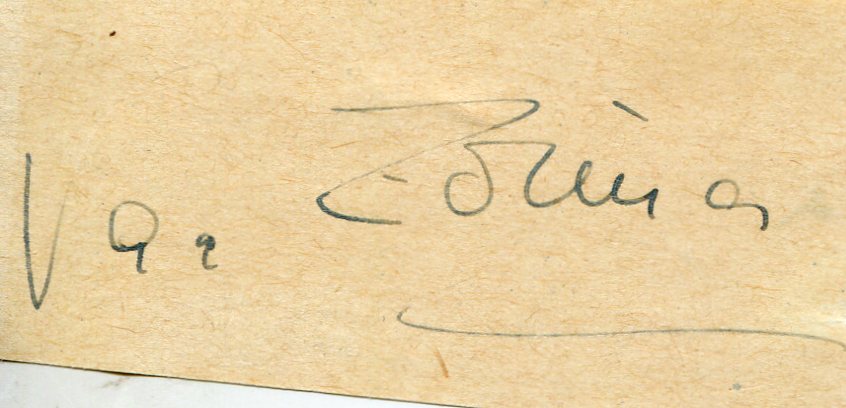
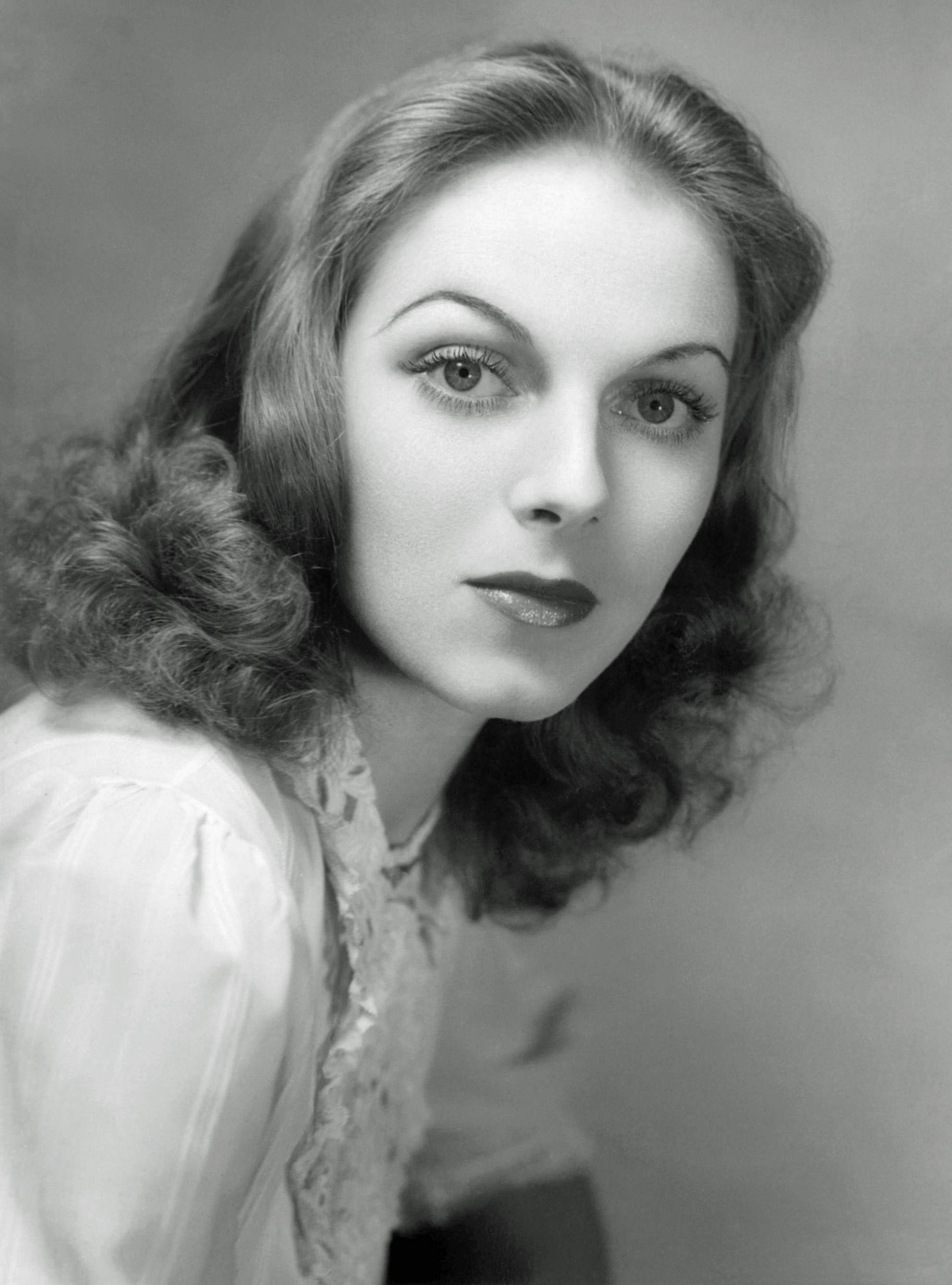

The “Guardian” obituary from 2003:
Vera Zorina, who has died aged 86, began her career as a dancer, but branched out into many forms of musical theatre.
Born Eva Brigitta Hartwig, in Berlin, she made her debut at the age of 14 as the First Fairy in Max Reinhardt’s production of A Midsummer Night’s Dream in 1930, and worked for him again the following year in Offenbach’s Tales Of Hoffmann. She then moved to London, where she studied with Marie Rambert and Nicholas Legat.
In 1933, Anton Dolin spotted her and cast her opposite him in Ballerina, a play with ballet interludes. Her name was changed to Vera Zorina (in private she remained Brigitta) when she was invited to join Colonel de Basil’s Ballets Russes de Monte Carlo in 1934.
Léonide Massine cast her in leading roles in several of his ballets, including La Boutique Fantasque, Le Beau Danube and Les Presages. She also danced in Bronislava Nijinska’s Les Noces, which de Basil briefly revived. Although Massine was married at the time to another dancer, Evgenia Delarova, Zorina became his lover, a fact of which she made no secret in her autobiography Zorina (1986).
In 1936, she left de Basil to star in the London production of the Rodgers and Hart musical, On Your Toes. A hit in New York, where it starred George Balanchine’s first wife, Tamara Geva, and Ray Bolger, the show was an artistic if not a commercial success in London. She also appeared in London in Balanchine’s Slaughter On Tenth Avenue, in which the hoofer hero (Jack Whiting) danced a pas de deux with the dead striptease dancer (Zorina).
Balanchine did not go to London to supervise his choreography, but Zorina was soon to work with him when Samuel Goldwyn brought her to Hollywood to appear in his film The Goldwyn Follies, for which Balanchine had been engaged to stage the ballets. The most notable was the Water Nymph ballet, in which Zorina rose from a pool in a gold lamé tunic.
This began a long professional and personal association with Balanchine. Soon after finishing the movie in 1938, Zorina was featured on Broadway in another Rodgers and Hart musical, I Married An Angel, with ballets by the choreographer. By the time The Goldwyn Follies was released, she and Balanchine were married. The following year she appeared in the film version of On Your Toes. On Broadway in 1940, she starred in the Irving Berlin musical Lousiana Purchase, again with ballets by Balanchine. (The film version of 1941 was essentially a record of the stage show and included his Mardi Gras ballet, without screen credit.)
Zorina also had aspirations as a dramatic actress but, cast opposite Gary Cooper in the film of Ernest Hemingway’s For Whom The Bell Tolls, she was replaced after a few days’ filming by Ingrid Bergman. This put paid to Zorina’s ambitions and effectively to her film career.
She made a brief return to ballet in 1943, as a guest artist with (American) Ballet Theatre, where Balanchine cast her as Terpsichore in a revival of his Apollo. But it seemed that the ballet public was not prepared to accept her as a serious ballerina, and she returned to the Broadway stage in 1944 in another Balanchine musical, Dream With Music. When she played Ariel in The Tempest the following year, he arranged her movements, though without credit.
B y this time their association was only professional, and in 1946 they were divorced. Zorina then married Goddard Lieberson, later president of Columbia (CBS) Records. But in 1954 there was yet another production of On Your Toes on Broadway, this time under Balanchine’s personal supervision, and Zorina starred again as the temperamental Russian ballerina, 14 years after playing the part in the West End.
Always a glamorous, cultivated woman, Zorina was entirely at home in the New York intellectual and artistic circles in which both her husbands moved. In later years, she enjoyed considerable success as a narrator in such works as Arthur Honegger’s Jeanne d’Arc Au Bûcher and Claude Debussy’s Le Martyre De Saint-Sebastien. She worked again with Balanchine when she recited André Gide’s text for Perséphone in the New York City Ballet’s 1982 Stravinsky Festival.
Zorina also directed operas for the Santa Fe Opera, New York City Opera and the Norwegian Opera.
She is survived by her third husband, Paul Wolfe, a harpsichordist, and her son Peter Lieberson, the com poser. Another son by her marriage to Goddard Lieberson predeceased her.
· Vera Zorina (Eva Brigitta Hartwig), dancer, born January 2 1917; died April 9 2003
Gary Brumburgh’s entry:
Practically born with ballet slippers on, the dark, lithe and exotic Vera Zorina had memorable careers with the Ballet Russe and, to a lesser degree, Hollywood. Born in Berlin, her father Fritz was German and mother Billie Hartwig Norwegian. She took to ballet at age 2 (she used to take them to bed with her) and by age 4 was performing. She received her education at the Lyceum for Girls in Berlin but was trained in dance by Olga Preobrajenska and Nicholas Legat, the latter teaching Anna Pavlova and Nijinsky at one time.
The dancing prodigy was presented to Max Reinhardt at age 12 and he in turn cast her in his “A Midsummer Night’s Dream” (1929) and “Tales of Hoffman” (1931). A performance at London’s Gaiety Theatre led to her entrance into the company of the Ballet Russe de Monte Carlo in 1933. She was encouraged to change her stage name to something Russian and exotic in style and she chose “Vera Zorina” for its authenticity and simplicity from a long list of names. She also learned Russian in the process to feel closer to her dancing compatriots. She stayed with the renowned ballet company for three years appearing everywhere from Covent Garden in London to the Metropolitan Opersa House in New York.
Again, timing proved to be on Vera’s side when she won a lead role in the London company of “On Your Toes” in 1937 and was spotted by movie mogul Samuel Goldwyn, who signed her to a movie contract. The build-up was considerable and she made her official debut with the musical The Goldwyn Follies (1938). That same year she increased her visibility ten-fold by marrying noted choreographer/director George Balanchine. She followed her film debut successfully recreating her role in the movie version of On Your Toes (1939) and then played the role of a faux countess in the comedy crime caper I Was an Adventuress (1940). She impressed on Broadway with “I Married an Angel” and even more so in the 1940 musical “Louisiana Purchase” before returning to Hollywood once again to perform in the movie version of Louisiana Purchase (1941) opposite Bob Hope. She was cast as Maria in what could have been the beginning of a dramatic career in the Oscar-winning For Whom the Bell Tolls (1943), but was abruptly replaced after only two weeks of shooting by Ingrid Bergman, an action that proved detrimental to her movie career. When the sudden surge of film offers began to wane after the releases of Follow the Boys (1944) with George Raft and Lover Come Back (1946) co-starring Lucille Balland George Brent, she bade Hollywood a prompt goodbye.
Following her divorce from Ballanchine in 1946, she married Goddard Lieberson, president of Columiba Records and a social whirlwind ensued. The prominent couple went on to have two sons, Peter and Jonathan. In later years her lilting accent was used for narrations (in several different languages, including English, German and French) on several records and in tandem with numerous classical symphony orchestras and opera houses. She also directed a production of “Herod” for Norwegian TV. Vera was active with the Lincoln Center as an adviser and director and for several seasons directed operas at the Santa Fe Opera Company in New Mexico. She died in Santa Fe of a cerebral hemorrhage in 2003, predeceased by her second husband and son Jonathan.
– IMDb Mini Biography By: Gary Brumburgh / gr-home@pacbell.net
Vera Zorina (1917 – 2003) was a singular performer who bridged the classical rigor of European ballet and the expressive theatricality of Hollywood’s “Golden Age.” Though her screen career was relatively short, she brought a precision and poetic seriousness to British and American musical cinema in the late 1930s and 1940s, giving visual form to an ideal of “modern classicism”: intellect made visible through motion. She occupies a key transitional place between the Russian‑émigré ballet tradition and the athletic, camera‑aware stylization of mid‑century dance on film.
Early Life and Formation
Born Eva Brigitta Hartwig in Berlin to a Norwegian‑German musical family, she trained from childhood in ballet, studying with Mary Wigman and the Ballet Russe de Monte Carlo—the company that preserved Diaghilev’s lineage after his death. Renamed “Vera Zorina” by impresario René Blum, she debuted professionally at 17 and quickly advanced under the influence of famous mentors, among them George Balanchine, whose fusion of neoclassical purity and theatrical flair shaped Zorina’s artistic identity.
Her European stage seasons during the mid‑1930s made her known for versatility: fluency in German expressionist tradition combined with Balanchine’s musical clarity. That dual vocabulary—emotional intensity framed by measured geometry—became her signature style.
Broadway: The Balanchine Collaborations (1936 – 1938)
Zorina reached New York as part of the original American import wave of European ballet dancers.
Her first breakthrough came with Balanchine’s choreography for Rodgers & Hart’s “On Your Toes” (1936), where she appeared in the “Slaughter on Tenth Avenue” ballet sequence. Although star billing centered on Ray Bolger and Tamara Geva, observers singled out Zorina for precision and restrained sensuality. The New York Times described her as “a dancer who shapes intelligence as motion, not adornment.”
This period defined her dramatic temperament: a performer who could inhabit fantasy yet suggest modern psychology. Her rapport with Balanchine became personal as well as artistic—they married in 1938—and he crafted roles tailored to her stately, sculptural presence.
Hollywood Years (1938 – 1946)
Paramount Studios, seeking to blend European sophistication with American glamour, signed Zorina in 1938. She entered film at a moment when the studio musical was shifting from vaudevillian verve to choreographed spectacle. Her genius lay in adapting stage choreography to cinematic phrase—playing dance as drama, not interlude.
The Goldwyn Follies (1938)
Her screen debut, shot in early Technicolor under producer Samuel Goldwyn, displayed both the promise and limitations of Hollywood’s engagement with ballet. Balanchine’s choreography cast her as a “living embodiment” of classical art awakening Hollywood modernity. Critics admired her ethereal restraint; Variety noted that she “moves like an idea rather than an ingénue.” Yet her cool perfection perplexed audiences used to the warmth of Eleanor Powell or Ginger Rogers.
On Your Toes (1939, film version) and I Was an Adventuress (1940)
Fox borrowed her to reproduce Slaughter on Tenth Avenue, expanding the number with camera motion that captured her architectural line. The performance remains one of the clearest early examples of ballet presented cinematically rather than theatrically—every arabesque designed for lens perspective. Her acting in I Was an Adventuress earned praise for understated humor; she played a jewel thief feigning respectability, finding irony in elegance.
The Ballet of Vienna (1941) and Louisiana Purchase (1941)
Zorina’s image now blended sophistication and patriotism, aligning with wartime ideas of European culture defended by American energy. In Louisiana Purchase, opposite Bob Hope, her dead‑pan wit surprised reviewers who assumed her purely “serious.” Time magazine remarked that she “suggests Garbo laughing—amused, slightly alien, always composed.”
Star Spangled Rhythm (1942)
Her duet with Hope and Bing Crosby confirmed her versatility—she used her aura of refinement as foil for their comedy. Yet Hollywood struggled to cast her: too elegant for the chorus‑girl archetype, too subtle for broad farce.
Follow the Boys (1944)* and Lover Come Back (1946)*
By mid‑decade her film career waned. The American industry, shifting toward populist musicals and postwar realism, had little place for European formalists. Balanchine returned to concert dance; Zorina gradually retreated from film.
Post‑Hollywood Stage and Concert Work (1946 – 1960)
Zorina rejoined the concert stage, performing in Leonide Massine’s ballets and touring as guest artist across Europe. She returned to Broadway in classical revivals (The Tempest, Helen Goes to Troy) where critics praised her diction and tragic poise.
By the 1950s she expanded into directing dance for opera and theatre—most notably staging sequences for the Royal Danish Ballet and Deutsche Oper Berlin. Her sensitivity to text and movement translated smoothly to production; Dance Magazine called her “the natural diplomat between narrative theatre and pure dance.”
Later in life she became an artistic administrator for the Norwegian National Opera and guest lecturer at universities in Europe and the U.S., advocating humane discipline and choreographic literacy.
Acting and Dancing Style: Critical Analysis
| Attribute | Description and Critical Implications |
|---|---|
| Physical Architecture | Zorina’s movement emphasized line over velocity; her extensions were geometrically pure, expressing containment rather than bravura. This quality reads on film as serenity, an uncommon stillness that differentiates her from Hollywood tap‑based dynamism. |
| Expressive Intelligence | Critics repeatedly described her dancing as “thinking made visible.” She embodied Balanchine’s dictum that choreography is “music made flesh.” Her rare ability to convey motivation through physical rhythm anticipated later actor‑dancers such as Leslie Caron. |
| Emotional Reserve | Whereas American musicals encouraged extroversion, Zorina radiated interior life. Her detachment—sometimes mistaken for froideur—aligned with European modernist aesthetics valuing control over demonstration. |
| Screen Personality | Cinematically she never fused with the public imagination because her acting remained idealised: less confessional than symbolic. Yet modern scholars interpret that abstraction as proto‑modern dance performance: the self as image, not anecdote. |
| Vocal Delivery and Language | Fluent but accented English gave her speech a sculpted tone that lent dignity but limited spontaneity. This European inflection paradoxically preserved her distinctiveness in ensemble scenes, acting almost as an auditory signature. |
Thematic and Cultural Significance
-
Modernist Mediation — Zorina illustrated how European high art could converse with American popular entertainment. Her collaborations with Balanchine and Goldwyn formed the earliest fusion of ballet grammar with cinematic montage.
-
Women and Control — Unlike many Hollywood heroines, she exuded self‑command rather than vulnerability. Her characters—whether courtesan, ballerina, or comedienne—carry autonomy rooted in discipline.
-
Transition from Performer to Curator — Her later administrative career mirrors the twentieth‑century shift where women artists moved from muse to maker, asserting interpretive authorship in institutional culture.
-
Trans‑national Aesthetic — Zorina’s trajectory—from Berlin Expressionism to Broadway to Paramount—is emblematic of displaced European modernists whose classical ideals were re‑imagined within American populism.
Selected Works and Critical Highlights
| Year | Medium | Title | Role / Contribution | Critical Response |
|---|---|---|---|---|
| 1936 | Stage | On Your Toes (Balanchine choreography) | Dancer, “Slaughter on Tenth Avenue” | Defined neoclassical dance on Broadway |
| 1938 | Film | The Goldwyn Follies | Ballet sequence | Praised for purity of movement, criticized for aloofness |
| 1940 | Film | I Was an Adventuress | Co‑lead, sophisticated thief | Commended for ironic humor and continental charm |
| 1941 | Film | Louisiana Purchase | Marina Von Minck | Displayed comic timing opposite Bob Hope |
| 1944 | Film | Follow the Boys | Self (ensemble) | Symbol of wartime cultural solidarity |
| 1950s | Stage / Opera | Direction and choreography for Carmen, The Tempest | Stage director | Critics noted choreographic intelligence shaping narrative tone |
Legacy
While her filmography is small, Vera Zorina’s influence extends through Balanchine’s institutionalization of ballet in America, to which she contributed both artistry and pedagogy. Film historians identify her as one of the first to embody ballet specifically for cinema, preceding Gene Kelly’s later fusion of concert dance and popular storytelling.
Her persona—intellectual, poised, cosmopolitan—anticipated later European‑born stars such as Leslie Caron and Audrey Hepburn, who similarly balanced delicacy and self‑possession.
Contemporary dance scholars credit her with legitimizing choreographic precision on film: making movement serve narrative atmospherics rather than spectacle alone.
Summary: Critical Evaluation
| Strengths | Limitations |
|---|---|
| Exceptional technical control; capacity to translate dance language to camera grammar | Emotional reserve sometimes mistaken for coldness; limited range within Hollywood’s voice‑driven acting |
| Intelligence and structural understanding of music and choreography | Typecasting as “the cultured European”; studio inability to frame her seriousness |
| Versatility—comedienne, tragedienne, artistic director | Brief screen career prevented full realization of her dramatic potential |
Conclusion
Vera Zorina’s artistic life represents a crossroads of dance history and film aesthetics. She carried the discipline of classical ballet into the visual logic of Hollywood, demonstrating how movement could articulate emotion without sentimentality. Though her fame faded quickly among mainstream audiences, her contributions remain pivotal to the genealogy of the film musical and to the twentieth century’s expanding definition of the performing artist—as intellectual as well as entertainer. Zorina turned restraint into eloquence, proving that cinematic grace could be achieved not through ornament, but through clarity of mind in motion