

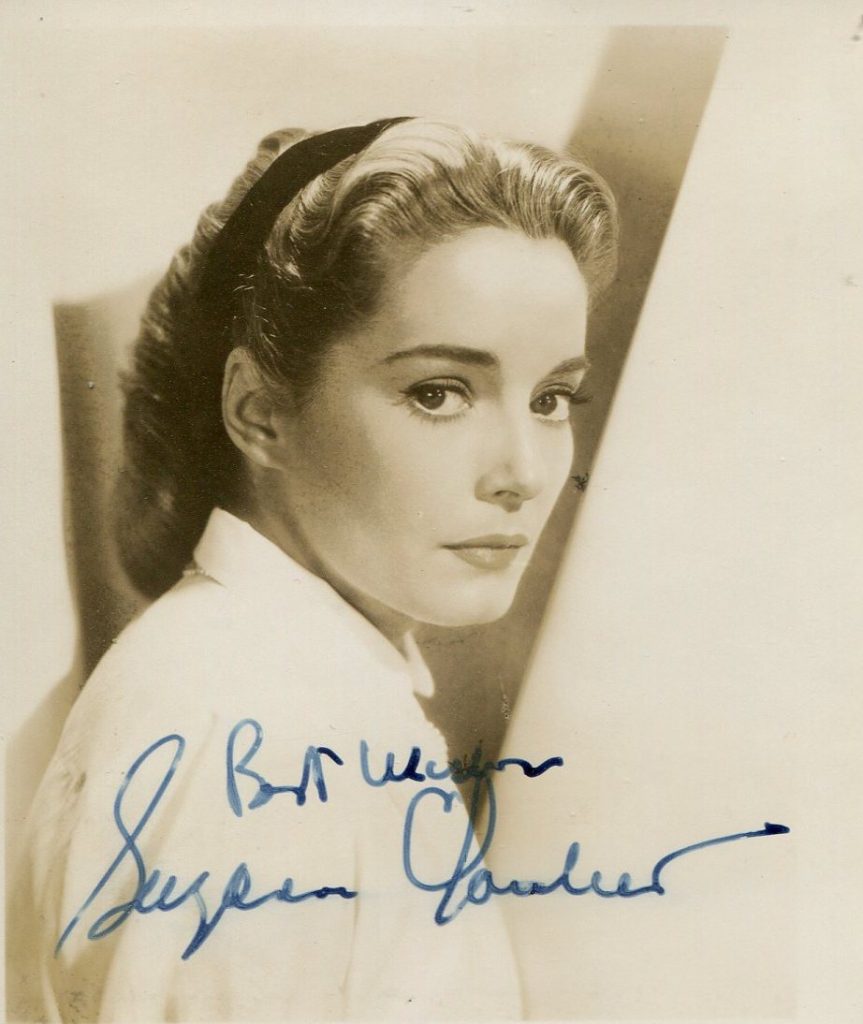
Ronald Bergan’s 2003 obituary from “The Guardian”:
In reality, Welles had spent months trying to seduce her, but she resisted. Because of that rejection, he could be brutal towards her. Once, at dinner, surrounded by the rest of the cast, he snapped, “You contribute nothing to the conversation unless you talk about yourself.”
Michael MacLiammoir, who played Iago, wrote of Cloutier: “She is indestructible. She will discuss herself tirelessly for hours in French or English, in a faintly gilded clipped drawl (like sunshine on snow) without pausing for breath – even when she is silent you know that, like a cat, an immense activity is in progress.”
Welles spent hours trying to get a good performance from her. In a scene in which Othello (Welles) strikes Desdemona across the face, the director wanted her not to flinch from the blow, yet every time his hand moved, she (understandably) looked terrified.
David Thomson considered “she had no equal in standing still and looking beautiful”, and suggests the reason Welles picked her was because “the lady is a stooge to his Othello, not nearly as married to the Moor as Iago”. Actually, Cloutier gives a finely honed, poignant performance, despite some of the crude sound and editing. Several of her lines were dubbed by Gudrun Ure, and instead of reshooting long and medium shots which he had done with Padovani, he simply included them in the finished film, hoping the audience would not notice.
Mischievously, Welles contemplated dubbing her whole role. “I can’t wait to see what Cloutier’s reaction will be when she attends the premiere and finds out it’s not really her, at least not her voice, and in many shots, not her body, on the screen.”
Yet Welles must have thought highly enough of her, because he cast her in his one-act play The Unthinking Lobster, staged in English in Paris in 1950, about a female saint who appears in a corrupt Hollywood. Later she helped him find financing for his aborted film projects, The Other Side Of The Wind and Don Quixote.
Born in Ottawa, Cloutier became a Powers Model in New York at the age of 18, after running away the day after her wedding to an eminent Canadian doctor. As the marriage was not consummated, it was annulled. She was soon offered a small role in Temptation (1946), a “woman’s picture” starring Merle Oberon, and then joined Charles Laughton’s stage company for one season in New York.
During a period in Paris, she was a member of Jean Dasté’s Comédie Française touring company and appeared in two prestigious films: Julien Duvivier’s Au royaume des cieux (The Sinners, 1947), opposite Serge Reggiani, and Marcel Carne’s Juliette ou la clef des songes (Juliette Or The Key Of Dreams, 1950) in which she had the title role of the mysterious girl whom Gérard Philipe, in a prison cell, meets in his dreams.
Immediately after making Othello, Cloutier was in London to play in Herbert Wilcox’s Derby Day (1950), a four-part picture with Cloutier as a film fan winning a star (Peter Graves!) in a raffle. At the same time, she met Peter Ustinov. Coincidentally, Ustinov had seen a photograph of the “strikingly beautiful girl” on a French magazine cover three days before his French agent introduced them backstage during a production of his play The Love Of Four Colonels. She told him she was on the run from Welles, who was searching for her to fulfil a contract for which she had not been paid. She also told him that her mother was a German Jew and that her father was descended from an Indian chief, neither of which turned out to be true.
“People were enchanted by her freshness,” explained Ustinov in his autobiography, “her extraordinary capacity for invention, and her acumen in pursuing her ends, and I must admit, I was among them.”
They appeared together in Ustinov’s play No Sign Of The Dove at the Piccadilly Theatre (1953), and were married a year later. Except for a role in Doctor In The House (1954), Cloutier was busy during the decade bringing up their three children, Pavla, Igor and Andrea, all of whom survive her.
In 1961, she resumed her acting career briefly with Ustinov in his play Romanoff And Juliet. Gradually the marriage broke down; Cloutier disliked England and the English, and Ustinov became disenchanted with her ever-increasing Québecois nationalism. They divorced in 1971.
Cloutier no longer worked as an actor, but she remained busy as an artistic adviser to various film festivals in addition to producing two musical documentary films. She returned to Canada in 1988, living in Montreal.
· Suzanne Cloutier, actor, born July 10 1927; died December 2 2003
The above “Guardian” obituary can also be accessed online here.
Suzanne Cloutier (1923–2003) was a French-Canadian actress whose career, while relatively brief in terms of filmography, is of immense historical and critical importance. She is primarily remembered as the definitive Desdemona of the 1950s, but a closer analysis reveals a woman of high intellectual caliber who functioned as a muse and collaborator to some of the most difficult geniuses of the 20th century, including Orson Wellesand Peter Ustinov.
I. Career Overview: From Ottawa to Elsinore
1. The Discovery (1940s)
Born in Ottawa to a family of high-ranking Canadian officials, Cloutier began her career as a model and stage actress in New York and Paris.
-
The French Debut: She was discovered by the legendary director Jean Isars, making her mark in French cinema with films like Au royaume des cieux (1949).
-
The “Gamine” Phase: Early critics compared her to a young Michèle Morgan—possessing a luminous, fragile beauty that seemed to belong to a bygone era of romanticism.
2. The Welles Partnership: Othello (1951)
The defining moment of her career came when Orson Welles cast her in his troubled, years-long production of Othello.
-
The Casting Hunt: Welles had famously gone through several Desdemonas (including Lea Padovani and Betsy Blair) before settling on Cloutier. He sought a face that possessed “unearthly innocence” but could withstand the visual shadows of his expressionist style.
-
The Result: The film won the Palme d’Or at Cannes in 1952, and Cloutier’s face became the iconic visual representation of Shakespearean tragedy for a generation.
3. The Ustinov Era and Retirement (1954–1960s)
Cloutier married the polymath Peter Ustinov in 1954. During their marriage, she appeared in several of his projects, most notably Romanoff and Juliet (1961).
-
The Shift to Production: Following her divorce from Ustinov in 1971, Cloutier largely retreated from the screen to work behind the scenes, particularly in the restoration and preservation of Orson Welles’ estate, becoming a vital gatekeeper of his legacy.
II. Detailed Critical Analysis
1. The “Stillness” of Desdemona
Critically, Cloutier’s performance in Othello is analyzed as a triumph of cinematic presence over theatrical dialogue.
-
The Visual Foil: Welles’ Othello is a film of “crags and shadows.” Cloutier, with her pale skin and wide, luminous eyes, served as the film’s essential light source.
-
Vocal Restraint: Critics have noted that Cloutier played Desdemona with a “hushed intensity.” Unlike stage actresses who played the role with high-drama indignation, Cloutier projected a quiet, almost holy acceptance of her fate. This made the “Willow Song” sequence and the final bedroom scene feel profoundly intimate and modern.
2. The “Intellectual Muse”
Cloutier was rarely cast as the “girl next door.” Directors utilized her for roles that required ethereal sophistication.
-
The “European” Sensibility: Even though she was Canadian, Cloutier was viewed by Hollywood and London critics as an “essentially European” actress. She possessed a formal grace and a mid-Atlantic accent that allowed her to fit seamlessly into period dramas and high-concept comedies.
-
The Collaboration with Ustinov: In Romanoff and Juliet, she played the “Juliet” figure with a satirical edge. Analysts suggest that her work with Ustinov was a “deconstruction” of her earlier tragic persona—showing she had a sharp, comedic intellect that was often underutilized by more “serious” directors.
3. The Survivor of the “Wellesian” Chaos
One of the most frequent critical discussions regarding Cloutier involves her durability.
-
The Chaotic Production: The filming of Othello was notoriously fragmented, with scenes shot years apart in various countries (Italy and Morocco).
-
Consistency of Character: Critics marvel at how Cloutier maintained the emotional thread of her character across such a disjointed production. Her ability to “snap” back into the tragic mindset of Desdemona after months of production delays is cited as a testament to her technical discipline and psychological focus.
Iconic Performance Comparison
| Character | Work | Year | Critical Legacy |
| Desdemona | Othello | 1951 | Created the “Golden Standard” for the role in cinema. |
| Maria | Au royaume des cieux | 1949 | Established her as a major “Romantic Naturalist” in France. |
| Juliet Mouldsworth | Romanoff and Juliet | 1961 | Showcased her gift for sophisticated, satirical comedy. |
| Ninetta | Casque d’Or (Stage) | 1950s | Proved her “Streetwise” range in French theatrical circles. |
Susanne Cloutier was the “Luminous Anchor” of 1950s cinema. While her filmography is not vast, her contribution to the visual language of Shakespearean film is indelible. She was an actress of profound grace who managed to remain a singular, haunting presence even when surrounded by the gargantuan egos of the era’s greatest directors.