

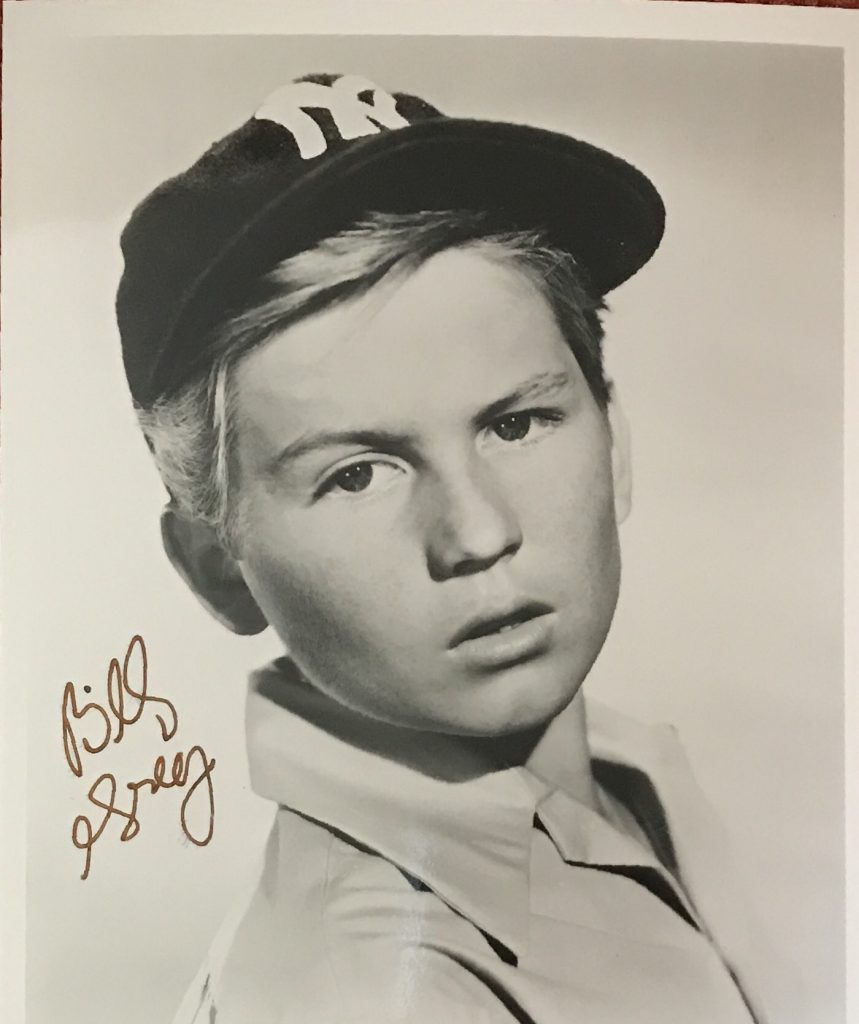
Billy Gray (Wikipedia)
Billy Gray was born in 1938 and is an American former actor known primarily for his role as James “Bud” Anderson, Jr., in 193 episodes of the situation comedy Father Knows Best, which aired between 1954 and 1960 on both NBC and CBS. A motorcycleaficionado, Gray maintains a large collection of the vehicles.
Gray was born in Los Angeles to actress Beatrice Gray (March 3, 1911 – November 25, 2009), and her husband, William H. Gray. His mother was mostly uncredited in the 1930s and 1940s, having appeared in Otto Preminger‘s Laura, with Gene Tierney and Dana Andrews. In 1949, Billy Gray and his mother appeared in separate scenes in the film Abbott and Costello Meet the Killer, Boris Karloff.
In 1951, at age 13, he appeared in the film Jim Thorpe — All-American, with Burt Lancaster in the lead role. Gray portrayed the Indian athlete Jim Thorpe as a child. Later that year, he was chosen to appear in the science fiction picture The Day the Earth Stood Still. Michael Rennieplayed the part of the alien who befriends a boy played by Gray.[2] In 1952 he appeared in an uncredited role as one of the many children in Ma and Pa Kettle at the Fair. That same year he played George Murphy‘s son in MGM‘s Talk About a Stranger, portraying a boy who saves his money to buy a dog, only to have it killed. He blames a strange reclusive new neighbor played by Kurt Kasznar for the death. Gray in 1952 was also slated to play the part of Tagg Oakley in the syndicated western television series Annie Oakley, starring Gail Davis and Brad Johnson. Billy did perform as Tagg in the first of two pilots produced for that series, in the 1952 episode titled “Bull’s Eye”, which potential sponsors opted not to purchase and underwrite the series. Oddly, the Bull’s Eye episode was aired as Season 1, Episode 21. This makes watching the series a bit confusing when Annie’s appearance is somewhat different and Tagg is played by a completely different actor for a single mid season episode. The role of Tagg later went to 12-year-old Jimmy Hawkins for the series’ second pilot, “Annie Gets Her Man” (aired as Season 1, Episode 14)[6], and for the full run of Annie Oakley after sponsors bought the series. Gray instead joined the cast of Father Knows Best, which would premiere nine months after the first broadcast of Annie Oakley in January 1954.
After Gray’s brief work on the Annie Oakley series, Warner Bros. in 1953 cast Gray as Wesley Winfield in By the Light of the Silvery Moon, a sequel to On Moonlight Bay (1951) in which Gray had played the role of the same Wesley Winfield. He appeared as Alan in the 1953 episode “Shot in the Dark” of the Adventures of Superman, starring George Reeves. In that episode’s plot, the character Alan takes a photograph of Superman that could expose the hero’s secret identity. Also in 1953 Billy Gray appeared in “The Girl Next Door” as Dan Dailey’s son Joe Carter. In 1953 Billy Gray appeared in “All I Desire” as Barbara Stanwyck’s son Ted Murdoch.
In 1955, Gray appeared in The Seven Little Foys, which starred Bob Hope as famed vaudeville entertainer Eddie Foy, in the teen role of Bryan Lincoln Foy. In 1957, while still on Father Knows Best, Gray appeared as Mike Edwards in the episode “Come Back Darling Asta” of Peter Lawford‘s NBC crime series The Thin Man, based on the work of Dashiell Hammett.
After Father Knows Best, Gray appeared in several dozen single-appearance television roles. In 1960, he guest-starred as Frankie Niles in the episode “Dark Return” of the ABC western series Stagecoach West, a program similar to the longer-running Wagon Train. That same year he portrayed David Ross in the episode “Ginger’s Big Romance” on Bachelor Father.
In 1961, he played Johnny Blatner in the episode “Two-Way Deal” of the Henry Fonda/Allen Case NBC western The Deputy. He appeared twice in 1961 on the anthology series General Electric Theater, hosted by Ronald Reagan. That same year he was Perry Hatch in “The Hatbox” of CBS’s Alfred Hitchcock Presents. In 1962, he appeared on CBS’s The Red Skelton Show.[8] His other roles included appearances on The Greatest Show on Earth and Combat!. He guest-starred in such series as Rawhide, Arrest and Trial, and Custer.
In 1977, Gray appeared on both Father Knows Best television movie reunion specials that aired on NBC: the Father Knows Best Family Reunion special on May 15, 1977, and the Father Knows Best: Home for Christmas special on December 18, 1977. Both specials were reunions of the entire cast from the former series that had left the air 17 years earlier.
As the co-owner of a company called BigRock Engineering, Gray markets several products that he has invented, including a self-massager, high-technology guitar picks, and a candleholder for jack-o-lanterns. He raced competitively at dirt tracks in southern California from 1970 to 1995. He has since been a spectator and finds the sport is shrinking in availability.
Gray still resides at the house in Topanga, California, which he purchased in 1957 at the height of his Father Knows Best popularity. The house has over the years become something of a “motorcycle museum”.
Billy Gray (born January 13, 1938) is an American actor whose career began in childhood and who became one of mid‑20th‑century television’s most recognizable young performers. His work offers a valuable perspective on the dynamics of child and adolescent acting in Hollywood, especially the transition from film to television family narratives during the 1950s.
Early Entry into Film and Child Acting (1940s–Early 1950s)
Gray began acting around age five, appearing in a string of films from the late 1940s onward. As a child performer, he often played younger sons, spirited or earnest boys, and supporting family figures in a range of genres. His early credits included appearances in drama (Fighting Father Dunne), horror comedy (Abbott and Costello Meet the Killer, Boris Karloff), and classic studio pictures.
Critical Notes on Early Film Work
- Versatility within youthful types: Gray was cast in a wide array of supporting roles as a child, from Westerns to family comedies, which highlighted his ability to be engaging and naturalistic without excessive theatricality — a valuable trait when working alongside seasoned adult actors.
- Standout early dramatic moments: In The Day the Earth Stood Still, Gray played Bobby Benson, the curious and courageous boy who befriends an alien entity. Critics and genre historians note that Gray’s performance lent the film a human anchor amid its speculative narrative, providing emotional accessibility for audiences within what could otherwise be a detached science‑fiction scenario.
His early film work demonstrates how studio casting of children in the post‑war era emphasized innocence, curiosity, and moral clarity, qualities that Gray embodied consistently.
Breakthrough on Television: Father Knows Best (1954–1960)
Gray’s most culturally significant role — and the one most defining his career — was as James “Bud” Anderson Jr. on the family sitcom Father Knows Best (1954–1960). In a series that became synonymous with 1950s American domestic idealism, Gray portrayed the rebellious but essentially good‑hearted teenage son of a traditional middle‑class family.
Critical Evaluation
- Archetype of the American Teen: Bud Anderson stands as one of television’s early representations of an adolescent character defined by individuality within a generational framework of post‑war conformity. Gray imbued the character with a mix of wit, vulnerability, and occasional defiance, enabling Bud to function not just as comic relief, but as a bridge between child and adult perspectives in a family narrative.
- Naturalistic Screen Presence: Gray’s grounded, conversational acting helped make Bud relatable rather than purely comedic, a significant distinction in a sitcom environment often prone to broad caricature. His ability to be sincere and humorous allowed viewers to invest emotionally in his kinetic teenage energy and conflicting impulses.
- Critical Recognition: For his work on Father Knows Best, Gray received a Primetime Emmy nomination for Outstanding Supporting Actor in a Comedy Series, evidence that his performance was not just popular but industry‑recognized for its quality.
In this role, Gray helped shape the television teen archetype that would be elaborated upon in later family comedies and dramas.
Film Roles Beyond Television
While Gray became best known for Father Knows Best, he also continued to perform in feature films throughout the 1950s and early 1960s.
Notable titles include:
- Jim Thorpe – All‑American — Gray portrayed the younger version of legendary athlete Jim Thorpe, signaling a capacity for roles that required dramatic focus and biographical emotiveness.
- The Seven Little Foys — his performance in this musical family film demonstrated his ability to adapt to ensemble comedy, holding his own alongside established veteran performers like Bob Hope.
- All I Desire — working with Barbara Stanwyck, Gray’s presence contributed to the emotional dimension of this drama about familial and personal tensions, again showcasing his ease in dramatic contexts.
Critical Context
- Archetype Consistency: Across roles, Gray was consistently cast as the “boy next door” — curious, earnest, and morally mindful — which both defined his screen persona and limited the breadth of roles available to him as he matured.
- Range within Constraint: Though often cast in similar types, Gray showed emotional range within these boundaries — from the playful range of musicals and comedies to the more earnest tones of family drama and genre classics.
Transition and Later Career
Following the height of Father Knows Best, Gray’s career encountered challenges:
- In the early 1960s, a marijuana possession arrest and associated publicity reportedly disrupted his mainstream acting prospects, a common pattern in that era when scandals could swiftly derail public careers.
- Gray made occasional television appearances and reprised Bud Anderson in two reunion television films in the late 1970s, but his on‑screen work never matched the cultural impact of his 1950s roles.
This pattern — early prominence followed by diminished visibility — mirrors that of many child and teen actors of the period who struggled to transition into adult roles within a Hollywood system that did not always provide pathways for such growth.
Acting Style and Screen Persona
Several thematic elements characterize Gray’s body of work:
- Authenticity and Relatability: Gray rarely employed exaggerated mannerisms; instead, he favored a grounded, believable style that enhanced sincerity in his characters.
- Youthful Emotional Accessibility: Whether in film or television, his performances captured the inner world of young characters — their curiosity, anxieties, and aspirations — with surprising emotional acuity, especially for a performer who began acting so young.
- Familial Affability: In Father Knows Best, Gray’s Bud became an avatar of mid‑century American adolescence— a figure shaped by family, community, and emerging individuality.
Legacy and Cultural Impact
Billy Gray’s legacy rests most prominently on two pillars:
1. Early Science Fiction Iconography
His work in The Day the Earth Stood Still remains culturally significant within genre cinema, not because he was the film’s lead but because his character’s innocent curiosity helped ground the film’s philosophical themes in human terms.
2. Defining the Television Teen
Through Father Knows Best, Gray became one of the earliest actors to personify the American teen on television, contributing to an archetype that would shape decades of sitcom and drama casting. His performance helped the show become a cultural touchstone of 1950s family life.
Critical Conclusion
Billy Gray’s career reflects the dynamic interplay between child stardom, television’s rise, and the complexities of maturing within a public persona. As a child actor, he brought sincerity and emotional depth to roles that might otherwise have been generic. In television, his performance as Bud Anderson helped solidify the family sitcom as a space for meaningful character development. While his later career never recaptured its early momentum, Gray’s body of work remains instructive for understanding how mid‑century American media shaped and was shaped by representations of youth, family, and maturity.