

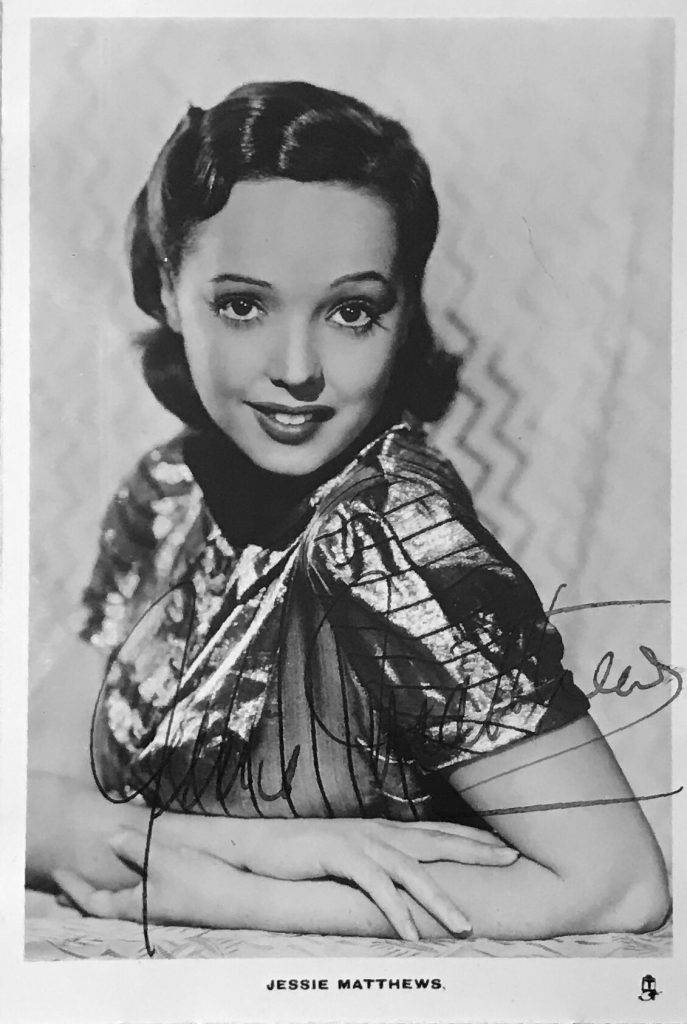
Jessie Matthews. Wikipedia
Jessie Matthews was born in 1907 and was an English actress, dancer and singer of the 1920s and 1930s, whose career continued into the post-war period.
After a string of hit stage musicals and films in the mid-1930s, Matthews developed a following in the USA, where she was dubbed “The Dancing Divinity”. Her British studio was reluctant to let go of its biggest name, which resulted in offers for her to work in Hollywood being repeatedly rejected.

Matthews was born in a flat behind a butcher’s shop at 94 Berwick Street, Soho, London, in relative poverty, the seventh of sixteen children (of whom eleven survived) of a fruit-and-vegetable seller. She took dancing lessons as a child in a room above the local public house at 22 Berwick Street.
She went on stage on 29 December 1919, aged 12, in Bluebell in Fairyland, by Seymour Hicks, music by Walter Slaughter and lyrics by Charles Taylor, at the Metropolitan Music Hall, Edgware Road, London, as a child dancer

She made her film debut in 1923 in the silent film The Beloved Vagabond. She had a small part in Straws in the Wind (1924).
Matthews was in the chorus in Charlot’s Review of 1924 in London. She went with the show to New York, where she was also understudy to the star, Gertrude Lawrence. The show moved to Toronto, and when Lawrence fell ill she took over the role and was given great reviews.
Matthews was acclaimed in the United Kingdom as a dancer and as the first performer of numerous popular songs of the 1920s and 1930s, including “A Room with a View” by Noël Coward and “Let’s Do It, Let’s Fall in Love” by Cole Porter.
Matthews’ fame reached its initial height with her lead role in Charles B. Cochran‘s 1930 stage production of Ever Green, premiered at the Alhambra Theatre Glasgow. The musical by Rodgers and Hart was partly inspired by the life of music hall star Marie Lloyd and her daughter’s tribute act resurrection of her mother’s acclaimed Edwardian stage show as Marie Lloyd Junior. At its time Ever Green, which included the first major revolving stage in Britain,was the most expensive musical ever mounted on a British stage.
Matthews’ first major film role was in Out of the Blue (1931). She was in two films directed by Albert de Courville, The Midshipmaid (1932) and There Goes the Bride (1932).
Matthews enjoyed great success with The Good Companions (1933) directed by Victor Saville, although it was more of an ensemble film and The Man from Toronto (1933). Waltzes from Vienna (1933) was an operetta directed by Alfred Hitchcock, followed by Friday the Thirteenth (1933).
She was in the film version of Evergreen (1934) which featured the newly composed song Over My Shoulder which was to go on to become Matthews’ personal signature song, later giving its title to her autobiography and to a 21st-century musical stage show of her life.
She was in First a Girl (1935) as a cross dresser, then It’s Love Again (1936), where she had an American co-star Robert Young. Exhibitors voted her the sixth biggest star in the country that year.
Matthews started to appear in films directed by husband Sonnie Hale: Gangway (1937), Head over Heels (1937) and Sailing Along (1938). She did Climbing High (1938) directed by Carol Reed. In 1938 she was the fourth biggest British star.
Her warbling voice and round cheeks made her a familiar and much-loved personality to British theatre and film audiences at the beginning of World War II. She was one of many British-born stars in the Hollywood film Forever and a Day (1943) (in whose cast Matthews was virtually unique by virtue of not being an expat: while in New York City preparing for a Broadway role Matthews had been recruited to film a role intended for Greer Garson in Hollywood over three days). Her popularity waned in the 1940s after several years’ absence from the screen followed by an unsatisfactory thriller, Candles at Nine (1944).
Post-war audiences associated her with a world of hectic pre-war luxury that was now seen as obsolete in austerity-era Britain.[ In the late 1940s she ran an amateur theatre group at the Theatre Royal in Aldershot.
After a few false starts as a straight actress she played Tom Thumb‘s mother in the 1958 children’s film, and during the 1960s found new fame when she took over the leading role of Mary Dale in the BBC‘s long-running daily radio soap, The Dales, formerly Mrs Dale’s Diary.
Live theatre and variety shows remained the mainstay of Matthews’ work through the 1950s and 1960s, with successful tours of Australia and South Africa interspersed with periods of less glamorous but welcome work in British provincial theatre and pantomimes.
Jessie Matthews was awarded an OBE in 1970 and continued to make cabaret and occasional film and television appearances through the decade including one-off guest roles in the popular BBC series Angels and an episode of the ITV mystery anthology Tales of the Unexpected. She memorably played Wallis Simpson’s “Aunt Bessie” Merriman in the 1978 Thames TV series Edward & Mrs. Simpson.
She took her one-woman stage show to Los Angeles in 1979 and won the United States Drama Logue Award for the year’s best performance in concert.
In 1926 she married the first of her three husbands, actor Henry Lytton, Jr., the son of singer and actress Louie Henri and Sir Henry Lytton the doyen of the Savoy Theatre. They divorced in 1929.
Her second and longest marriage (1931–1944) was to actor-director Sonnie Hale; the third to military officer, Lt. Brian Lewis, both marriages ending in divorce.

With Hale she had one adopted daughter, Catherine Hale-Monro, who married Count Donald Grixoni on 15 November 1958; they eventually divorced but she remained known as Catherine, Countess Grixoni.
Matthews suffered from periods of ill-health throughout her life and eventually died of cancer, aged 74. She is buried at St Martin’s Church, Ruislip.