

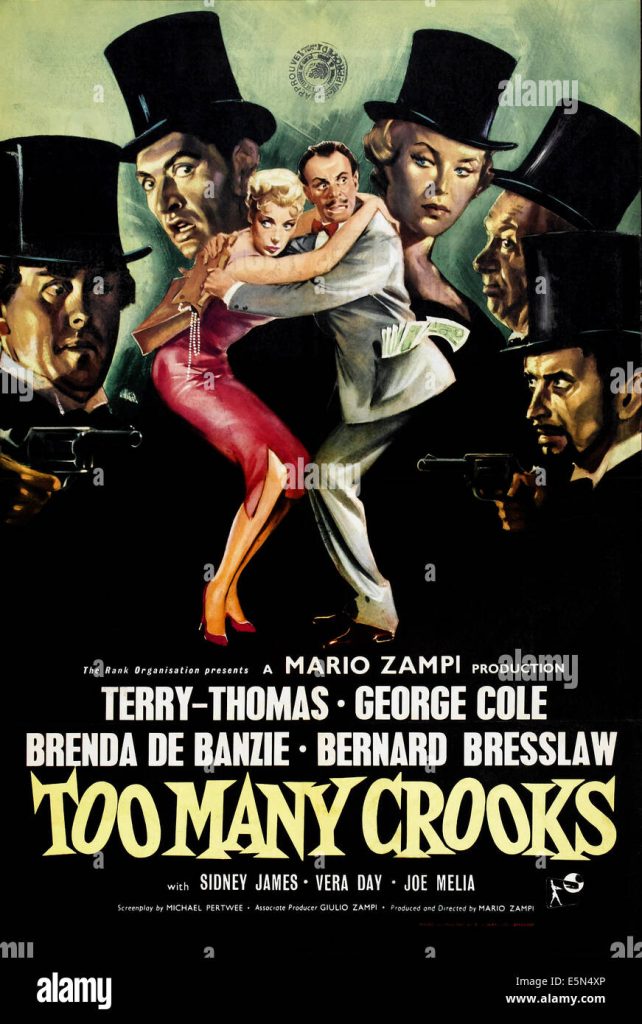
Brenda de Banzie

Brenda de Banzie
Brenda de Banzie
Brenda de Banzie

Brenda de Banzie starred in several major films in Britain in the 1950’s and 60’s but biographical information on her seems very scarce.   She was born in Manchester in 1909.   She did not begin a career on film until she was in her mid 40’s.   Her film debut was in “The Yellow Balloon” with Kathleen Ryan and Kenneth More in 1953.   She had the female lead opposite John Mills and Charles Laughton in “Hobson’s Choice”.   Her other major films include “The Purple Plain”, “The Man Who Knew too Much”, “A Kid for Two Farthings”, “Doctor at Sea” , “The Entertainer” and “The Pink Panter”.      Her last film was “Pretty Polly” as the aunt of Hayley Mills in 1967.   She died in 1981 at the age of 71.   She never seemed to play tender roles.   It would have been interesting to see her in such parts.

Her IMDB mini biography:

The daughter of a musical conductor, fair-haired, slightly plump Brenda de Banzie appeared in just a handful of films. As the result of two outstanding performances, she became an unexpected star when well into her middle age. Brenda first came to public notice as a sixteen year old chorine on the London stage in “Du Barry Was a Lady”, in 1942. By that time, she had already been treading the boards in repertory for some seven years. The theatre was, first and foremost, her preferred medium. In the early 1950’s, she had an excellent run of top-billed performances at the West End, which included “Venus Observed” with Laurence Olivier, and “Murder Mistaken”, as a wealthy hotel owner whose husband is plotting to bump her off for her money. For this, she won the coveted Clarence Derwent Award as Best Supporting Actress.

Critical plaudits tempted her to try her luck on screen, so Brenda eventually made her celluloid debut in Anthony Bushell‘s murder mystery The Long Dark Hall (1951). Her performance, as a rather vulgar and dowdy boarding house landlady, drew good notices – including one from Bosley Crowther of The New York Times. In 1954, director David Leancast Brenda in her defining role as Maggie Hobson, a middle-aged, temperamental spinster, opposite Charles Laughton and John Mills in Hobson’s Choice (1954). She pretty much stole every scene from her illustrious co-stars. Rather surprisingly, a BAFTA, eluded her. In 1958, Brenda landed the prize role of Phoebe Rice, the bitter, alcoholic wife of a second-rate music hall performer (played superbly by Olivier) in John Osborne‘s The Entertainer (1960). She recreated her performance for Broadway and for the film version in 1960 and received a Tony Award nomination. Sadly, little else came along which did much justice to Brenda’s intelligence and acting skills. During the 1960’s, she appeared primarily in matronly character roles and passed away during surgery for a non-malignant brain tumor in March 1981.

– IMDb Mini Biography By: I.S.Mowis

Interesting article on Brenda de Banzie here.

Brenda de Banzie (1909–1981) was a formidable presence in British cinema and theatre, an actress who achieved “stardom” later in life by specializing in women of immense steel, hidden fragility, and occasionally, sharp-tongued wit. While often labeled as a “character actress,” her peak years in the 1950s saw her commanding the screen alongside the greatest titans of the era, frequently outshining them with her grounded, unsentimental realism.

Career Overview

De Banzie was a veteran of the “repertory grind,” spending nearly twenty years perfecting her craft on stage before the film industry took notice.


  • The Theatre Foundation (1930s–1950s): She began as a chorus girl but moved into serious drama, winning the Clarence Derwent Award for Murder Mistaken. Her stage presence was so commanding that Laurence Olivier specifically sought her out for major West End productions.


  • The Breakthrough (1954): Her role as Maggie Hobson in David Lean’s “Hobson’s Choice” transformed her into a major cinematic force at age 45—an age when most actresses of the era were being relegated to minor supporting roles.

  • The International Transition (1956–1963): She became a reliable “prestige” actress, appearing in Alfred Hitchcock’s The Man Who Knew Too Much and headlining the film and stage versions of John Osborne’s The Entertainer.


  • The Later Years: As the “Swinging Sixties” shifted the focus to younger stars, she transitioned into matronly and often comedic character roles (notably in The Pink Panther) before her untimely death during surgery in 1981.


Critical Analysis of Her Work

1. The Mastery of “Quiet Authority”: Hobson’s Choice

In Hobson’s Choice, de Banzie played Maggie, the eldest daughter of a tyrannical bootmaker (Charles Laughton).


  • Analysis: This performance is a masterclass in understatement. While Laughton gave a bombastic, theatrical performance, de Banzie anchored the film with a dry, unwavering stillness. Critics of the time noted that she “stole the film” from Laughton by doing less. She portrayed Maggie not as a victim, but as a strategic genius. Her chemistry with John Mills was revolutionary for the time; it was a romance based on mutual respect and “business-like” affection rather than typical Hollywood melodrama.

2. The Anatomy of Despair: The Entertainer (1960)

As Phoebe Rice, the long-suffering, gin-soaked wife of Archie Rice (Laurence Olivier), de Banzie delivered what many consider her most emotionally raw performance.

  • Analysis: If Maggie Hobson was a study in strength, Phoebe was a study in erosion. De Banzie captured the specific “shabby-genteel” tragedy of the English middle class. She avoided the clichés of the “drunkard’s wife,” instead focusing on the character’s relentless, chattering anxiety and her desperate clinging to a vanished past. It was a performance of great dignity in a role that offered none, earning her a Tony nomination on Broadway.


3. The “Hitchcockian” Moral Ambiguity

In Hitchcock’s “The Man Who Knew Too Much” (1956), de Banzie played Lucy Drayton, a character who begins as a friendly tourist but is revealed to be a kidnapper.


  • Analysis: This role demonstrated her range in the thriller genre. She possessed a “maternal” warmth that Hitchcock weaponized to create a sense of unease. Her critical contribution to the film was her ability to show a flicker of conscience at the end; she humanized a villainous archetype, making the Draytons feel like a tragic couple caught in a geopolitical game they couldn’t control.

4. Technical Precision and “Upstaging”

De Banzie was famously technically proficient, which occasionally led to friction with her more temperamental co-stars.

  • Analysis: On the set of Hobson’s Choice, Charles Laughton was reportedly frustrated by her efficiency and her tendency to draw the audience’s eye even when she wasn’t the focus of the scene. Critics have noted that she was an “actor’s actor”—she understood the geography of the frame and the rhythm of the dialogue so perfectly that she could control the tone of a scene simply with her reaction shots.


Key Performances for Study

 
Work Year Role Significance
Hobson’s Choice 1954 Maggie Hobson Her defining role; won her a BAFTA nomination and international acclaim.
The Man Who Knew Too Much 1956 Lucy Drayton Showcased her ability to play psychological complexity in a major thriller.
The Entertainer 1960 Phoebe Rice Her most critically acclaimed dramatic work; a study in domestic tragedy.
Flame in the Streets 1961 Nell Palmer A powerful performance in a film addressing racial tensions in Britain.
The Pink Panther 1963 Angela Dunning Demonstrated her flair for high-society comedic timing.


In summary: Brenda de Banzie was the “Iron Lady” of British cinema’s golden era. She brought an intellectual rigour to her roles that prevented her from ever being “just another character actress.” She represented the unsung strength of women who survived the war and the changing social landscape of Britain, making her a vital link between the theatrical traditions of the past and the realism of the 1960s

Leave a Reply

Your email address will not be published. Required fields are marked *