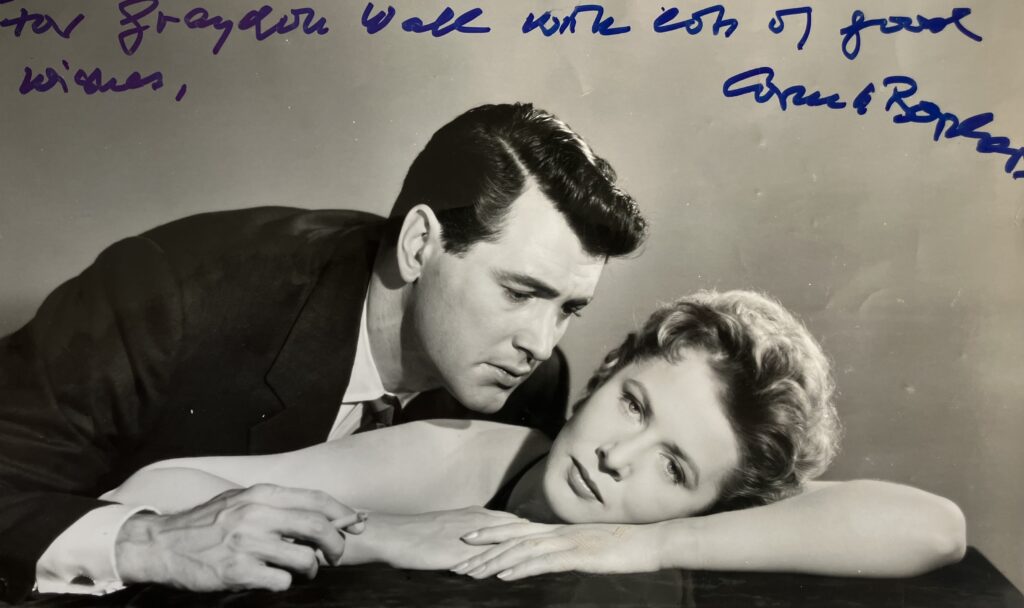



Cornell Borchers. Wikipedia.
Cornell Borchers was born in 1925 in Lithuania. In 1950 she was cast opposite Montgomery Clift in “The Big Lift”. In 1953 she won acclaim for her performance in “The Divided Heart”. She was brought to Hollywood in 1956 to make “Never Say Goodbye” opposite Rock Hudson and then “Flood Tide” with George Nader after which she returned to Europe. She died in 2014.
Wikipedia entry:
Borchers was born in Šilutė (German: Heydekrug), Klaipėda Region (German: Memelland), Lithuania in a German either Prussian Lithuanian or Memellander family. She appeared on the cover of East German magazine Neue Film Welt of 1949, Volume 3, Issue 4. She won a BAFTA Film Award it the category of Best Foreign Actress in 1955 for the movie The Divided Heart of 1954. She retired from acting to raise her child.
She married twice, to Bruce Cunningham and to Dr. Anton Schelkopf (aka Dr. Toni Schelkopf, Toni Schelkopf or Schelkopf Toni), a Psychologist Doctor and Film Producer whom she met twice when she starred in his films Schule für Eheglück (1954) and Rot ist die Liebe (1957), later divorced, by whom she had at least one daughter, Julia Schelkopf, born in Munich, on 15 September 1962, who married at Aufkirchen on 30 May 1987 HSH Friedrich Wilhelm Philipp Georg Heinrich Jakob 7th Fürst von Hanau und zu Horowitz Graf vonSchaumburg, born in Munich on 26 June 1959, and by whom she had three children: HSH Tassilo Hubertus Heinrich Antonius Erbprinz von Hanau und zu Horowitz Erbgraf von Schaumburg (born Starnberg, 8 November 1987), HSH Philippa Maria Theresia Prinzessin von Hanau und zu Horowitz Gräfin von Schaumburg (born Starnberg, 15 January 1989) and HSH Thaddäus Carl Heinrich Prinz von Hanau und zu Horowitz Graf von Schaumburg (bornStarnberg, 16 June 1995). She lived in Bavaria, Germany in July 2007 and died in 2014.


Her”Wikipedia” entry cn also be accessed online here.
IMDB entry:
Tall, blonde, turquoise-eyed Cornell Borchers was born of Lithuanian ancestry and studied medicine before turning towards a career in the performing arts. She attended drama classes from 1947 to 1948 and was discovered for films by the director Arthur Maria Rabenalt. She made a few German films before signing a seven-year contract with 20th Century Fox. Publicity quickly touted her as the new Ingrid Bergman, but her first Hollywood sojourn turned out to be rather brief.
After just one picture, The Big Lift (1950), Cornell walked out on her contract, convinced that quality roles were not forthcoming. For a while, her career lost its direction and she toiled away in a brace of minor German crime dramas and romances. Fortuitously, she was then snapped up by Michael Balcon for his Ealing production of The Divided Heart (1954), a sober post-war drama for which Cornell won a BAFTA award as Best Foreign Actress.
This rekindled Hollywood’s interest and Universal-International signed her to a two-picture-a-year deal. She was co-starred opposite Rock Hudson in the melodrama Never Say Goodbye (1956), and, in Ingrid Bergman-like fashion (even rather sounding like her) beguiled Errol Flynn in the romantic espionage dramaIstanbul (1957).
Her swan song was an undistinguished social drama entitled Flood Tide(1958), a misfire, which resulted in Universal failing to renew her contract.
Cornell returned to Germany, having reached what amounted to be the apex of her career. She eventually quit acting in 1959, devoting herself to her family and living a secluded life away from the limelight.
– IMDb Mini Biography By: I.S.Mowis



Acting style and screen persona
Classical screen femininity with emotional directness: Borchers’s screen presence combined classical good looks, similar to Ingrid Bergman, with an ability to register feeling simply and clearly. She often played earnest, vulnerable or morally conflicted women—characters whose emotional life was signaled through facial nuance and vocal timbre rather than overt melodrama..
Critical analysis Strengths
Screen empathy: Borchers excelled at rendering credible emotional reactions and making secondary moral dilemmas feel immediate; even modest parts gained human interest because of her specificity.
Versatility for mid‑century European cinema: She successfully navigated studio modes in German‑language film while also adapting to the demands of international co‑productions—an asset for an actor building a transnational career in the 1940s–50s.
Photogenic, camera‑friendly technique: Directors used her for roles that required closeups and intimate exchanges; she had a capacity to hold the frame without ostentation.
Limitations and constraints
Typecasting and limited star consolidation: While visually prominent, she rarely became the sustained box‑office star outside a confined period; studios and publicity often boxed actresses like her into particular romantic or tragic types, limiting longer-term diversity of roles..
Relative critical neglect: Compared with better‑documented contemporaries who built long international careers or auteur collaborations, Borchers’s work has attracted modest critical reappraisal—her strongest recognition remains among specialists in postwar German and Central European cinema.
Artistic contribution and legacy
Representative postwar European leading lady: Borchers’s career illustrates how talented European actresses moved between national cinemas and occasional Hollywood or Anglo projects in the immediate postwar era—actors who both embodied national film recoveries and briefly bridged to international screens.
Scholarship and rediscovery potential: Film historians interested in postwar German cinema, the reconstruction era and transnational stardom find her career informative; targeted retrospectives or restorations could sharpen appreciation of her range.
Cornell Borchers (1925–2014) was a singular figure in post-war cinema—a “Continental” star whose career served as a cultural bridge between the shattered landscape of Germany and the polished studio systems of London and Hollywood. Often described as the “German Ingrid Bergman,” Borchers possessed a unique combination of stoic suffering and luminous intelligence, making her the definitive face of the “Trümmerfilm” (rubble film) era.
1. Career Arc: From the Rubble to the Red Carpet
-
The Post-War Discovery (1947–1950): Born Gerlind Cornell Borchers in Lithuania, she began her career in the ruins of German theater. Her breakthrough came in The Big Lift (1950), filmed on location in Berlin, where she played opposite Montgomery Clift.
-
The British Triumph (1954): She achieved international stardom and a BAFTA Award for her role in The Divided Heart. This performance established her as the premiere “emotional heavyweight” of European cinema.
-
The Hollywood Migration (1956–1959): Universal-International attempted to mold her into a successor to the “European Noblewoman” archetype (following Bergman and Garbo). She starred in big-budget dramas like Never Say Goodbye opposite Rock Hudson.
-
The Abrupt Exit: At the peak of her international fame, Borchers retired from acting to focus on her family. Like Barbara White, her retirement was absolute, preserving her in the cinematic memory as a figure of perpetual, dignified mystery.
2. Critical Analysis of Key Performances
The Divided Heart (1954) – The Anatomy of Maternal Grief
Based on a true story, Borchers plays Inga Hartl, a German mother whose son was taken by the Nazis and adopted by a Yugoslavian family, sparking a post-war custody battle.
-
Analysis: This is Borchers’ definitive work. She utilized a restrained, interior style of acting that made her grief feel almost unbearable to watch. Instead of “performing” sorrow, she allowed it to radiate through her physical stillness.
-
Critique: Borchers won the BAFTA for Best Foreign Actress (a category that then included all non-British performers). Critics praised her for avoiding the melodrama inherent in the script; she played the role with a moral gravity that elevated the film into a profound meditation on the scars of war.
The Big Lift (1950) – The “Realist” Ingenue
As Frederica, a German woman involved with an American soldier during the Berlin Airlift.
-
Analysis: Borchers was cast because she looked like the “New Germany”—tired but resilient. Her performance is noted for its naturalism; she held her own against Montgomery Clift (a pioneer of naturalistic acting) by matching his “thinking on screen” technique.
-
Critique: Film historians often cite this as a rare moment where a German actress was allowed to play a complex, non-stereotypical survivor. Borchers brought a sharp-edged pragmatism to the role that challenged the “innocent victim” trope.
Never Say Goodbye (1956) – The Hollywood “Polish”
As Lisa, a woman separated from her husband (Rock Hudson) and daughter by the Iron Curtain.
-
Analysis: This was Borchers’ primary attempt to conquer the American market. Universal surrounded her with Technicolor glamour, but Borchers fought to keep the character grounded and emotionally authentic.
-
Critique: While the film is a quintessential “weepy,” Borchers’ performance was singled out for its intellectual depth. She possessed a “European soulfulness” that the American studio system struggled to categorize; she was too mature for the “girl next door” and too grounded for the “femme fatale.”
3. Style and Legacy: The “Bergman” of the Rubble
Cornell Borchers’ style was defined by vocal and physical economy.
| Attribute | Critical Impact |
| The “Listening” Face | Much like the great silent film stars, Borchers could convey a paragraph of thought through a single change in her gaze. |
| Linguistic Versatility | She was fluent in several languages, and her “accent” was seen as a sign of cosmopolitan sophistication rather than a barrier. |
| Understated Power | She specialized in “Quiet Strength”—characters who endure immense trauma without losing their essential humanity. |
The “Trümmerfilm” (Rubble Film) Context
Critically, Borchers is essential to the study of post-war German identity. In films like Martina (1949), she represented the conscience of a nation trying to rebuild. She didn’t offer easy comfort; her performances always contained a hint of the trauma that had come before.
Critical Note: Cornell Borchers was an actress of “The High Middle.” She didn’t seek the explosive peaks of histrionics, nor did she fade into the background. She occupied the center of the frame with a haunting, architectural beauty and a sense of “lived-in” truth. Her early retirement meant Hollywood lost one of its most sophisticated dramatic voices just as the “Mature Woman” roles of the 1960s were beginning to emerge