

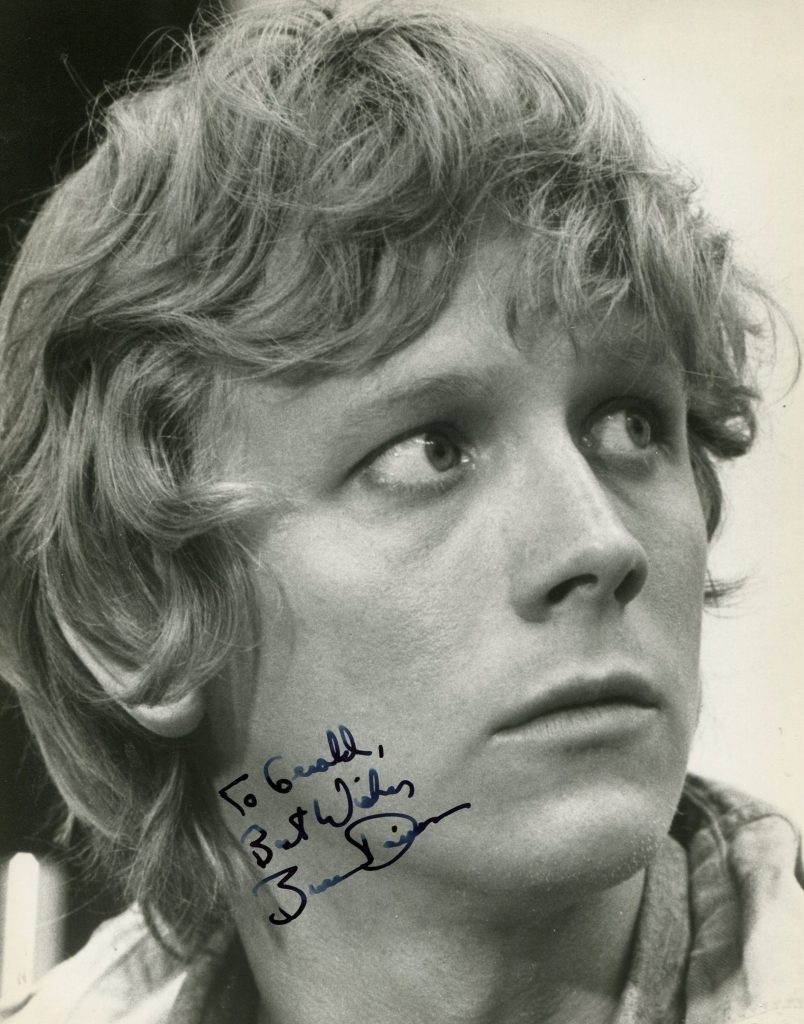
Gary Brumburgh’s entry:
With his blond, clean-cut, Ivy League handsomeness and ready-whipped smile reminiscent of Kennedyesque times, actor Bruce Davison fits the prototype of today’s more current crop of fresh-faced, likable blonds such as Brian Kerwin and Aaron Eckhart. While it proved difficult at times for the actor to get past those perfect features and find meatier roles, his talent certainly overcame the “handicap”. Extremely winning and versatile, the award-worthy actor, now enjoying an over four decade career, has included everything from Shakespeare to Seinfeld. He has also served as a writer, producer and director on an infrequent basis.
Born on June 28, 1946, in Philadelphia, Pennsylvanis, the son of Clair, an architect and musician, and Marian (Holman) Davison, a secretary, Bruce’s parents divorced when he was just three. He developed a burgeoning interest in acting while majoring in art at Penn State and after accompanying a friend to a college theater audition. Making his professional stage debut in 1966 as Jonathan in “Oh Dad, Poor Dad, Mama’s Hung You in the Closet and I’m Feelin’ So Bad” at the Pennsylvania Festival Theatre, he had made it to Broadway within just a couple of years (1968) in the role of Troilus in “Tiger at the Gates” at the Vivian Beaumont Theatre. The year after that he was seen off-Broadway in “A Home Away from Home” and appeared at the Lincoln Center in the cast of “King Lear”.
Success in the movies came immediately for the perennially youthful-looking actor after he and a trio of up-and-coming talents (Barbara Hershey [then known as Barbara Seagull], Richard Thomas and Catherine Burns) starred together in the poignant but disturbing coming-of-age film Last Summer (1969). From this he was awarded a starring role opposite Kim Darby in The Strawberry Statement (1970), an offbeat social commentary about 60s college radicalism, and in the cult horror flick Willard (1971) in which he bonded notoriously with a herd of rats.
Moving further into the 70s decade, his film load did not increase significantly as expected and the ones he did appear in were no great shakes. With the exception of his co-starring role alongside Burt Lancaster in the well-made cavalry item Ulzana’s Raid(1972) and the powerful low-budget Short Eyes (1977) in which he played a child molester, Bruce was surprisingly ill-used or underused. Insignificant as the elder Patrick Dennis in the inferior Lucille Ball musical film version of Mame (1974), he was just as overlooked in such movies as The Jerusalem File (1972), Mother, Jugs & Speed (1976),Grand Jury (1976) and Brass Target (1978). Bruce wisely looked elsewhere for rewarding work and found it on the stage and on the smaller screen. Earning strong theatrical roles in “The Skin of Our Teeth,” “The Little Foxes” and “A Life in the Theatre,” he won the Los Angeles Drama Critics Award for his work in “Streamers” in 1977. On TV, he scored in mini-movie productions of Mourning Becomes Electra (1978), Deadman’s Curve (1978) (portraying Dean Torrence of the surf-era pop duo Jan and Dean) and, most of all,Summer of My German Soldier (1978) co-starring Kristy McNichol as a German prisoner of war in the American South who falls for a lonely Jewish-American girl. In 1972 Bruce married actress Jess Walton who appeared briefly as a college student in The Strawberry Statement (1970) and later became a daytime soap opera fixture. The marriage was quickly annulled the following year.
The 1980s was also dominated by strong theater performances. Bruce took over the role of the severely deformed John Merrick as “The Elephant Man” on Broadway; portrayed Clarence in “Richard III” at the New York Shakespeare Festival; was directed by Henry Fonda in “The Caine Mutiny Court Martial”; played a moving Tom Wingfield oppositeJessica Tandy‘s Amanda in “The Glass Menagerie”; received a second Los Angeles Drama Critics Award for his work in the AIDS play “The Normal Heart”; and finished off the decade gathering up fine reviews in the amusing A.R. Gurney period piece “The Cocktail Hour”. While hardly lacking for work on film (Kiss My Grits (1982), Crimes of Passion(1984), Spies Like Us (1985), and The Ladies Club (1986)), few of them made use of his talents and range. It was not until he was cast in the ground-breaking gay dramaLongtime Companion (1989) that his film career revitalized. Giving a quiet, finely nuanced, painfully tender performance as the middle-aged lover and caretaker of a life partner ravaged by AIDS, Bruce managed to stand out amid the strong ensemble cast and earn himself an Oscar nomination for “Best Supporting Actor”. Although he lost out to the flashier antics of Joe Pesci in the mob drama Goodfellas (1990) that year, Bruce was not overlooked — copping Golden Globe, Independent Spirit, New York Film Critics and National Society of Film Critics awards. Other gay-themed films also welcomed his presence, including The Cure (1995) and It’s My Party (1996). The actor eventually served as a spokesperson for a host of AIDS-related organizations, including Hollywood Supports, and, elsewhere, is active with foundations that help children who are abused.
Bruce has been all over the screen since his success in Longtime Companion (1989). Predominantly seen as mature, morally responsible dads and politicians, his genial good looks and likability have on occasion belied a weak or corrupt heart. Bruce married actress Lisa Pelikan in 1986 (well over a decade after his first marriage ended) and they have one son, Ethan, born in 1996. The handsome couple became well known around town and worked frequently together on stage (“The Downside,” “Love Letters,” “Breaking the Silence,” “To Kill a Mockingbird”) and in TV movies (Color of Justice (1997)). Bruce’s more popular films these days have included Six Degrees of Separation (1993) starringWill Smith, the family adventure film Far from Home: The Adventures of Yellow Dog(1995) and the box-office hit X-Men (2000) and its sequel in the role of Senator Kelly. More controversial art-house showcases include Dahmer (2002), as serial killer Jeffrey Dahmer’s father, and Hate Crime (2005), as a bigoted, murderous pastor.
Bruce has attempted TV series leads in later years. With Harry and the Hendersons(1991), he ably directed a number of the show’s episodes. He has also been tapped for recurring parts on The Practice (1997) and The L Word (2004), and is fondly remembered for his comedy episodes on Seinfeld (1989) as an attorney who goes for George’s (Jason Alexander) throat when George’s fiancée dies inexplicably of toxic poisoning. The actor recently completed a TV series revival of Knight Rider (2008).
Divorced from Lisa Pelikan, Bruce is married these days to third wife Michele Correy and has a daughter by her, Sophia, born in 2006. They live in the Los Angeles area.
– IMDb Mini Biography By: Gary Brumburgh / gr-home@pacbell.net